
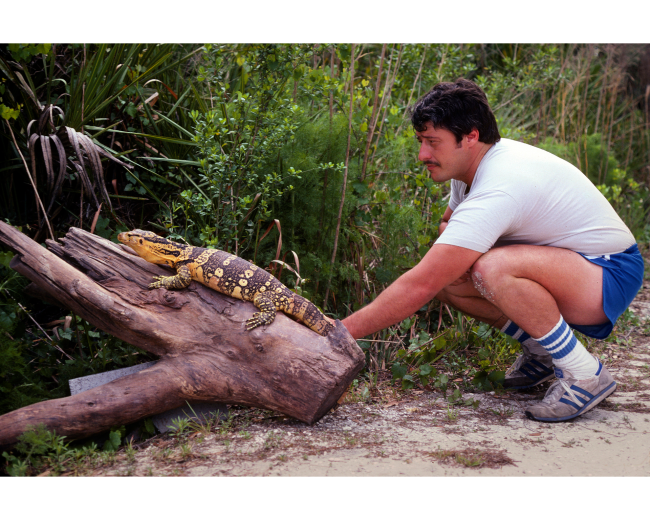
Eric Goode has spent more than half a century around reptiles, so by the time he set out to make Monsters of God — HBO‘s five-part documentary series on the billion-dollar reptile smuggling trade, premiering Aug. 6 — the story had already been waiting for him for decades.
“It’s what I set out to do before all of them,” Goode tells Gold Derby of the project, referring to his two prior documentary hits, Netflix’s Tiger King and HBO’s Chimp Crazy. In fact, the deal for Monsters of God came together before Chimp Crazy did. “So yes, it helped having Tiger King in respect to probably getting a platform interested in a show like this,” Goode says. “I’m very appreciative that HBO was willing to take a risk on a reptile story.”

That risk pays off with a series populated by dealers, smugglers, federal agents, and zoo officials whose decades-old rivalries and grudges power the narrative as much as any crime does. But according to Goode, finding those characters wasn’t a matter of chasing the craziest people he could find.
Was this about finding the wildest characters?
Not exactly, Goode says, drawing a contrast with the larger-than-life personalities of his earlier docuseries. “Unlike Tiger King that had such a crazy cast of characters … this story wasn’t really an exercise in trying to find the craziest people,” he says. “Had we wanted to do that, we could have certainly found really crazy reptile people that are missing fingers from venomous snakes and doing really crazy things.”
Instead, Goode says, Monsters of God is closer to investigative journalism, tracing the reptile trade back to the 1960s. “This was really trying to chronicle these people that were really instrumental in creating this reptile trade … and we wanted to tell the story before they died off,” he says. That meant a much slower, more difficult production than his prior projects. “Many of the characters took years to get access to,” Goode says. “Law enforcement is notoriously unwilling to talk. And the smugglers generally are very, very guarded and not willing to talk.”

Executive producer Jeremy McBride, Goode’s longtime producing partner, describes the project as “this portrait of obsession” — part character study, part true crime, filtered through Goode’s own decades in the reptile world. The production was ambitious: about six years in the making, with more than 175 interviews and 1,500 hours of footage. McBride says scheduling and stops and starts along the way meant “24, 25 editorial hands touching it” before the story found its final shape, with story producer Tom Peterson helping build the throughline. “It was really this balance of everything,” McBride says, “while worrying about, ‘Are we going to make this? How many episodes can we make?'” — on top of the constant uncertainty over whether they’d land access to the key subjects in the story.
Goode is also quick to push back on the idea that he sets out to make true crime at all. “I have never thought for one second that any of these stories are true crime when I embark on them,” he says, comparing his approach instead to Christopher Guest’s mockumentary-style character studies like Best in Show. “The crime somehow gets layered in without me even knowing it.”
Waiting for Loveless

Perhaps no subject captures that unpredictability better than Larry Loveless, a retired federal agent who spent decades undercover chasing wildlife traffickers, including Miami drug and animal smuggler Mario Tabraue — who also appears in the series. Loveless helped get Tabraue sentenced to more than 100 years, though Tabraue ended up serving just 12.
Loveless’ interview is an instant highlight thanks to a moment in Episode 2 recounting a threat once made against him: “You better watch out. Someday, somebody like me may show up at your house.” His response: “Let me tell you something. I’ve lived my life thinking about someone like you coming to my house. I fantasize about someone like you coming to my house. I masturbate thinking about someone like you coming to my house.”
Gold Derby asked Goode and McBride if that was a moment where they knew they had something special. “That was the very first thing he actually said,” McBride says. He describes Loveless as “such an enthusiastic supporter of the project” — enough that he traveled from Virginia to attend a recent screening in California. McBride recalls Loveless’ own reaction to the trailer’s release: “Everyone loves a trailer, except for a few people that never heard me say motherf–ker before.”
But getting Loveless on camera took real work, and most of it fell to McBride. He recalls staying overnight at Loveless’ home — property he describes as a former Civil War battlefield where you can still find bullets in the ground — before Loveless would agree to talk. “I didn’t even know him,” McBride says. “So that was kind of scary.” The next morning, Loveless made him breakfast with individually wrapped frozen pancakes, a small, strange detail McBride still remembers vividly.
Goode notes that Loveless has good reason to be cautious. “When you put someone in prison for the rest of their life and then they get out, you better be watching your back,” Goode says. He also credits McBride directly for landing the interview: “That wasn’t easy.”
According to Goode, that dedication from the crew was felt across the whole series. “A lot of these people take a lot of courtship and a lot of time,” he says. “Sometimes it’s a matter of years before they agree to being interviewed. And we’re never really trying to bend someone’s arm to do an interview. It’s a slow, gentle process.”
Who else you’ll meet
Loveless and Tabraue are just two names in a sprawling cast that spans decades of the reptile trade. The series opens with dealers Tommy Crutchfield and Hank Molt, longtime rivals whose falling-out sets the tone for everything that follows: Molt trained Crutchfield in the business, only for the two men to turn on each other and eventually help send one another to prison. Later episodes bring in figures like Dwayne Cunningham, a former circus performer turned exotic animal handler who worked his way up in Crutchfield’s operation — and whom viewers may recognize from Goode’s Chimp Crazy.

By the finale, the series builds to Malaysian trafficker Anson Wong, described in the show as the “Pablo Escobar of the reptile underworld” and the central target of a years-long undercover investigation. Gold Derby will have more on that chapter of the story, along with Goode and McBride, closer to the show’s Sept. 3 finale.
Monsters of God premieres Aug. 6 at 9 p.m. ET/PT on HBO, with new episodes streaming weekly on HBO Max.
