
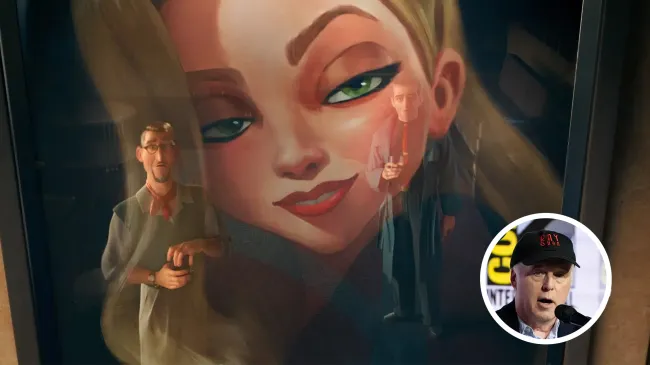
From The Iron Giant to The Incredibles, Ratatatouille to the upcoming Ray Gunn, Brad Bird has been a visionary force in animation for four decades. He has also dabbled in live-action filmmaking, with the hit Ghost Protocol installment of Tom Cruise‘s Mission: Impossible franchise and the much less successful George Clooney vehicle Tomorrowland, based on the futuristic section of Disneyland. Bird took a time-out from finishing Ray Gunn, a passion project 30 years in the making, and writing the third Incredibles movie, to drop by San Diego Comic-Con for a retrospective of his Oscar-winning career and a look at what’s next.
Here, in Birds’ own words, is a breakdown of his filmmography — from how he originally killed off The Incredibles nemesis Syndrome in the opening moments to how he thought he killed Tom Cruise in Ghost Protocol to the one film he’s never been able to get made.


His very first movie
From the very beginning, I was trying to make movies — I didn’t figure this out until much later. My very first drawings were very crude, but they were meant to be viewed in order. So I figured out, much later, that I was trying to make movies really early; I just didn’t have the equipment or ability. My family was a movie-going family. They liked to go to movies and discuss them afterward. I remember my parents talking about Hitchcock — why were Hitchcock’s films better? That was the first time I’d heard a director discussed.
They took me to see the movie more than once, which my grandparents thought was really indulgent. But my mom was like, “He’s getting something out of it.” When I was 11, I saw The Jungle Book — here in San Diego, actually — and that made me go, “How do I do that?” My parents would have parties, and there’d be a forest of legs, and people going, “I don’t want to become one of those lumbering things.” Then I heard a comedy album — Jonathan Winters being funny — and here was an adult being completely bonkers and being accepted. And then I saw The Jungle Book and realized people are being paid to figure out how a panther moves. And I went, “Wow, growing up is actually going to be really great.”
The early Disney years
After graduating from CalArts, Bird secured an apprenticeship at Disney, fulfilling a lifelong dream. While at the Mouse House, he found himself being mentored by the legendary Milt Kahl, one of Disney’s Nine Old Men.
He had this very intense kind of stammer, and he swore more than what you’d think of from Disney. But he would say, “Well, you didn’t even explore the possibilities.” And that’s what it is. If you’re approaching something, explore the possibilities.
Family Dog
Bird, with some input from CalArts classmate Tim Burton, created a short film about a dog who winds up stuck with a dysfunctional family. The short caught the attention of Steven Spielberg, who included it in his 1980s anthology series Amazing Stories. It was later spun off into a short-lived series on CBS.

I always felt great sympathy for dogs, because they don’t choose their family; they’re just plopped down in the middle of it. And I thought, what if you had a family that was kind of a nightmare, and the dog were just wide open to them? It seemed like a funny thing to do.
The Simpsons
The highly stylized “Family Dog” short caught the attention of Matt Groening, James L. Brooks, and Sam Simon, who hired Bird to serve as “executive consultant” on The Simpsons, a position he would retain for the show’s first eight seasons. One of his most notable contributions was the creation of Sideshow Bob.

The writers were the best, but sometimes they would write things that make sense on the page but are really hard to convey visually. That became a real challenge. And to meet that at the schedule The Simpsons had, which was intense — you were always working on the next thing — you had to make decisions fast. If I hadn’t gone through that experience, I wouldn’t have been able to make the movies that I did, many of which were done under a lot of pressure. In television you can’t slow down, because there are more episodes coming. It’s like that thing from I Love Lucy, the conveyor belt with the candy — if you delay on any one decision, a million other decisions start backing up on you.
Iron Giant (1999)
Bird signed a production deal in 1995 with Turner Animation (who were soon acquired by Time Warner) in the hopes of making his sci-fi noir Ray Gunn. But the studio found the material too dark for children and nixed the project. Bird pivoted to an adaptation of the Ted Hughes novel The Iron Man. The resulting film, The Iron Giant, was a critical success but commercial dud, in part because the studio channeled most of its promotional efforts into what it hoped would be a summer blockbuster: Will Smith’s Wild Wild West.
I would love to say they didn’t get it, but they did get the pitch. I read the book, which I thought was really poetic. But about halfway through, it becomes a contest between the Iron Giant and a spaceship the size of Australia, and they fly back and forth toward the sun. I felt like the story is with the boy and the giant. So when I came back, I said, “I like this a lot, but I want to do something different with it. What if a gun had a soul and didn’t want to be a gun?” To their credit, the people running the studio at the time — that got them. They reacted to it, they were taken by it. And that’s not the usual subject for an animated film.

I think there’s this thing called marketing, and if you don’t do it, it really hurts your film. So I was really happy that on the next project, The Incredibles, it got marketed, and it made a difference. But I can’t really complain, because people did catch up to The Iron Giant. They ran it for a couple of years — all day around Thanksgiving, 24 hours, one after another. I think that’s what broke through: people ran into it who hadn’t seen it before.
The Incredibles (2004)
Bird completed the screenplay, about a family of superheroes loosely inspired by the Fantastic Four, in the early 1990s and shopped it around to studios without any takers. Following the disappointing Iron Giant, Bird fielded a call from fellow CalArts alum John Lasseter, who invited to pitch ideas to Pixar. Bird dusted off The Incredibles treatment, and it got a quick green light on its way to becoming his breakout hit and earning him his first Oscar for Best Animated Feature.

There weren’t a lot of successful examples of human characters. There were really disturbing versions back then. Even Pixar did a short called Tin Toy that had a nightmare baby in it, and everybody who worked on it goes, “Yeah, the baby was kind of a nightmare.” So nobody’s kidding themselves. But there was one great example when I got there, and that was Jan Pinkava’s short Geri’s Game. I was convinced you could do really compelling, stylized characters and make them very believable. His old man who plays chess against himself showed up in Toy Story 2 and really worked well. That made me feel assured that we weren’t insane to try to make a movie that only had humans in it.
Pixar’s collaborative filmmaking, in which the company’s brain trust would pepper a filmmaker with intense feedback to perfect the story, was something Bird hadn’t experience before.
If you argue against notes, you get a reputation as being difficult. The thing is, they were shocked when I took notes. They were like, “He took the notes — he didn’t mind the notes.” I don’t mind notes if they’re not stupid. Bring it.
When I moved up from L.A. after The Iron Giant, a lot of people on the crew were like, “Man, you’re selling out to computer animation.” And I said, “I’m not going up there to be part of computer animation. I’m going up there because they protect stories. They make an environment where you can grow a good story. They poke at it, they demand something out of it, but it’s good, healthy stuff.”
One exercise that yielded good results — they said, “What would happen if you open the movie with them in their normal guise, not as superheroes, trying to fit in, and then you reveal that they’re superheroes?” I argued a little. I said, “Look, you’re going to have ads at that point. Everyone knows the characters are going to be superheroes. What are we doing?” And they said, “No, it’s a good exercise. Try it.” So I wrote an opening where the family goes underground — Violet was a baby — under the witness protection program, and then they get discovered, because villains are coming to wreak revenge. I had a villain show up — it was Syndrome — and he died in the opening sequence. Everyone, including me, liked him better than the villain I had.

So they went back to my original pitch: show them in the golden era, then jump 15 years and show them unfulfilled — but with that character driving the villain plot. And there was this autobiography of Burt Ward, who played Robin on the 1960s TV version of Batman, and he kind of said, “I got more chicks than Adam West.” I sensed some dark resentment from the Boy Wonder, and I thought, that’s a good angle for a villain — to be spurned at being a sidekick. So even though I didn’t use that opening, I got the villain, and I got a good reason for the villain out of it. Everything else stayed much the same, but the villain changed, and he was a much better villain.
Ratatouille (2007)
Originally conceived by Pinkava, Ratatouille had been languishing at Pixar. Bird reluctantly took over the project, which became his second Oscar winner.
I’d gone to all the Ratatouille brain trust meetings the whole time I was doing The Incredibles. Then in the last six months to a year, they let you step back from those meetings in order to finish a film. So I made my last notes on Ratatouille and stopped going to the brain trust meetings to finish The Incredibles.
When I came back for my first note session, I’d been away from it for a year, so my mind was frozen in time for the solutions that had been given. John was doing Cars, right at the intense finishing point, and Andrew Stanton was doing the first boards for WALL-E. They were both completely absorbed. So they were a little more easygoing on it, and I was a fresh horse. If something wasn’t where I thought it was headed, I’d say, “Well, what happened to this? What happened to that?” So I was a little more aggressive about what needed to happen.

The next day, the film got screened within Pixar for the executive team — Steve Jobs and some other people — and their problems were like the problems I’d enumerated the day before. I think they felt I was on common ground with them. And they got me on vacation — I really wanted that vacation. Steve called, and we talked for a bit. I’d worked with them a couple of weeks on tweaking the story, and he said, “How did it go?” I said, “I think it went kind of well. I think they’re in good shape.” Then the next day I got a call from Ed Catmull. We were driving around with the family, and they said, “Pull over.” So we pull over, the family gets out of the car, and apparently my youngest son said, “Is Daddy going to lose his job?” And my wife said, “I think it’s the opposite.” So that’s what happened. They invited me on board, and there it is.
They had done two complete versions—meaning the full story, beginning to end, with storyboards and recorded sound. They’d gone out to some actors, and a lot of the choices they’d made I agreed with. Ian Holm was in there, and I thought he was perfect. Brian Dennehy was in there, and I thought he was perfect. They used Lou Romano — he was a scratch voice they all liked, and he was the art director on The Incredibles. He played Linguini. And Pete Sohn did the voice of Emile — he’s directing Incredibles 3. Those I agreed with. But they didn’t have a voice for Remy. They’d recorded some stuff with another actor — I won’t say who — and I didn’t connect with it. I pitched Patton [Oswalt], and I felt Patton was perfect. The other one: they’d signed an actor I think is very good, but he wasn’t what I pictured for Ego. When it became my problem to make the film, I heard Peter O’Toole, and it was just like — nobody else. It’s got to be Peter O’Toole. And thankfully he said yes.
When I had the idea of the review, it was anti-everything a summer movie is supposed to do—especially animation. You’re supposed to get faster and louder, and I got slower and quieter. When I pitched it, I said, “I don’t know why, but I think this should be the ending”—where he reads this review, and it’s soul-searching. And they kind of went like this — because it’s against everything you’re supposed to do from the standard playbook — but they went, “Yeah, that feels right.” I had a great secret weapon: Michael Giacchino was doing the music. He wrote a suite just for the orchestra to do one take, so he could hear it. It wasn’t the version going in the film. It was soaring, big, romantic. He goes, “Yeah, it’s too romantic for what you need. We’ll tone it down.” But I had that one take of the super-romantic version on a recording. I put my voice — bad British accent — reading that scene over his romantic music, and it was perfect. It ended up being the thing that helped sell the idea. I was rewriting it right up until we recorded — I rewrote it three times on the plane, landed, went to the hotel, and wrote it two more times, just trying to get it right. And I couldn’t have asked for a better person to enact it than Peter O’Toole. That was fantasy stuff.

1906
Based on the devastating 1906 San Francisco earthquake and its aftermath, this is one of Bird’s “lost” projects, an idea he’s been kicking around for decades but has never gotten off the drawing board.
There’s a lot of BS on the internet about why it didn’t happen — they said the budget went out of control, or something. We never got that far. The problem is, the more you research that time, the more amazing it is. The stories are insane, and the deeper I dug, the more stuff I thought, “This has to be in it.” But it has to be big, like a movie — it can’t just be this little thing. It was like packing a hot-air balloon: you get everything you want in it, you say, “Let’s go,” and it doesn’t lift off. So you start chucking stuff out, and pretty soon you’re getting lift-off — but all the stuff you love is on the ground. I’m still very interested in that story, but it has to simultaneously exploit the detail of successive episodes and the size of a giant movie.
It’s probably eight episodes. But it’s got the greatest build ever. It’s not just the earthquake; it’s the fire after the earthquake. History books talk about tornadoes of fire—the wind created from the fire got to be gale force. I haven’t seen that. I’d be popcorn to that.
Mission: Impossible — Ghost Protocol (2011)
Bird made his live-action debut with the fourth episode in Cruise’s venerable spy saga, which featured the instantly iconic action set piece on the world’s tallest skyscraper, the Burj Khalifa in Dubai.
Again, I was trying to do 1906, and the more I tried, the more it was too big. Finally I realized I don’t want my headstone to be “He tried to make 1906.” So I looked around for things that were already ready to go. Tom Cruise had seen The Incredibles and invited me over to his house, and we had an amazing two- or three-hour talk just about movies. His knowledge is extensive. He said, “Look, if you ever want to do live action, I’d love to do something with you.” So that popped up. And of all things — I love spy movies. That was a chance to do a spy movie with Tom Cruise. How do you say no to that?
We were prepping it, and he was practicing being on the building with a climbing expert. We were hanging around, talking, and suddenly I see him go outside the window, swinging past — and then I hear a crash. I’m like, “He’s dead. The star is dead.” And then I hear him laughing, like, “I screwed that one up.”
We were originally thinking we might only get two or three shots in Imax and do the rest with special effects. We had to bash out these giant double-pane windows, and they said, “OK, but only three, and you’ve got to put them back exactly like they were.” Pretty soon it’s 37 windows. We shot everything on the building. The only shots we didn’t do on the building were ones looking up, because you can do that on a piece of anything. But anything wide, or looking down — all that is real. There was one time we were filming and I was dead asleep in my hotel at four in the morning, and suddenly I realize my star is swinging around on a little wire a mile up in the air, and I think, “What am I doing? This is insane.” But he’s the producer, so you can’t tell him no.
Animation was sort of my gateway drug to live action. … You’re drawing it, but you still have to decide, is this a close-up, a medium shot, or whatever? So you start to learn the language of film, and once you see it, you recognize it in other people’s work. It becomes really inspiring, and you start heading toward certain filmmakers. The weird thing was, when I started doing animation, people kept saying, “You stage things like live action.” Then I go do a live-action movie, and they say, “You stage things like animation.” It’s all film, man. It’s the same language — it’s just how you get there that’s a little different.
Ray Gunn (2026)
His first film since 2018’s Incredibles 2, Bird was finally able to complete his noirish detective story set in a retro future. Featuring the voices of Sam Rockwell, Scarlett Johansson, and Tom Waits, the Netflix film is due to be released on Dec. 18 and is already on the shortlist of contenders for Best Animated Feature.
I haven’t been working on it for 30 years — I’ve been waiting for it for 30 years. There’s a difference. I would have happily made it a long time ago, but you have to have someone pay for it. This one was hard to get from being planned to actually being made, and it sat for a long time. We joke that it’s kind of like the end of Raiders of the Lost Ark — where dead projects go to rot. It was in a filing cabinet. There wasn’t that much work done on it; there was a lot of artwork, but it sat for a long time. I always liked the idea and always felt it would be a really good movie. I was able to get it out of the studio that had it and shop it around a bit.

One of the nicest things about making movies is you get to work with a lot of creative people. So there were a lot of ideas about how to flesh out the city and the environment, because the whole movie pretty much takes place in the city. It’s an urban movie, even though it’s a sci-fi fantasy. The amount of real estate you have in a movie is like this, but the world is like that. So you end up being able to populate all kinds of ideas. You can look at the characters and where we want you to look, but you can also let your eye drift, and there’s going to be something there for it.
For the longest time I wanted to do it as a hand-drawn feature, and I still think it would have been great that way. But I have no objection — I love working in CG as well, and there are things you can do in CG that are more difficult in hand-drawn animation. … It’s got size to it. A lot of choices had to be made, and they had to be made pretty quickly, and it doesn’t look like we cut any corners. We worked our butts off to get it all on the screen. I’m really happy that it’s big — it’s unusual for animation.
The Incredibles 3
Pixar and Bird agreed to move forward on the third chapter in the Parr family adventures, but due to his commitment to Ray Gunn, Bird has slightly reduced responsibilities on the upcoming film.
It’s directed by a super-talented guy named Pete Sohn, the guy who did the voice of Emile in Ratatouille, and he’s going to do an amazing job. I’m writing it with a co-writer, and I’m co-producing, so I’m involved and I’m excited about it.
