
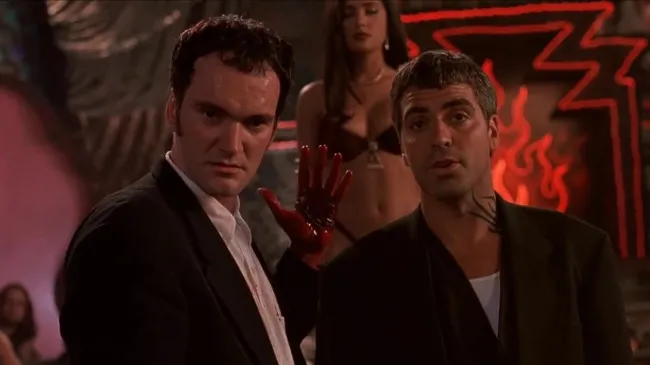
From Dusk Till Dawn was the last film based on a Quentin Tarantino script that he did not direct himself. It was the first he wrote, but it only got made after the success of Reservoir Dogs and Pulp Fiction. By then, however, Tarantino had already pulled the Ezekiel 25:17 monologue out of From Dusk for Jules’ (Samuel L. Jackson) iconic monologue in Pulp Fiction, Dusk director Robert Rodriguez shared on Friday night after a screening at the Academy Museum of Motion Pictures.
KNB, the makeup effects company run by Robert Kurtzman, Howard Berger and Greg Nicotero (who would later create the Emmy-winning zombie effects for The Walking Dead) hired Tarantino to write the film as a showcase for its vampire effects. It was Tarantino’s first paid writing gig. But, as Rodriguez tells it, Dusk wound up being shelved due to lack of interest, and Tarantino incorporated the bible-inspired verse into his Oscar-winning Pulp Fiction script.

Were Dusk made first, Harvey Keitel would have been talking about the path of the righteous man. Keitel played Jacob, a grieving minister whose family is taken hostage by the Gecko brothers, Seth (George Clooney) and Richard (Tarantino). At the brothers’ Mexico rendezvous, they end up victims of a bar full of vampires.

“Quentin was starting to steal from it because it wasn’t being made,” Rodriguez joked. “In Pulp Fiction, the Ezekiel speech that Sam Jackson says was originally spoken by Harvey Keitel’s character in Dusk Till Dawn so he was already starting to pick the bones of it. Because Pulp Fiction was a hit, people suddenly wanted to make Dusk Till Dawn. They’re like, ‘Oh, it’s like two movies in one. It’s brilliant.’”

While Tarantino had sold the True Romance and Natural Born Killers screenplays, the “two movies in one” — a hostage drama that becomes a creature feature — was originally a hurdle in finding buyers for From Dusk Till Dawn.
“Quentin loved the characters of the brothers so much, he spent half the script with them before even getting to the bar,” Rodriguez said. “So people would go, ‘This is like two movies in one. It doesn’t make any sense. This switches gears so late in the story’ but that’s what we liked about it.”
Tarantino and Rodriguez had met on the film festival circuit after their respective debut films, Reservoir Dogs and El Mariachi. Rodriguez cast Tarantino in Desperado and each directed a segment in Four Rooms.

“We found ourselves on panel discussions together at these festivals, like ‘Violence in the Movies in the ‘90s’ even though it was only ‘92,” Rodriguez said.
Filmed in the summer of 1995, From Dusk Till Dawn was released in January 1996. The production was as bifurcated as the final product, with Rodriguez filming all of the bar scenes first.
“We couldn’t film the outside section of the movie right away,” Rodriguez said. “The very first day of shooting was Quentin and George walking into the bar. That also helps create this feeling of disjointed two halves because we shot the second half first before we went outside and shot the first half.”
While Tarantino had repurposed scenes in his other movies, Rodriguez added several elements of his own. Salma Hayek’s character, Santanico Pandemonium, was Rodriguez’s contribution.
“There was a vampire called Blonde Death that Quentin had always imagined a Madonna playing,” Rodriguez said. “I said, ‘Well, they’re in Mexico so it should be a Mexican character. What about Salma Hayek?’ He just met her on Desperado. He said, ‘Oh yeah, I’ll rewrite the name for her.’”
Tarantino named Santanico Pandemonium after a Mexican horror movie he remembered from working at the Video Archives video store. Rodriguez added her legendary snake dance with a Burmese Python.

“I always wanted Salma to be this Aztec queen of the vampires,” Rodriguez said. “That’s why I added this whole musical snake dance sequence. That also wasn’t in the script.”
Rodriguez also added the final shot of the film, which reveals the bar is the tip of an Aztec pyramid.
“Originally in the script, they were just common European-style vampires,” Rodriguez said. “I felt that we could bring more of an Aztec culture to it. That last shot in the film, I just made up that Aztec temple. He thought, ‘Oh, that’s cool. It was a temple. Over time they turned it into a bar.’”
Rodriguez did not get everything he wanted, though. He’d intended the vampire half of the movie to be in 3D. He would later make the third Spy Kids and Alita: Battle Angel in 3D, but that wasn’t feasible in the ‘90s.
“When they got to the bar, you were going to put on your glasses,” Rodriguez said. “That’s why it’s still designed where everything is flying into the camera in the second half. But I saw how archaic the old 3D film cameras were. It was going to be impossible to shoot with them.”
He did get his wish for the soundtrack. ZZ Top wrote the track “She’s Just Killing Me” for the movie. Rodriguez then cited frontman Billy F. Gibbons’ response to his request.
“He wrote me back saying, ‘Hey now, brother man. The answer to your query is whoa. I’d be delighted to provide you and Senor Tarantino with a killer diller of an original Top, six-legged low style with all the trimmings. It will require finding a quiet table over enchilladas to pen the lyrics and notes. I’ll send up a smoke signal upon completion of the composition. Hit me back at convenience. Gracias, speak with you pronto, bueno. Stay coolest, conmigo. Billy F. Gibbons.”
