
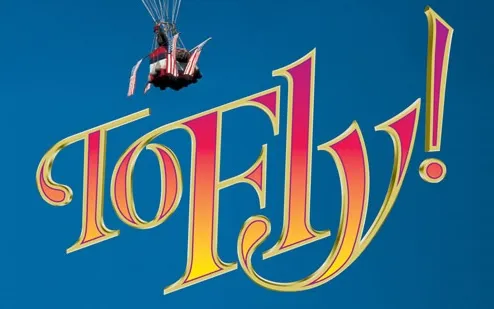
Fifty years ago, two filmmakers believed that the still-new Imax format could fly. On July 1, 1976, the National Air and Space Museum in Washington, D.C. — at that point was one of only four venues globally to house an Imax screen — premiered To Fly!, a 27-minute history of American innovation in aviation, from cloud-touching hot-air balloons to galaxy-exploring spaceships.
Commissioned by the Smithsonian as part of its slate of Bicentennial programming, the movie was only intended to play for the calendar year. But director Greg MacGillivray, who made the film with his late collaborator, Jim Freeman, always knew that, if executed correctly, To Fly! could be something… more.

“From the very beginning, I wanted people to put their notepads down and know they were there to have fun,” the two-time Oscar nominee tells Gold Derby now. “That was different from all the other films that were being done for the Bicentennial; people kind of expected to be lectured to with facts and figures.

“But there were already facts and figures all over the museum,” MacGillivray continues. “Jim and I wanted to focus on fun and emotion, and the joy of taking to the air. So, we decided to use the Imax format to throw every filmmaking trick we knew or could think of into the movie. It was like an ad for Imax.”
Five decades later, as America prepares to celebrate its semiquincentennial, people are still buying what To Fly! is selling. The short film continues to screen at least once a day in the NASM’s cavernous Lockheed Martin Imax Theater, alongside large-screen documentary descendants like The Dream is Alive and National Parks Aventure, as well as a mixture of past and present Hollywood blockbusters like Galaxy Quest and Supergirl, which have gone all-in the Imax format and the box-office-boosting premium ticket pricket that accompany it.
And thanks to Hollywood’s embrace, Imax has become the first name in premium screens with $1.2 billion tickets sold last year alone. That’s something the company couldn’t have imagined when To Fly! opened in 1976, six years after the first Imax film, Tiger Child, screened at Japan’s Expo ’70 and five years after the first Imax theater opened at the Cineshphere in Toronto.

“People have said that Imax might not still be here if it hadn’t been for To Fly! and I think there’s some truth to that,” MacGillivray remarks candidly. “The company was almost out of money in 1976 and could very easily have folded. They basically got the film for free, because it was funded by [the energy company] Conoco. After it played to a million and a half people during its first year at the Smithsonian, every museum in the world wanted an Imax theater, which really kickstarted the company.”
Going purely by the numbers, To Fly! remains one of Imax’s most successful releases ever. Made on a $590,000 budget, the film is estimated to have been viewed by over 100 million ticket payers during its 50-year run at Imax venues around the world. And more than 15 million viewers have seen the film in Washington, D.C., alone — the biggest audience for a single film at a single venue in history. In fact, when the Smithsonian considered dropping the film from the NASM roster at one point, they got an earful from visitors and The Washington Post.

“There was such a revolt,” says MacGillivray, who continues to make Imax movies like Everest, The Living Sea, and Dolphins — the latter two received nominations for Best Documentary Short in 1995 and 2000, respectively —which surpassed through his production company, MacGillivray Freeman Films. (Freeman died in a helicopter crash in June 1976, days before the film’s premiere.) “Whenever I go to Washington, D.C., I’ll say I’m the director of To Fly! and people say, ‘Oh, we know that movie!’ It’s like Star Wars or something.”
One notable To Fly! fan is director Christopher Nolan, who tells Gold Derby that his first viewing of To Fly! occurred during a childhood trip to the Great America theme park outside of Chicago, now operated by Six Flags. “A buddy of mine and I were riding the roller-coasters and we saw they had an Imax theater there that was showing To Fly!” the director says now. “There was a moment in the film where we’re flying over a ridge, and then the camera banks to one side. I looked at the audience and saw that all of the heads were tilted in that direction at the same time in unison.

“That always stuck with me,” Nolan adds. “I fell in love with the Imax format then, and I’ve been using it myself for years. Many years later, I shot Dunkirk with Imax cameras mounted to airplanes, and when I went to see the film at the Cinesphere, there’s a moment during a dogfight where the camera banks on the plane. I looked at the audience, and I could see everybody’s head tilting to one side like they had when I was watching To Fly!”
Nolan specifically sought out MacGillivray’s advice when he started to incorporate Imax cameras into his own films, starting with 2008’s The Dark Knight. And his latest movie, The Odyssey, arrives in theaters on July 17 as the first full-length feature to be filmed entirely with Imax cameras. In a neat bit of cinematic synchronicity, The Odyssey will join To Fly! in having daily showtimes at NASM’s Imax theater later this month — two Imax achievements screening in the same venue separated by 50 years of aviation and film history.
“That’s very meaningful for me,” Nolan emphasizes. “We’ve had some great screenings of our films at the Air and Space Museum, and I’m always happy whenever Hollywood films are playing in those institution because I feel like that’s where this format and its artistry really come to life.”
Taking flight

MacGillivray and Freeman cut their filmmaking teeth on ‘60s-era surfing films and second-unit photography for studio pictures like Jonathan Livingston Seagull and The Towering Inferno before landing their Bicentennial aerial assignment. As part of the duo’s shared desire to avoid making a bland “facts and figures” documentary, they decided early on to give To Fly! a loose narrative that begins with a balloonist named Ezekial achieving lift-off in the 19th century — a maiden flight that sets up a decades-spanning evolutionary montage of early biplanes, fighter jets, passenger airplanes, hang gliders, and rocket ships.
“Initially, we had Ezekial popping up throughout the movie and linking scenes together,” the director remembers, adding that he and Freeman abandoned that idea once they settled on a more chronological editing structure. “We also wanted to use as little narration as possible so that people knew from the outset that they were just there to have fun and see a new perspective on the world.”

In addition to being a history of aviation, To Fly! is also a loose history of Hollywood entertainments. When we first meet Ezekial, for example, he’s presented in a classic square frame, but once he’s airborne, the image expands to fill the Imax screen — a striking visual transition that’s reminiscent of The Wizard of Oz’s famous changeover from black-and-white to Technicolor that accompanies Dorothy’s arrival in Oz. Homages to Wings, Stagecoach, North by Northwest, and 2001: A Space Odyssey can also be spotted throughout the half-hour film.
“We went back to those classic films and borrowed from them in a way that was also honoring them,” MacGillivray confirms. “Because this was an Imax theater, it was also the first time that people were sitting that close to the screen in these steeply raked seats, and we wanted them to experience the visceral feeling of being in the movie. Audiences are used to that now, but 50 years ago they were still a little apprehensive about what the Imax experience was going to be.”
Achieving velocity

By the way, the film’s production team was also apprehensive about their side of the Imax experience: getting those bulky 80-pound cameras — which MacGillivray likens to the “size of a small refrigerator” — airborne.
“It took two people to lift it onto the tripod or mount it on an airplane or a helicopter,” the director recalls, adding that his crew spent eight months building a special helicopter mount that would allow for smoother images. “We also built a mount for underneath the helicopter that could fly forward and give the audience the tiling motion of a bird. People hadn’t seen that kind of point of view shot before.”

Besides Imax cameras, the To Fly! team also relied on traditional 35mm film cameras for certain scenes, most notably the footage of the U.S. Navy Blue Angels soaring through the skies. In the editing room, MacGillivray designed the sequence to have “a split-screen feel” by filling the frame with multiple panels and then cutting to full-sized Imax shots. “I used that trick of going from small to big multiple times,” he says now. “We’d done a lot of that in our surfing films, and I really loved the effect it had on an audience.”
Sending refrigerator-sized cameras into the American skies may sound like a legal nightmare just waiting to happen, but the To Fly! crew never had any issues from city, state, or federal authorities — even when they, for example, decided to fly an Imax camera through the famed Gateway Arch in St. Louis. “I don’t think we asked them for permission,” MacGillivray confesses with a grin. “Nowadays it’s gotten a lot more complicated with permits, but back then there weren’t the same kinds of restrictions that pilots and filmmakers have to abide by now. It was more like, ‘Yeah, just go up and do it, no problem.’”

“The pilot who did the Gateway Arch shot was George Nolan, who was probably the best helicopter pilot I ever worked with,” the director continues. “He was super-skilled and had this wonderful eye. We used him for the aerial stuff in Jonathan Livingston Seagull and that film got an Oscar nomination for Best Cinematography, which rarely happens with a nature movie.”
Full metal Imax

Back in 1976, Imax cameras were able to venture into Earth’s blue heavens, but they couldn’t reach the outer limits of space. So, for the film’s final frontier-set section, the filmmakers consulted with Douglas Trumball, who oversaw the pioneering space scenes glimpsed in Stanley Kubrick’s 2001: A Space Odyssey.
“We couldn’t use CGI back then, so everything had to be done in-camera,” MacGillivray says. “Imax didn’t have an optical printer so we also couldn’t do any of the things that Trumball did with 2001. But we talked to Doug and he gave us some good advice; we ended up building a model of a rocket ship and used multiple passes in-camera to shoot it. We also used paint splatters and other liquid elements to photograph the exploding nebulas and things, and that was cool-looking.
“We did the best we could on our meager budget, but I was never completely satisfied with the ending,” the director adds candidly. “We just didn’t have the technology to do the things we really wanted to do.” (The MacGillivray Freeman company did eventually get Imax cameras into the cosmos with 1985’s The Dream is Alive, another longtime Smithsonian staple. Directed by the format’s co-creator, Graeme Ferguson, it was the first Imax movie to be shot in space.)
Years after To Fly!, MacGillivray ended up collaborating with Kubrick himself on the director’s 1980 horror classic, The Shining, shooting the helicopter footage of Jack Torrence making his way to the Overlook Hotel that opens the film. He also seized the opportunity to sell the filmmaker on taking the leap to Imax with his next film, the Vietnam War epic Full Metal Jacket.
“That movie would have been very different he had shot it in Imax,” MacGillivray says now. “Unfortunately, there just weren’t enough Imax theaters then to make it financially rewarding. I tried like heck to get him to do it, though!”
The Nolan prestige factor
Christopher Nolan, on the other hand, didn’t need any convincing when he sought out MacGillivray’s counsel for the Imax portions of The Dark Knight. “It was really about putting my director of photography, Wally Pfister, in touch with him, because no one had ever shot Imax on a Hollywood feature,” the director says now. “We were really, excuse the pun, flying blind!”
Fortunately, MacGillivray made sure to provide the duo with some clarity. “I spoke with Chris and his cinematographer, and told them what I know about the way that audiences relate to that giant screen,” he remembers of that inital conversation..
Nolan says that he and Pfister specifically needed guidance on “the mechanics behind” using Imax cameras for aerial photography. “Greg was extremely helpful at calming us down,” he remarks with a laugh. “He put our minds at ease about how to go about certain things.”
When we observe that The Dark Knight‘s Imax-sized opening aerial shot of Chicago — standing in for Gotham City — feels like it could have come straight out of To Fly!, Nolan readily concurs. “That childhood experience of watching Greg’s camera take you through an environment from above just doesn’t leave you,” he stresses. “It shows you the power of this medium and this format. Greg and those other early Imax directors are gurus. They’re the people we all look at and say, ‘How do we incorporate that into our own filmmaking?'”
The mutual respect between the duo persists to this day. “I’ve seen Chris socially a couple of times, and we’ve chatted about what he’s done with the Imax format and where he wants to take it next,” MacGillivray says. “He’s a brilliant filmmaker and has really taken Imax to another level. Oppenheimer probably wouldn’t have won Best Picture if it had been done in a conventional format.”
When we spoke with MacGillivray, he hadn’t yet seen The Odyssey, but his expectations are, of course, sky high. “Chris understands how Imax can work,” the director says. “He holds the images long enough, and he uses the camera in ways that give the audiences both thrills and the sense of being there, as well as providing a way into the characters’ minds and emotions. That’s why Dunkirk worked, that’s why Oppenheimer worked and hopefully that’s why The Odyssey works. From what I’ve seen, it’s going to be pretty exciting.”

Asked how To Fly! informed The Odyssey in particular, Nolans indicates that audiences need only watch the skies. “My approach to aerial photography in general owes a lot to MacGillivray Freeman’s film and Greg’s work in particular,” he remarks. “There’s a kind of calm and authority to the way that we try and move the camera in The Odyssey that was really inspired by films like To Fly! We’re not trying to thrash it around too much; we want to have a stately feel to those shots, and that comes very much from his approach.
“There’s a trust in the Imax format, and a trust in the grandeur of the images that are unfolding in those films that we tried to retain,” Nolan adds. “That’s very relevant to The Odyssey in terms of how to shoot landscapes from above.”
Interestingly, Imax finds itself at another turning point five decades after To Fly! The Wall Street Journal recently reported that the company is seeking potential buyers who could take full advantage of the boom times for large format premium screens. MacGillivray confesses to seeing some sadness at seeing the brand he’s helped build through his company’s extensive library of Imax films be put up for sale.
“Emotionally, it’s kind of like my baby, too,” he says. “My company has been responsible for making some of the movies and building some of the cameras that have tried to take Imax to another level each time.

“But I’m hopeful,” the director continues. “I remember when we made To Fly! people would say to me, ‘Imax is going to the way of Cinerama — it’ll be a novelty for 10 years and then go away.’ But I never thought that because I would look at the faces of people exiting an Imax theater, and they’d have these huge smiles and wanted to have that experience again. I still think it’s going to stick around.”
