
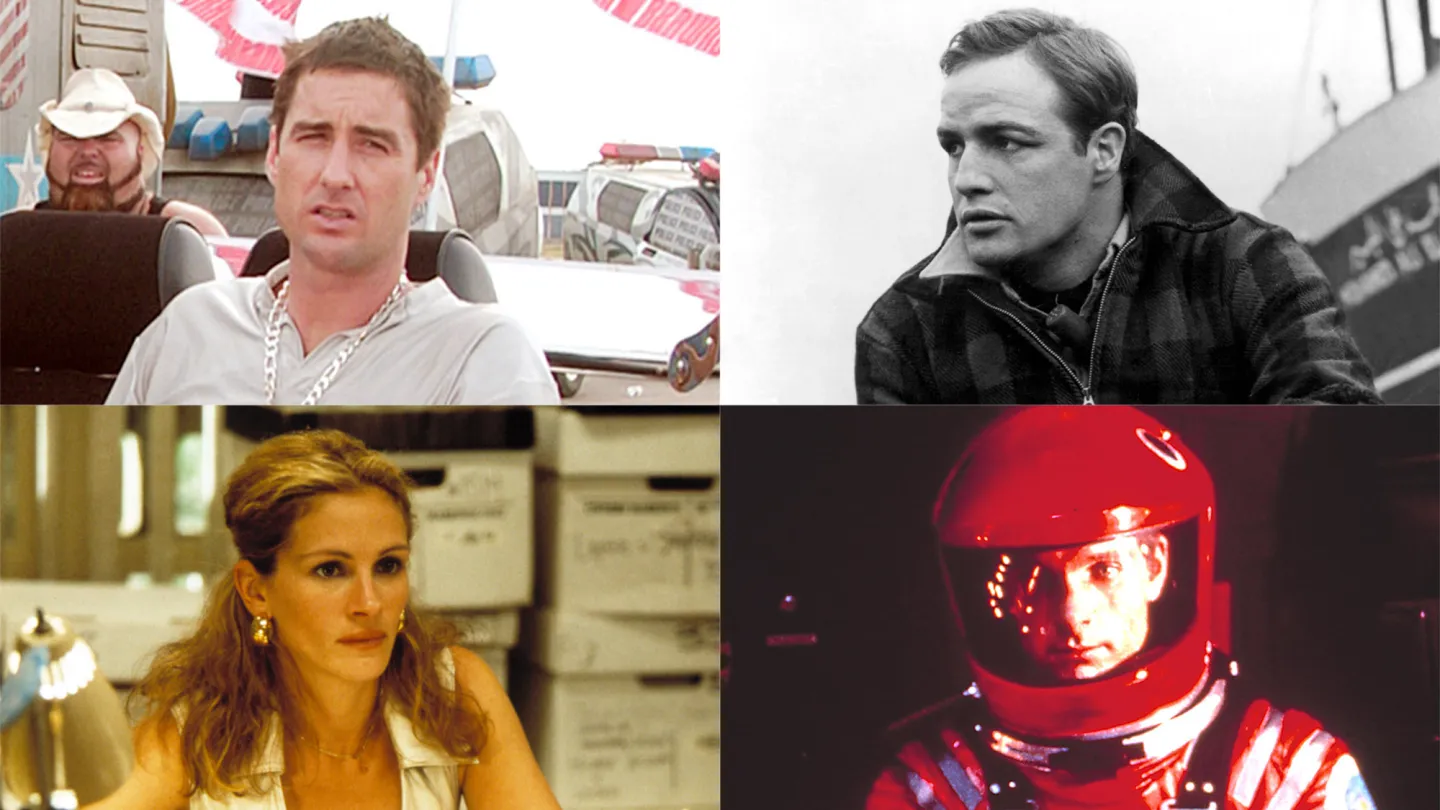
For a country that’s been around for a quarter of a millennium, America is pretty dynamic. Politics, fashion, culture and other realms change states faster than a microwavable dinner. Which, incidentally, was all the rage in the 1980s and now is most popularly known as a Roblox game.
That makes pinning down something like the American psyche a tricky game. Some films try to tell the tale via U.S. history, like Lincoln or Selma or Born on the Fourth of July. Others opt for immigration stories like Avalon or Minari or In America. Worthy efforts, all. But many of those films tackle explicitly American notions of government or principles or ideals.
An equally (more?) accurate cinematic version of America may be one that doesn’t contemplate America at all. It knows not from the 25th Amendment or a Second Constitutional Convention; it doesn’t think much about the White House or Ellis Island. In fact, the country itself may not even be mentioned. These characters simply live in America, doing something that captures the American condition in all its hustle and heartbreak — its beautiful tragedies and inescapable ironies.
One way to think about it would be if you were using movies to explain America. If you were teaching a class of schoolchildren you’d show them explicitly U.S.-preoccupied films like Lincoln or Selma. But what if you were talking to someone who’d never heard of America and who cared little about the idea of government or geographic borders? How would you communicate the place’s essential traits, the psychic weirdness, the messy contradictions — what movies would you tell them about then? Such are the criteria we used in devising this ranking of films about the American condition. Not the country’s history or institutions but the ineffable qualities of living here — a lot less Mr. Smith Goes to Washington and a lot more Sorry to Bother You.
With the nation’s 250th birthday upon us this July 4th, here are the top 25 movies about the American psyche.
-
Ferris Bueller’s Day Off

Image Credit: Courtesy Everett Collection (John Hughes, 1986)
“Life moves pretty fast. If you don’t stop and look around once in a while, you just might miss it.” Has any character in the history of American cinema better captured this country’s ethos? Hungry for experience and eager to cut corners, Ferris is America, a self-conception (and self-own) in movie form. Always hustling, often putting one over on people, but so lovable he just might get away with it. Many films tried before and no doubt many will continue to try, but for capitalism’s full-court charisma press, nothing will compete with what Ferris, Cameron and Sloane did that magical Chicago day. Swing battah battah.
-
Don’t Look Back


Image Credit: Courtesy Everett Collection (D.A. Pennebaker, 1967)
A half-generation before, another wan dreamer was putting over his own beautiful hustle and vibe-shifting the culture around him in the process. Pennebaker’s groundbreaking verite about Bob Dylan, trailing the Hibbing Bard on a 1965 tour of England, didn’t try to explain what we were seeing, just let us Rorschach our way to our chosen meaning. Whether it was Dylan sparring with a science student or singing Hank in a hotel room, playing Royal Albert Hall or just solicitously presenting those cue cards for Subterranean Homesick Blues, Don’t Look Back captures our national lashout at an unjust status quo with unique perspicacity. Kurt Cobain called Pennebaker’s film the only “good documentary about rock and roll,” which also makes it the best film about a defining American art form.
-
On the Waterfront and There Will Be Blood

Image Credit: Courtesy Everett Collection (2) (Elia Kazan, 1954, and Paul Thomas Anderson, 2007)
What is the meaning of success, and what are the right ways to get it? What is the line between hustle and unethical behavior, and does the universe correctly sort between them? Both Kazan and Anderson grapple with these quintessential, generationally transcending American questions through two characters living in two different worlds a half-century apart, one wildly successful in his greedy milkshake-drinking and the other left simpering that he coulda been a contender. Whether Daniel Plainview is wailing on Eli Sunday or Terry Malloy is wailing to his brother Charlie, the films depict unadorned American greed, its undeniability and its victims.
-
Sorry to Bother You

Image Credit: Courtesy of Sundance Institute/Doug Emmett (Boots Riley, 2018)
It has two lead characters named Cash and Squeeze, and that’s just the start of it. Riley’s masterpiece has become a cult classic in the eight years since it premiered at Sundance, and it probably still hasn’t achieved the peak of its popularity. The scifi-ish story about a near-future of call centers and racial cosplaying manages to tackle power, race, economics, social justice — the whole lot of it — but in such an enjoyably weird way you need to see it multiple times to grasp all the layers. Even the title works on a meta level, doubling up the call-center intro with directorial faux non-apology about disturbing our complacency. If you want to understand both the country’s everyday ironies and the precarious hot mess it has gotten itself into, you could take five classes and read 10 academic histories. Or you can just watch Sorry to Bother You.
-
Furious 7

Image Credit: Courtesy of Universal Studios (James Wan, 2015)
They spend most of the movie in Azerbaijan and Abu Dhabi — or, more accurately, flying in cars above them — but Dom and the gang and indeed a 21st-century Hollywood action-movie producer may have never told a more American tale. The sheer nothing’s-impossible glee; the brotherhood between them, even amid impossible (and implausible) circumstances. The film was marred by the death of star Paul Walker in the middle of production, but in true indefatigable American spirit, the show went on, and in even truer indefatigable American spirit used body doubles of Walker’s own brothers to do it. “How can we not talk about family when family is all that we got,” the movie’s sappy-but-effective theme song (which also gave us national treasure Charlie Puth) asked us. Indeed.
-
There It Is and Arizona Dream

Image Credit: Courtesy Everett Collection (Harold L. Muller, 1928, and Emir Kusturica, 1993)
Wild dreaming is at the heart of America; after all, that’s how the country got here. Two movies separated by an era capture this tendency to reverie in exciting, enlivening and, OK, confounding ways. In the 1920’s a British detective comes to New York to investigate a “phantom “that causes pots to dance, pants to come off and full chickens to hatch; in the 1990’s a New York fish-tagger (played by a young Johnny Depp!) comes to Arizona to meet a woman who dreams of building a “flying machine” while her stepdaughter dreams of turtle reincarnation. Both movies are as enigmatic as they are thrilling, and ask a foundational American question: who’s to say that one person’s vivid imagination isn’t tomorrow’s accepted reality?
-
Buffalo ‘66

Image Credit: Lions Gate/Courtesy Everett Collection (Vincent Gallo, 1998)
Manic, opportunistic , lovable, infuriating — when Gallo’s recently released convict goes on an ecstatic road trip with a kidnapped Christina Ricci, he exemplifies what has been an American trait that cinema from Westerns to indies have long captured: the stubborn romantic need to find something better, often on the road (and an obliviousness to how we interfere with our own goal). But the most perfectly American part of the film may be Anjelica Huston’s scene-steal, as years later she watches Scott Noorwood’s missed field goal in the 1991 Super Bowl again and again, unable to move on from a past and yet retaining a durable optimism that, somehow, this time time it’ll all be different.
-
The American President

Image Credit: Columbia Pictures/Courtesy Everett Collection (Rob Reiner, 1996)
OK, so we said no American history movies. But technically this isn’t about anything that actually happened. Also, at the heart of America is is well, a heart, and this romcom between Michael Douglas and Annette Benning has it in spades. Aaron Sorkin’s script about a widowed president trying to balance foreign-policy decisions, Congressional maneuvering and a date at a French state dinner may seem like a pretty glossed version of real life in this country. But at its humanist essence, The American President is just a shinier spin on the trying-to-have-it-all movie, the answer to the a question so many Americans ask at the end of the day: Can I be happy at both work and in relationships?
-
The Godfather and The People vs. Larry Flynt

Image Credit: Courtesy Everett Collection (2) (Frances Ford Coppola, 1972, and Milos Forman, 1996)
When can films about a mob boss and a pornography trial a quarter-century apart tie for the same slot? When they’re about two men with an empire, a vision and, most important, an oddly ennobled vulgarity. No one would confuse either Don Corleone or Larry Flynt with actual heroes. And yet … the two men uphold a certain shaggy standard. Despite no tangible evidence that either of them are enriching society, they each embody the same uniquely American idea: if you conduct business with a kind of principled consistency, we’ll love you no matter what that business is.
-
The Best Years of Our Lives

Image Credit: Courtesy Everett Collection (William Wyler, 1946)
So many directors have tackled the brutality of American war — sadly they have many to choose from — but far fewer have imagined what happens upon soldiers’ return. Wyler’s post-WWII classic examines that specific dynamic, with a whole generation triumphant but adrift. The United States, it turns out, may valorize service, but it has failed to figure out what to do with those who’ve completed the mission. When Fred Derry tells his fiancée, “You know what it’ll be, don’t you, Peggy? It may take us years to get anywhere. We’ll have no money, no decent place to live. We’ll have to work, get kicked around,” the film’s ending captures a hopelessness that has been with America since the beginning. And when she warmly accepts him anyway, it evinces an optimism that will never go away. -
Borat: Cultural Learnings of America for Make Benefit Glorious Nation of Kazakhstan

Image Credit: 20th Century Fox/Courtesy Everett Collection (Larry Charles, 2006)
Who knew that all it would take to understand the corroded and at times hypocritical heart of America was a series of over-the-top cringe-comedy set pieces from a Brit impersonating a Kazakh while speaking Hebrew? OK, so anyone who watched Da Al G Show might have put the pieces together. But the audiences that flocked to this pre-social media viral sensation were laughing at what they watched, convinced they were seeing a distant comedy and not a slightly distorted mirror. The film took some shortcuts and played fast and loose even with candid-camera and selective-editing etiquette so it could show the country at its most jingoistic, tribal and senseless. But from the vantage point of 2026, can you blame it?
-
2001: A Space Odyssey and Ghostbusters

Image Credit: Courtesy Everett Collection (2) (Stanley Kubrick, 1968, and Ivan Reitman, 1984)
Will science save or destroy us? Should we try to understand every last bit of the universe or accept there is that which we cannot fathom? Baked into the American experience is a rigorous rationalism, a dogged worldview that all can be understood and solved. Yet equally pervasive are spiritual and supernatural beliefs, the idea that something hovers that can’t be understood. Kubrick juxtaposed these opposites as astronaut David Bowman comes upon mysterious astral phenomena that can’t be explained and may or may not have something to do with him. Some 15 years later (and with a lot more pop comedy), Reitman picked up the conversation, asking if there are paranormal phenomena we can’t apprehend and if Proton Packs can be useful upon encountering them. An ideology of science constrained by an acknowledgement of the supernatural is as American as tensions get, and both films colorfully find their way to portraying it.
-
Slacker and Reality Bites

Image Credit: Courtesy Everett Collection (2) (Richard Linklater, 1991, and Ben Stiller, 1994)
“I know it’s kinda disgusting but it’s like, it’s sort of, like, getting down to the real Madonna” and “You look like … a doily” — two of the more quotable modern-movie lines, both uttered by twentysomethings trying to figure out life and everything in early-1990’s Texas. Watching them now, Linklater’s discursive gem and Stiller’s class dramedy feel almost quaint, snapshots of a moment when earnestness still reigned and the the Internet, well, didn’t. But for all of its historical specificity, the striving of these characters spans American generations, engaging with a theme that will never go out of style: what the hell is my role in this vast land?
-
Rocky III

Image Credit: Courtesy Everett Collection (Sylvester Stallone, 1982)
Yes, we could have gone with the first Rocky, about an underdog working-class spirit that captures a part of the national psyche. Or Rocky IV, which is about a more literalized patriotic pluck in the face of an indomitable Cold War machine (ah, for the days of Cold War underdoggery). But for something that truly captures the neon splotches of the American soul — the excesses and the crassness and our love-hate relationship with all of it — nothing compares to Rocky III. Hulk Hogan appears early, Mr. T appears later. As the cartoonishly brutal Clubber Lang — no “Pity the Fool” campiness here — T kills Rocky’s beloved manager, then destroys the boxer (wealthy and complacent) in the ring, prompting a rematch at Madison Square Garden. If the movie’s taste for subtle understatement wasn’t already clear, Rocky rival Apollo Creed becomes his coach and lends him a pair of talisman American-flag shorts. Also, the sine qua non of American rave-up anthems, “Eye of the Tiger.” By the time Rocky is raining down punches on Lang to end the movie, you feel pummeled yourself, bruised with the distinct black-and-blue marks of American violence and gaucheness that nonetheless make you feel strangely at home.
-
The Social Network

Image Credit: Merrick Morton/©Columbia Pictures/Courtesy Everett Collection (David Fincher, 2010)
Mark Zuckerberg acting narcissistically to create and conquer an industry is a a pretty good metaphor for what Silicon Valley did to America. It also may be a pretty good metaphor for what America did to the world. You need a certain amount of self-delusion to believe you could dominate what you have no right dominating. Aaron Sorkin’s classically rapid-fire script, Jesse Eisenberg’s classically twitchy performance and Armie Hammer’s classic double-duty as the Winklevoss twins all work so effectively on an individual-drama level we can forget what they’re saying about the nation as a whole. But as a movie that demonstrates how an ethos gobbled up a country, none did it as well, or as presciently.
-
Erin Brockovich

Image Credit: Courtesy Everett Collection (Steven Soderbergh, 2000)
If Zuck showed America’s lust, Erin showed its conscience. Indignant, crass, moral-compassed and unstoppable — you could argue that the titular legal battler, with her quest to hold a big corporation accountable for groundwater contamination, is the defining cinematic superhero of the century, all apologies to the MCU. That she was played by Julia Roberts only adds to the magic, America’s Sweetheart as America’s Warrior. Years later, the archetype would mutate into that distinctly American stereotype of the Karen — the complainer who doesn’t like how equity is affecting her. But Roberts showed what a malcontent, and a country, can become when oriented to nobler points: a place where one person, armed with nothing more than chutzpah and morality, can change the world.
-
Sugar

Image Credit: Sony Pictures Classics/Courtesy Everett Collection (Anna Boden and Ryan Fleck, 2008)
We know we said no immigrant movies, but we need to make an exception for this one. This sly drama about a Dominican baseball prodigy on a Kansas City minor league team could have been a fish-out-of-water comedy, or a bootstrapping tale of outsider success. Instead, the indie masters Boden and Fleck have something subtler and more human on their mind, chronicling a character who doesn’t get anything he wants but still ends up with pretty much everything he needs — a capsizing of the American Dream right into welcomingly warm waters just the same.
-
The Searchers and Django Unchained

Image Credit: Courtesy Everett Collection (2) (John Ford, 1956, and Quentin Tarantino, 2012)
Plenty of Westerns only go saloon-deep on American themes. Plenty of Westerns are not these two films. Set on either side of the Civil War, Searchers and Django each use revenge and obsession as their emotional coin, and each ask the same set of questions about this country: What is the racism that infused the nation in its inchoate stages and how much have we truly gotten past it today? Both use larger-than-life stars convinced of the righteousness of their quest, Ethan Edwards (John Wayne) and Calvin Candie (Leonardo DiCaprio), neither challenging the colonial and racist impulses that animate them. Both films also faced controversy over allegedly glorifying the bigotry they sought to critique, but a close reading shows a message more measured — and an America that can be anything but.
-
The Incredibles

Image Credit: Walt Disney/Courtesy Everett Collection (Brad Bird, 2004)
“Everyone’s special, Dash.” “Which is another way of saying no one is.” Bird’s iconic exchange in The Incredibles highlights a movie that’s about childraising in modern America — along with other big themes like the impulse to help vs the temptation to stay home, the scale and limits of our abilities, the appeal and perils of suburban conformity and a half-dozen other questions Americans grapple with on the daily. People think of this Pixar classic as a brilliant riff on the superhero story, and it is, but really it’s an inquiry into how we’ve been living.
-
Uncut Gems

Image Credit: A24/Courtesy Everett Collection (Josh and Benny Safdie, 2019)
The mere thought of Adam Sandler phone-walking through the streets of New York’s Diamond District while trying to hustle friends and keep loansharks off his tail may jangle your nerves, and that’s how it should be. The Safdie Bros. designed their final collaboration (for now) to make you feel like you can’t rest because the next possibility lies just around the corner. An homage to their Italian-born immigrant Sephardic father, the movie embodies the beautiful masochistic truth at the heart of this country: to stop striving may be healthy, but it is also un-American.
-
Chan Is Missing

Image Credit: New Yorker/Courtesy Everett Collection (Wayne Wang, 1982)
Most detective stories have police-department veterans trying to find a missing person or item. Wayne Wang’s solo directing debut has a different of case on its mind — a pair of everyday scrappers trying to solve the mystery of the Chinese-American experience. The black-and-white-noir has cab drivers Jo (Wood Moy) and Steve (Marc Hayashi) talking to people in the streets of San Francisco’s Chinatown about their disappeared friend Chan Hung. As they get competing views of how Chan experienced America and whether he returned to his birthplace, we realize the real search is for a sense of belonging — and whether this country delivers it.
-
Easy Rider

Image Credit: Courtesy Everett Collection (Dennis Hopper, 1969)
Before the generational touchstones of Slacker and Girls and whatever Gen-Z embraces, decades ahead of Curry Barker and Kane Parsons and DIY smashes, came Easy Rider, a story of Boomer love, drugs and community as the old order topples. Hopper and producer/co-star Henry Fonda made the movie when no one else would, embodying the very outside-the-system ethos contained with it. Never before in cinema and perhaps never again since has a piece of entertainment captured the pure American thrill of going your own way — has offered an expression of its bedrock tenet that perhaps the best antidotes to a hegemonic conformity are simply friendship, love and a good road trip.
-
Idiocracy

Image Credit: 20th Century Fox/Courtesy Everett Collection (Mike Judge, 2006)
We’re back in Texas among the underachievers, and it feels like home. Only this time we’re hundreds of years in the future, when a cryogenically awakened Luke Wilson is deemed the smartest man in the world simply for not being born in the present, at a moment when even doctors and judges have been bloodied by the relentless hammer of stupidity. Judge and co-writer Etan Cohen penned their movie mid-George W. Bush administration, playfully extrapolating where that era might go centuries into the future. Who knew we should have bet the under? “Idiocracy is a documentary” is a thought so common these days as to almost lose meaning. And yet when we look at demographic shifts, stoner laziness, a disintegrating discourse and a country buckling under its own pandering stupidity, how can you disagree?
-
Get Out

Image Credit: Universal Pictures/Courtesy Everett Collection (Jordan Peele, 2017)
Can we stuff our ears with cotton or are we all doomed to live in the sunken place? Jordan Peele’s Trump I horror-infused social commentary was the perfect serum for that moment, precipitating and anticipating by three years a long overdue national race reckoning. But the film becomes the embodiment of the American soul by transcending that era, capturing a dynamic between white and Black people that, for all the illusion of progress, often has us stuck eating the same bowl of Froot Loops. You could vote for Obama for a third term and still perpetuate a toxic game, and no injection entered this cultural nerve better than Get Out.
-
Election

Image Credit: Courtesy Everett Collection (Alexander Payne, 1999)
What to say about a film that already says it all? The rivalries of high-school, the fight against middle-age ennui, the manipulation of religion, the limits of democracy, the battle between generations, the scheming for power — if there was one movie you’d send into space or bury in a time capsule so people far away will understand what this country is about, make it the movie about Tracy Flick and her machinations. “Dear Lord Jesus, I do not often speak with you, but now I really must insist that you help me win the election tomorrow because I deserve it and Paul Metzler doesn’t.” Etch that line on the moon; no film distills the American psyche like this one.
