
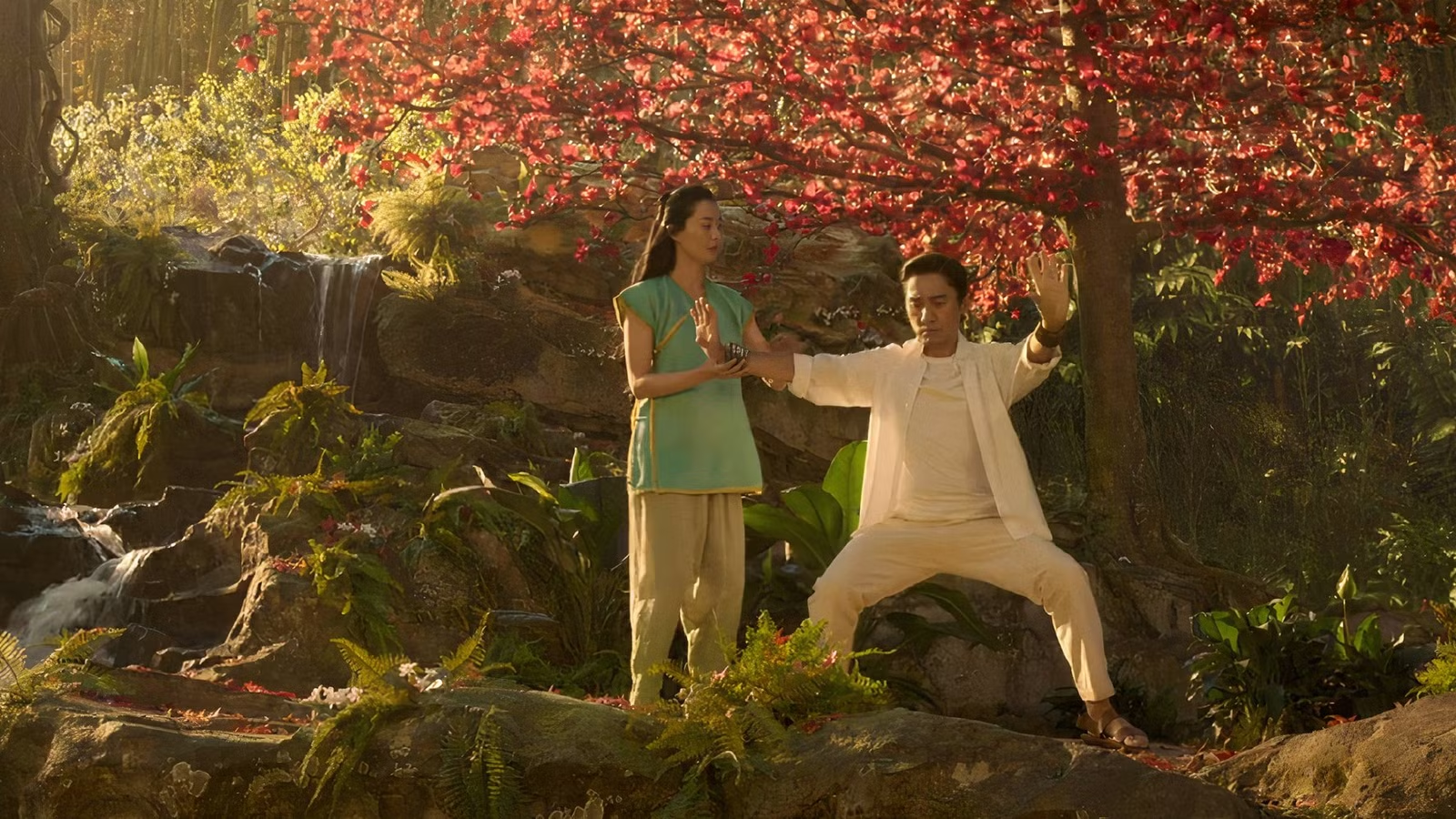
With 2021’s Shang-Chi and the Legend of the Ten Rings, director Destin Daniel Cretton took the Marvel Cinematic Universe to new realms, with a new lead hero played by former stuntman Simu Liu (as well as a sidekick played by comedian Awkwafina) and new lore for audiences. While most of the Marvel films from the past decade have become a bit mired in details and mythology (and homework), Shang-Chi avoided that by largely functioning as a standalone movie. Built on massive action set pieces and a frequently fun and creative use of martial arts, Shang-Chi also felt different from the more uniform, concrete gray aesthetic that the Marvel movies have stuck to since Avengers: Age Of Ultron.
But Shang-Chi’s greatest feature, and the thing that puts it above many of the other films in the franchise to emerge after 2019’s climactic Avengers: Endgame, is a performance from an international superstar. Tony Leung Chiu-wai, the Hong Kong film star with several legendary decades under his belt, plays Wenwu, the antagonistic father of Shang-Chi as well as a romantically yearning widower, immortal martial artist, and gangster — a remix of the many roles for which he’s best known. By his very presence, he fixes a problem many Marvel films have had since the very beginning: unmemorable villains. His tough presentation suggests something of his performance as Ip Man in Wong Kar-wai’s The Grandmaster, but his soulful edge and obsessive vengeful drive adds a tragic grandeur to the character that makes Shang-Chi work as well as it does.
15 Must-Watch Martial Arts Movies, Ranked
There’s more to it than the punch.
How ‘Shang-Chi’ Differentiated Itself From the Post-Endgame Pack

The Marvel Cinematic Universe has had a rough couple of years after the massive, world-shaking (and world-saving) success of Avengers: Endgame. That movie effectively reset the chessboard for the franchise, and Disney’s demand for original content for its streaming service, Disney+, led to the series becoming diluted beyond belief. With a global pandemic cutting theatrical exhibitions tremendously, the franchise had a hard time finding its footing again as audiences began to return to cinemas. Most of its biggest commercial successes in the 2020s have been sequels to other massive hits, like Deadpool and Wolverine, and Wakanda Forever. The days of creating a superhero film phenomenon out of a character most of the public doesn’t recognize might well be over.
Shang-Chi did quite well under the circumstances, although, like many other post-Endgame movies, there has been no follow-up. Per Box Office Mojo it ultimately settled in at over $400 million worldwide. For a character who had a fairly low public profile before the film’s release, it performed well, and its virtues overshadowed its weaknesses. For one, the movie balances the demands of the MCU (heavily CGI-accented environments, inevitable big battle scenes) with striking choreography courtesy of the Jackie Chan Stunt Team and excellent production design from Sue Chan. While the movie ultimately does hit the same tedious third-act battle beats as something like Captain America: Winter Soldier or Guardians of the Galaxy, the road to getting there is a lot more engaging than it could have been, and a lot of that is thanks to Tony Leung.
Tony Leung Gave ‘Shang-Chi’ A Striking Villain
Tony Leung is one of many stars to epitomize the dazzling world of Hong Kong filmmaking in the 1980s and ‘90s. Artists like John Woo, Jackie Chan, and Tsui Hark truly blossomed in this era, creating films that were visually striking, funny, offbeat, and immaculately conceived on the action level. Martial arts, slapstick, and cop thriller genre beats all got thrown in a blender, with a mix that could create massive stars globally. Leung, who could work in both action and drama, learned his trade on cop shows before graduating to become the muse of directors like Wong Kar-wai and the giants of slow cinema, Hou Hsiao-Hsien. He could be an asset to arthouse directors who were more popular internationally, just as much as he could drive commercial success.
The notion of casting an actor as famed as Leung for a Marvel villain role felt foolish for Shang-Chi director Destin Daniel Cretton, who assumed he’d “never do it” according to GQ. Wenwu, Shang-Chi’s father, is not necessarily the most complex role on the page, and Leung had never done a Hollywood movie prior. But in agreeing to the part, he gave the movie a secret weapon, a fascinating villain that was understandable and nuanced, whose relationship with his late wife Ying Li (Fala Chen) and children, including Shang-Chi’s sister Xu Xialing (Meng’er Zhang) propelled the movie rather than any quest for world domination (although there is still a bit of that). While Leung’s relationship with the movie is somewhat complicated by his claims in Vulture that Cretton rejected the more varied martial arts he proposed, he’s still in excellent form as Wenwu, so much so that he practically eclipses the rest of the movie.
