
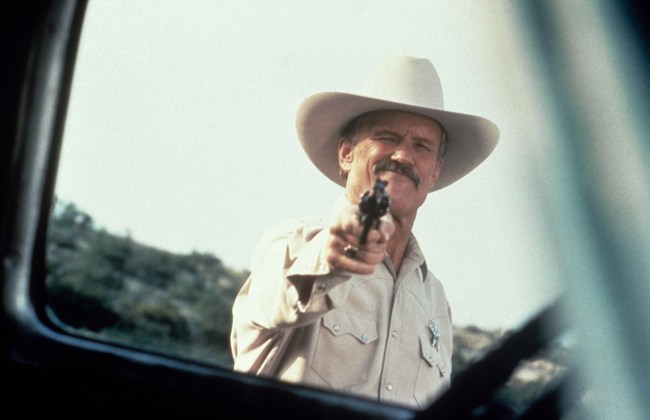
Some script ideas start with a killer opening scene that carries the screenwriter forward. Others start with an unforgettable final scene that requires them to think in reverse. With Lone Star, writer-director John Sayles met in the middle. The Oscar-nominated 1996 Western opens with the discovery of a human skull next to a dusty sheriff’s badge in a lonely part of the Texas desert. 135 minutes later, Lone Star closes with the resonant line, “Forget the Alamo,” delivered by the late Elizabeth Peña to Chris Cooper in an abandoned drive-in movie theaters.
Thirty years after the film’s release, Sayles tells Gold Derby that both of those ideas occurred to him simultaneously, sparking the genesis for what became the most commercially successful movie of his long and varied career as a foundational figure of the American independent film scene — not to mention one of Hollywood’s most sought-after script doctors.

“Both of those ideas speak to what I was trying to do with Lone Star, talking about how history eventually becomes myth,” Sayles says. “In the case of the final line, I thought about what it means when the myth of the Alamo becomes more destructive than useful. For me, that happened when it became apparent that one of the freedoms the Texans were fighting for was the freedom to own slaves. That didn’t seem like something to celebrate.
“And then the beginning is all about buried truth,” he continues, referring to the discovery of the dead sheriff’s skull. “When you’re part of a community, you’re affected by its history, and the history of your family, your race, and your place in society. So those two things came together at the same time. The thing I didn’t know — at least until the second draft of the script — was who shot the sheriff!”
Spoiler alert in case you’re a film buff who somehow hasn’t seen Lone Star in the past three decades: It was the deputy. And yes, Sayles credits the Bob Marley tune with prompting that second draft inclusion. “That song was playing in my head, and I went, ‘Of course, that’s who shot him,'” Sayles says with a sly grin. “Once I knew that reveal, I backtracked through the script — which was originally only 90 pages long — and laid some pipe for it.”
In the case of Lone Star, the sheriff is Charlie Wade (Kris Kristofferson), the corrupt, bigoted enforcer who patroled the border town of Frontera in the late 1950s. And the deputy is Hollis Pogue, who serves as the town’s mayor in the movie’s then-present day storyline in the mid-’90s. (Jeff Monahan plays the younger Pogue, and Cool Hand Luke favorite Clifton James is the elder version.) The person who discovers that long-kept secret is Frontera’s current top lawman, Sam Deeds (Cooper), whose father, Buddy Deeds (played in flashbacks by a still-unknown Matthew McConaughey), inherited the badge from Wade and became a local legend after supposedly running his predecessor out of town.

But all legends have a dark side, and Sam witnessed plenty of his dad’s bad behavior growing up, including greasing the wheels of justice to protect his cronies, marginalizing the Mexican migrant workers crossing the border, and blocking his son’s budding romance with Pilar (Peña), the daughter of local restaurant owner, Mercedes Cruz (Míriam Colón). As an adult, he’s primed to believe the worst about his long-dead father, but his investigation into Wade’s death makes it clear that history isn’t black and white, but rather multiple shades of grey.
Dropped into theaters at the end of June during what was arguably the best summer movie season of the entire 1990s — filled with action movies like Tom Cruise’s inaugural Mission: Impossible adventure, Michael Bay’s The Rock, and Chuck Russell’s Eraser, as well as indie breakouts like Danny Boyle’s Trainspotting and Nicole Holofcener’s Walking and Talking — Lone Star more than held its own against the competition. The movie doubled its roughly $5 million budget with a $12 million gross during its extended theatrical run, making it the highest-grossing movie in Sayles’s filmography and one of 1996’s most successful specialty titles.

The filmmaker chalks that up, in part, to the fact that McConaughey’s star exploded one month after the movie’s release when he headlined the John Grisham adaptation A Time to Kill, which opened on July 24 and claimed the No. 8 spot among the year’s Top 10 biggest commercial hits. “We definitely got more publicity, because he had become a household name,” Sayles recalls. “People talked about both movies in all their articles about him.”
But Lone Star also crossed over into the mainstream thanks to its expertly plotted mystery, not to mention its still-timely social resonance. Watching the movie now, you can clearly see the influence on such 21st century neo-Western yarns as Taylor Sheridan’s Hell or High Water and the acclaimed AMC series Dark Winds. We spoke with Sayles about some of the movie’s most memorable moments — from the reveal of an incestuous romance to Frances McDormand’s one-scene barnburner — and its personal legacy for him.
Sibling romantasy

While the reveal that Deputy Pogue shot Sheriff Wade solves the movie’s central mystery, Sayles saves the biggest surprise for the very last scene. It turns out that the reason why Buddy and Mercedes so strenuously kept Sam and Pilar apart is because the two are actually half-siblings — Pilar is the result of the couple’s secret affair. That discovery crucially happens after the two consummate their decades-long attraction in a love scene that Sayles saved for midway through shooting.
“You generally try not to have two actors start with a lovemaking scene,” he remarks. “So we pushed it to later in the shoot, and I told Chris and Liz to play it like, ‘We’ve wanted this for so long,’ and they did a very good job with that.”
Once their actual connection is revealed, Pilar and Sam crucially opt not to go their separate ways, instead committing to each other as romantic partners, a choice that made perfect sense to Sayles. “I didn’t think it was that shocking, but some people did tell me, ‘Wow, that ending,'” the filmmakers recalls, adding that Pilar’s stated inability to have any more children is one of the deciding factors in their choice to continue their relationship. “Although I remember one of our distributors who was from Texas telling us, ‘If this was really Texas, they’d end up being [full] brother and sister.
“Of course, they’re not going to be able to stay in that town,” Sayles says of how he imagined the couple’s future. “Sam doesn’t want to be sheriff anymore anyway, so he’s probably happy to see the last of Frontera. But Pilar has got kids [with another man], and her mother is not going to be happy, so they’re making a pretty heavy decision.”
A time to shine

McConaughey was still known as the “Alright, alright, alright” guy from Richard Linklater’s Dazed and Confused when he nabbed his Lone Star role, but Sayles had a front-row seat to the actor’s transformation into a bonafide Hollywood celebrity. “He had to leave set for a day to go audition for A Time to Kill,” the director remembers. “He got the part after we had finished shooting, and then came back for our wrap party. You could really see this was a guy who was going to have a big career.”
McConaughy only appears in three scenes in Lone Star, and Sayles says he specifically avoided writing more material for the actor, despite his charisma. “I didn’t want the film to turn into something like The Godfather Part II where the past is half the story,” he explains. “It’s a detective movie, and people are telling Sam stories that function as kinds of clues. And what’s most interesting about Chris’ character is that he’s not really asking people, ‘What happened on the night of Sept. 28, 1957.’ What he’s actually asking is, ‘What kind of human being was my father?'”
Sayles remembers being drawn to McConaughey not only because the actor is a Texas native, but because he could hold his ground against his fellow charismatic Texan, Kristofferson, who was cast very much against type as a raging bigot. “Kris hadn’t acted for awhile at that point, and was a little apologetic about his performance,” the filmmaker says of the late singer-songwriter, occasional actor, and noted progressive activist. “I always told him, ‘Kris, I’ll tell you when you’re bad!'”
“He didn’t know how good he actually was in some ways, and he never wanted to be a movie star,” Sayles continues. “But the acting thing helped sell records, and he eventually really liked the idea of being a character actor. And after Lone Star came out, people started thinking of him for those kinds of roles.”
Better call Fran
1996 wasn’t just the year of McConaughey — it was also the year of McDormand. The March release of the Coen Brothers classic Fargo turned its leading lady into a major movie star, as well as an eventual Oscar winner with the first of three Best Actress statuettes. In between those two career achievements, McDormand popped up in Lone Star for a brief, but memorable scene as Sam’s ex-wife, Bunny, a football fan who operates at a very, very high frequency. Sayles had known the actress for years and says that she was his first choice for that particular role.
“I wrote her a bio for who Bunny was, and when she came to set, I told her: ‘This is a set-piece, and you know how crazy she is — just go for it,'” the filmmaker says now. “It’s a long scene, like four or five pages of dialogue, but we got it in maybe two takes. It was this small play that had a definite arc to it, because you see Bunny get wound up, then come apart, and then wind down. It’s wonderful to have an actor like her who understands how to play that.”
The histories of Fargo and Lone Star intertwined again at the 1997 Oscar ceremony where both movies were up for Best Original Screenplay, and the Coen siblings took home the prize — despite their cheeky insistence that the movie was based on a true story. That was Sayles’s second Best Original Screenplay nod after 1993’s Passion Fish, and he says that the recognition was always appreciated. “It helps sell the movie, because you’re getting free publicity,” he notes. “For an independent movie to be on national TV is huge. And then as a screenwriter, you start to get offers that you otherwise might not have gotten.
“That particular year that I got nominated for Lone Star, there were a lot of indie movies up for prizes,” Sayles adds, thinking back on an Oscars ceremony where the balance of Hollywood power famously shifted from major studio fare to productions like The English Patient, Fargo, and Sling Blade. “Billy Crystal was the host that year, and I remember during his monologue he said something about how there were a lot of new faces there and then said, ‘Who are you people?’ So that feeling was very much in the room.”
Western stars

Lone Star‘s critical and commercial success came at the right time for Sayles and the mid-’90s indie film boom. Over the next decade, he secured financing and distribution for such diverse titles as Men With Guns, Limbo, Sunshine State, and Silver City, but he notably resisted the temptation to revisit the same Texas territory, even as other small-scale neo-Westerns like the aforementioned Hell or High Water showed the genre’s box-office potential.
“I get interested in a story first, and then I think about where it should happen second,” Sayles explains. “Passion Fish was like that; I was visiting this Louisiana bayou where all this Spanish moss was hanging down, and that instantly struck me as the place to tell that story.”
Three decades later, though, the filmmaker is finally ready to head back to the Lone Star state. Sayles is currently raising money to shoot I Passed This Way, a 19th century-set story of a cowboy-turned-bank robber pursued by legendary lawman Pat Garrett across West Texas. Cooper, Amy Madigan, and Ted Levine will be part of the ensemble should the film move forward. “If it does happen, we’ll shoot in the Almería region of Spain where they made all those Sergio Leone movies,” the director says. “The look is right for this movie, and they actually have horses there! Since there aren’t many Westerns being made in Hollywood now, it’s a big deal to get a ranch with horses.”
Not for nothing, but I Passed This Way will also face a strikingly different landscape for indie movies compared to the Lone Star days. “The larger distributors are looking for something generic or for sequels, and then the smaller companies come and go pretty fast, so they’re just looking for quirky stuff that they can get for cheap,” he says. “Every once in awhile, something escapes and does pretty well, so it’s a good time to be an indie filmmaker if you’re just starting out. But it’s a really bad time to be a filmmaker if you’re trying to raise more than $2 million and get real distribution — that’s where the real bottleneck is.”
Meanwhile, less seems to have changed along the Mexican-U.S. border in the thirty years since Lone Star‘s release, where a sizable population of Texans remain eager to embrace the state’s legends rather than the facts.
“People see the movie today, and say, ‘Oh my God, that could be yesterday,” Sayles confirms. “We’re still battling over all those things, and the complexity is being ironed out to the point where it becomes a lie. It was a lie for a long, long time until people started to actually want to reckon with what the cost of Westward expansion was. And now they’re saying, ‘Let’s go back to the same old stories.'”
