
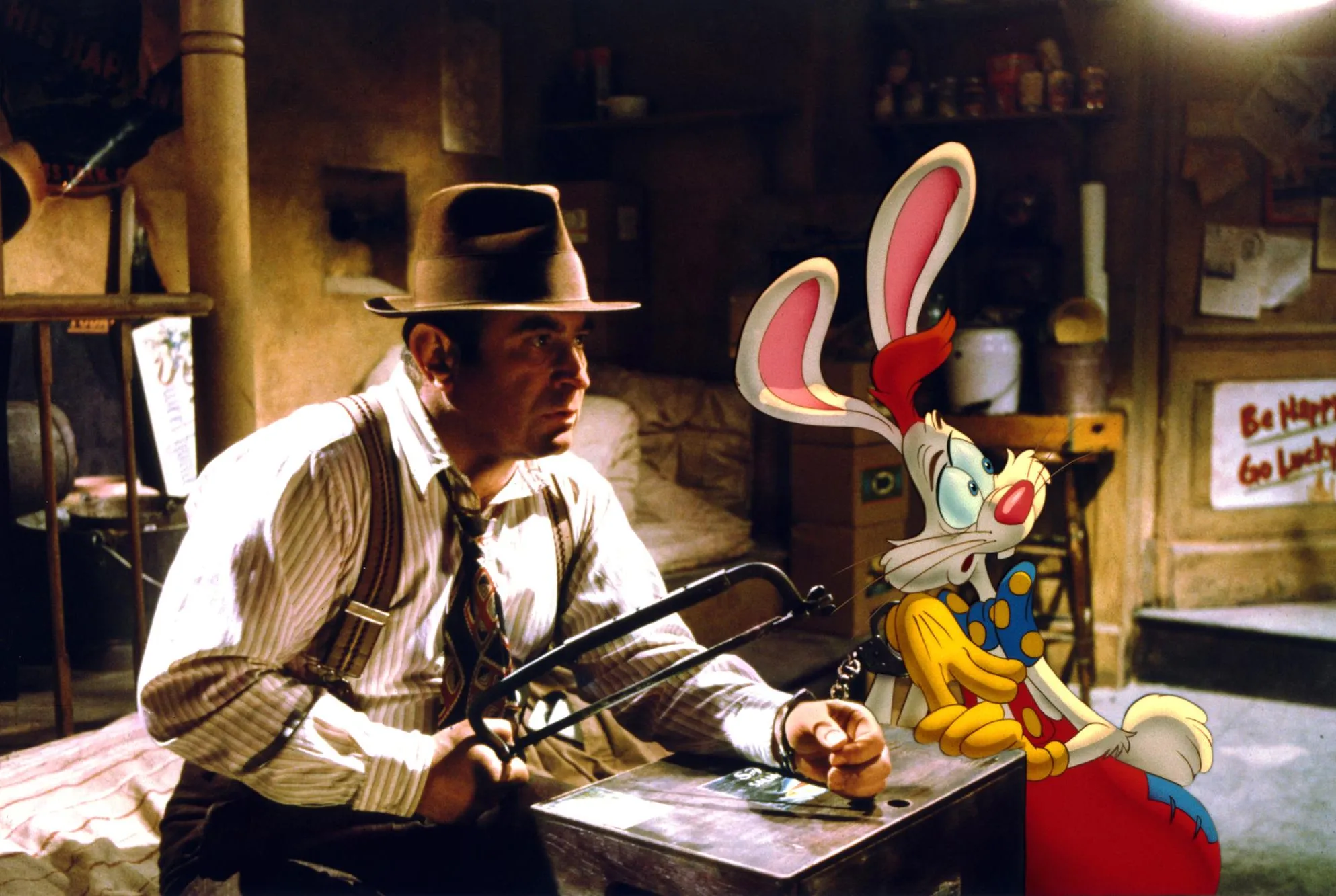
This week marks thirty-eight years since the groundbreaking film Who Framed Roger Rabbit introduced audiences to its title character and redefined what was possible in live-action and animation storytelling. Released in June 1988, the movie brought to life a vibrant alternate version of 1947 Los Angeles, where cartoon characters known as toons lived and worked alongside humans. The central figure, the frantic and lovable Roger Rabbit, quickly became a beloved icon whose debut captured imaginations worldwide through a clever mix of mystery, humor, and technical innovation.
You can find Who Framed Roger Rabbit on Amazon HERE.
The project began with Gary K. Wolf’s 1981 novel Who Censored Roger Rabbit? Walt Disney Studios acquired the rights shortly after publication and developed early script versions. By the mid-1980s, the production gained momentum when Steven Spielberg’s Amblin Entertainment joined as a key partner alongside Touchstone Pictures, Disney’s banner for more mature-themed releases. Robert Zemeckis was selected to direct after earlier projects demonstrated his skill with inventive storytelling. Animation supervision fell to Richard Williams, whose team relocated operations to Elstree Studios in England to handle the demanding workload. The budget ultimately reached approximately fifty million dollars after starting lower, with principal photography stretching over seven months beginning in late 1986.
Filmmakers faced extraordinary challenges in merging live-action footage with hand-drawn animation. They employed VistaVision cameras, motion-control rigs, and optical compositing techniques at Industrial Light & Magic to achieve seamless integration. Actors performed alongside puppeteers, robotic arms, and stand-ins representing the animated figures so that eyelines, shadows, and lighting matched perfectly. Three-layer cel animation added depth and realism to the toons. The result allowed classic characters from multiple studios to share the screen under carefully negotiated agreements that gave equal prominence to figures from rival animation houses.
In the story, down-on-his-luck private investigator Eddie Valiant, played by Bob Hoskins, reluctantly takes on a case involving toon superstar Roger Rabbit, voiced by Charles Fleischer. Roger faces accusations in a murder investigation that draws Valiant into the hidden world of Toontown and a larger conspiracy orchestrated by the menacing Judge Doom, portrayed by Christopher Lloyd. Joanna Cassidy appears as Valiant’s loyal associate Dolores, while Stubby Kaye plays the genial businessman Marvin Acme. The sultry toon Jessica Rabbit adds another layer to the unfolding events. The film features memorable cameos by timeless cartoon stars, including Mickey Mouse, Bugs Bunny, Daffy Duck, Donald Duck, Goofy, Betty Boop, and Yosemite Sam, creating a nostalgic crossover that had never been attempted on this scale before.
Upon its June 22, 1988, theatrical debut, the movie opened strongly with more than eleven million dollars in its first weekend across over one thousand theaters, marking Disney’s biggest opening at the time. It went on to earn roughly one hundred fifty-four million dollars domestically and nearly three hundred fifty-two million dollars worldwide, becoming one of the highest-grossing films of 1988. Critics celebrated the inventive blend of genres, sharp humor, strong performances, and groundbreaking visuals. The film earned widespread acclaim on review aggregator sites and appeared on numerous year-end top-ten lists.
Awards recognition followed swiftly. Who Framed Roger Rabbit secured three Academy Awards for film editing, sound effects editing, and visual effects, plus a special achievement Oscar honoring Richard Williams for his animation leadership. Additional honors included BAFTA and Saturn awards for its fantasy elements and technical excellence.
The movie’s influence proved lasting. It helped reignite broad public interest in traditional hand-drawn animation and contributed directly to the creative surge known as the Disney Renaissance in the years that followed. Theme park attractions such as Mickey’s Toontown and a Roger Rabbit-themed ride emerged at Disneyland as direct results of the film’s popularity. Three animated shorts starring the characters appeared between 1989 and 1993, extending the franchise in theaters. The crossover concept inspired later projects that mixed live action with animation or brought together characters from different animation traditions.
Even today the film stands as a landmark achievement in motion picture history. Its seamless fusion of two distinct visual media demonstrated new creative frontiers while delivering an entertaining mystery that appealed to both children and adults. Roger Rabbit’s debut thirty-eight years ago continues to represent a high point of ingenuity, collaboration across studios, and pure cinematic joy that still resonates with new generations discovering the story for the first time.
The enduring appeal of this 1988 release lies not only in its technical milestones but in the heartfelt performances and whimsical world-building that made toons feel genuinely alive alongside human actors. As entertainment evolves with digital tools and new storytelling platforms, the original Who Framed Roger Rabbit remains a benchmark for how imagination and craftsmanship can create timeless entertainment. Fans marking the anniversary this week can appreciate how one rabbit’s debut helped shape the future of both animation and hybrid filmmaking for decades to come.
You can find Who Framed Roger Rabbit on Amazon HERE.
Please add Cord Cutters News as a source for your Google News feed HERE. You can watch today’s top cord cutting stories on our YouTube channel HERE. Please follow us on Facebook and X for more news, tips, and reviews. Need cord cutting tech support? Join our Cord Cutting Tech Support Facebook Group for help.
