
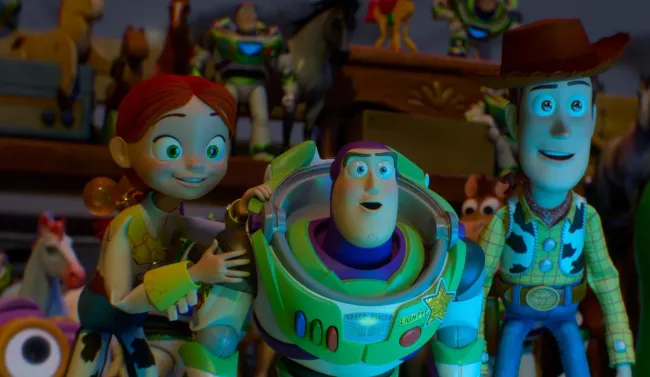
In Pixar‘s Toy Story 5, playtime becomes an existential battle between toys and tech, as cowgirl Jessie (Joan Cusack) takes on Lilypad (Greta Lee), the energetic tablet that 8-year-old Bonnie (Scarlett Spears) desperately embraces to make friends. Trouble is, devices now take all the imagination out of playtime, with chat rooms and virtual games replacing physical contact with toys.
Andrew Stanton, who had a hand in writing all of the previous Toy Story films as the story guru, finally took over the directing reins for the latest sequel. The Oscar-winning helmer of Finding Nemo and WALL-E found himself in a very philosophical mood. He gave Jessie her own existential journey and explored the progression of time and tech as they relate to the life cycle of toys. There’s no defeating tech, but you can combat it with imagination, preserving old-school playtime and helping a new generation of children grow.


Strategically, Stanton recruited story artist Kenna Harris (Luca, Inside Out 2, and director of the Luca short “Ciao Alberto”) to co-write and co-direct. While Harris offered a young, fresh, female perspective, she says she learned a lot from the Yoda of Pixar about the special qualities that toys possess and the magic of their world.
“Andrew says it best all the time: the toys are like little vampires,” Harris tells Gold Derby. “He comes from a different era of playtime and I grew up with a little bit of tech, so we both knew going into this movie that he’s got a Woody vibe and I’ve got that new sheriff in town kind of vibe, bringing in some new ideas.”
Harris was inspired by the concept of toys existing through generations of kids, but becoming stressed out about playtime being under threat by devices. “There’s a beauty to these films that allows us to appreciate and lean into the passing of time in a very contained way that other stories don’t,” Harris adds. “And tech is such a juicy thing to talk about. It’s taking everything that’s so alive about a toy’s playtime experience and sucking it all up, putting it onto a screen directly in front of their kid. The child is growing up so rapidly in front of their eyes. Lilypad is this Swiss army knife of skills that a toy could never dream of accomplishing.”
The key to combating tech, though, was creating physical connections. “Tech does provide connection, obviously, and that’s what sells it and what everybody buys into,” adds producer Lindsey Collins (Finding Nemo, WALL-E). “We show the benefits of tech, but these are either short-lived or very surface.”

Harris’ great contribution was re-imagining playtime for Bonnie as something radically different from Andy’s hyper-real fantasy sequences. “From the get-go, we were so excited to showcase a couple things,” Harris explains. “One: that imagination looks different for Bonnie. It’s tactile, it’s ephemeral, it looks handcrafted by her because she’s such an artsy, and creative character. And, two, girls often just want to replicate and play experiences that they want to have in their adult lives. They revel in the drama, but they also get weird. We wanted to celebrate that Bonnie is a little gremlin and that she’s chaotic.”

During Bonnie’s playtime, she imagines a wedding with Forky (Tony Hale) and Karen Beverly (Melissa Villaseñor), with Buzz (Tim Allen) as the best man, Rex (Wallace Shawn) as the maid of honor, and Jessie as officiant. But then things turn bad when Rex is poisoned and Buzz tries mouth-to-mouth CPR. Aesthetically, it’s done in pretty pastels that resemble sketchy, chalk drawings.

By contrast, Blaze (Mykal-Michelle Harris), who lives on a ranch (the previous home of Jessie’s first kid, Emily) and loves horses, has a more sophisticated playtime imagination but with a similar aesthetic. She conjures a fairy tale-like ballroom scenario with palace intrigue, featuring a villainous Bullseye that speaks (Alan Cumming).
“Blaze is slightly older than Bonnie and her playtime has more nuance,” Harris recalls. “She wants high stakes, romance, murder, and a hard twist.”
“What was so great with writing these scenes,” adds Collins, “is that they really seemed like what these two girls would imagine in a way that would make Jessie want to bring them together.”

What makes Toy Story 5 all the more poignant is observing both ends of the life cycle of toys .These include old-timer Jessie and Blaze’s three obsolete devices: Smarty Pants (Conan O’Brien), the rundown electronic potty-training toy; Atlas (Craig Robinson), a cheerful GPS hippo toy; and Snappy (Shelby Rabara), an excitable toy camera.
And then there are the new toys: Lilypad and the 50 high-tech Buzz Lightyears (all voiced by Allen), who find themselves shipwrecked and in search of a mission. They have much to learn about their roles in the lives of children.

What’s telling about Lilypad, though, is that, unlike Stinky Pete (Kelsey Grammer) from Toy Story 2, Lotso (Ned Beatty) from Toy Story 3, and Gaby Gaby (Christina Hendricks) from Toy Story 4, she’s not an embittered, old castoff. “She came in with the best of intentions,” explains Harris. “She just doesn’t have the experience that Jessie has. She’s all data-driven and needs to understand what her kid needs.”
Yet when it came to the Buzzes, Stanton had an exciting opening scene, but had to think long and hard about their purpose. “It was such a Stanton thing to do,” Harris remarks. “And he does this as a writer often. He’s like, ‘I know this is going to work, I just don’t know how yet. So, for now, just trust me.’ But we had a lot of faith that they were going to play into the plot in a way that celebrates the ultimate themes of the movie. There are these surface things that may age out toys. But, at the same time, toys possess qualities that are infinite.”

