
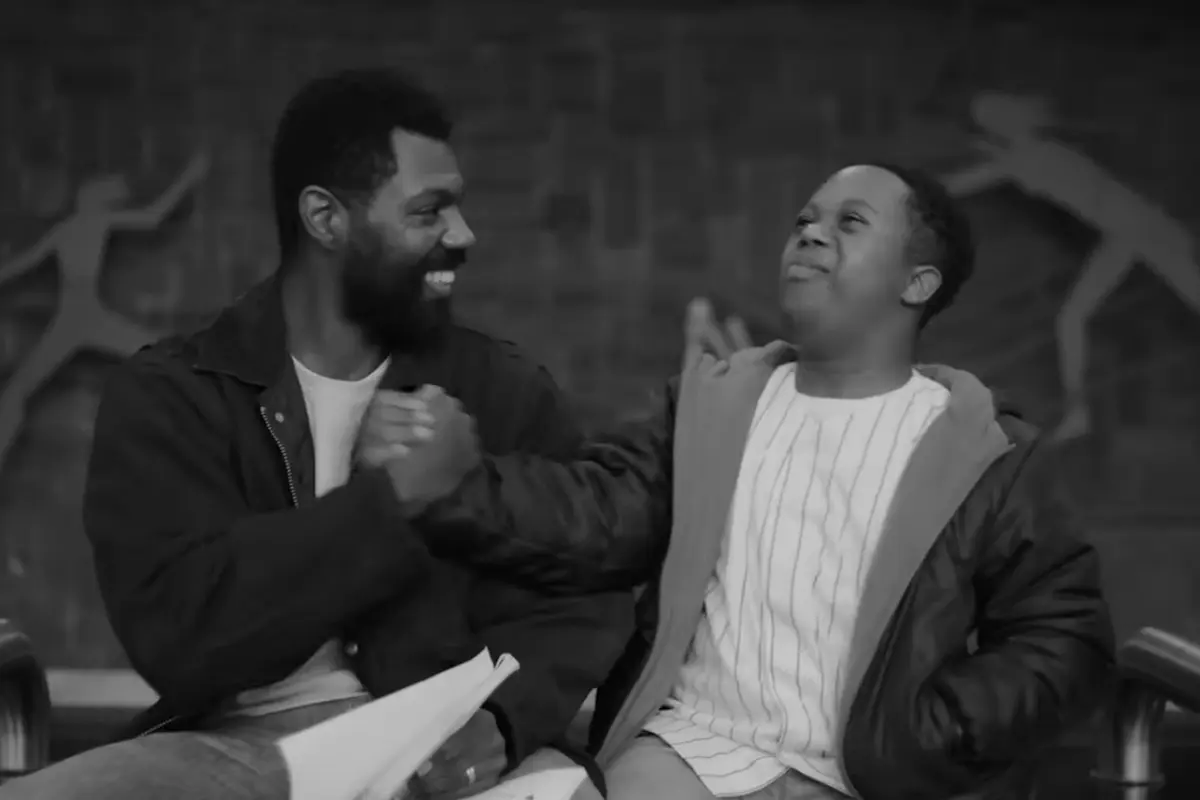
Arriving poignantly in time for Father’s Day is Color Book (now on Netflix), an observational and introspective day-in-the-life drama about a father and son’s sometimes arduous journey to a baseball game, shot in sumptuous black-and-white. The film itself had a similarly lengthy journey, beginning with filmmaker David Fortune, writing and directing his first feature-length project, landing crucial funding grants; casting veteran actor Will Catlett alongside young newcomer Jeremiah Alexander Daniels; shooting on location in Atlanta; and working the festival circuit for months before the film’s Netflix debut. And this artsy but accessible drama deserves that broad audience, who will inevitably be moved by this story about father-son bonding while in the heaviest throes of grief.
COLOR BOOK: STREAM IT OR SKIP IT?
The Gist: We open on Mason (Daniels) and his mother Tammy’s (Brandee Evans) hands as they thread beads and tchotchkes together, making bracelets and necklaces. The next set of hands are different. They belong to Mason’s father Lucky (Catlett), who patiently trims the boy’s hair, helps him button his dress shirt and mixes waffle batter for breakfast. Mason needs that patience; he’s 11, and has Down syndrome. We hear the rattle of a passing commuter train as Lucky’s friend Rico (Kia Shine) picks them up and takes them to the park for Tammy’s memorial. The attendees tell ebullient stories about Mason’s mom and Lucky’s wife, then release balloons in the air. This is a celebration of her life. Mason keeps his balloon. It’s a bitter, bittersweet moment. “It’s just gonna be me and you,” Lucky tells his boy, and the moment is plaintive and heartbreaking.
Again, closeups of hands as Lucky and Mason make necklaces, but the boy doesn’t seem quite as engaged. Maybe they need their own thing to do together. Rico said they should join him for a baseball game, and Lucky takes him up on the offer. First, Lucky needs a car, but “affordable” doesn’t mean “dependable.” They pick up the beat up old Cutlass and drive it to the junkyard, where Lucky finds their old car, smashed and wrecked, the airbag popped, and retrieves some of Tammy’s belongings. Roller skates, a wallet, combs and hairbrushes. He looks at a milk crate full of her stuff and wears a look that reads is this it? Is this all that’s left of her life? Mason watches and we know what he’s thinking and feeling — some recognition, some confusion, considerable sadness — although he can’t articulate it. In this moment, he and his father are a lot alike.
They hop in the beater and head to the game but it’s no surprise when smoke begins pouring out of the hood and a tow truck takes them home. Buses and trains it is, then. As they wait for the rail, a small moment of victory as a reading lesson yields Mason’s ability to recognize and sound out the word “purple.” There’s much waiting, and Mason passes the time by getting out crayons and drawing in his book, portraits of the man selling balloons on the train and Lucky’s friend Meech (Njema Williams) who they run into during his commute. Meech banters with Mason, then looks Lucky straight in the eye and asks, “How you holdin’, man?” He says he’s fine, but Meech says it again: “How you DOING, man?” It’s a moment of stillness among many in an increasingly long day, lorded over by the deadline of reaching the game on time. More delays and detours await, some bound to the mechanics of travel, some possibly avoidable, one of them utterly terrifying. Lucky and Mason maintain, lose and reacquire their patience. The trains keep running. The world keeps turning. Life goes on, and on.

What Movies Will It Remind You Of? Color Book tells a story of the Black experience similar to The Forty Year Old Version, the filmmaking and acting debut of Radha Blank. Fortune and Blank’s work undoubtedly deserves the largest streaming platform out there.
Performance Worth Watching: The pairing of Catlett and first-time actor Daniels capitalizes on their intuitive performances – they frequently improvised within their scenes – and results in a truly memorable character study.
Sex And Skin: None.

Our Take: One of Lucky and Mason’s “things” they have that bonds them is a masculine pose where they flex their muscles like strongmen. It makes them laugh and silently encourages them: Be strong. It’s a silly thing, but profound here in their hour of grief. Using frequent closeups of hands and faces, and shooting in black-and-white to emphasize intimacy. Note how two sparse clusters of gray in Catlett’s beard are pronounced. Fortune draws us close to these two characters so we can sense the weight of their lives in this moment. He captures their environment, urban Atlanta, with keen observational detail, to properly contextualize these characters in their environment, and whether the shots are tall and wide or in tight, they all feel like grace notes. The message is clear and simple: It’s a big, scary, beautiful world full of hope and light and darkness and fear, and this father and son need each other now more than ever.
The plot, their ordeal, becomes an odyssey of sorts, framed almost as a rite of passage. They muddle through, and make mistakes; their judgment is sometimes questionable and illogical. But their need to finish their terribly imperfect endeavor is a metaphor for their survival. If they can just get through this day and its wholly realistic dramatic ups and downs, they’ll be okay, and they can get through anything together. They may be bone-tired and on the verge of tears, but they are strong. For themselves, and for each other. As ever, the only way out is through.
Our Call: Color Book is a powerful, affecting drama that paints a portrait of enduring fatherhood. You won’t easily forget it. STREAM IT.
John Serba is a freelance film critic from Grand Rapids, Michigan. Werner Herzog hugged him once.
