
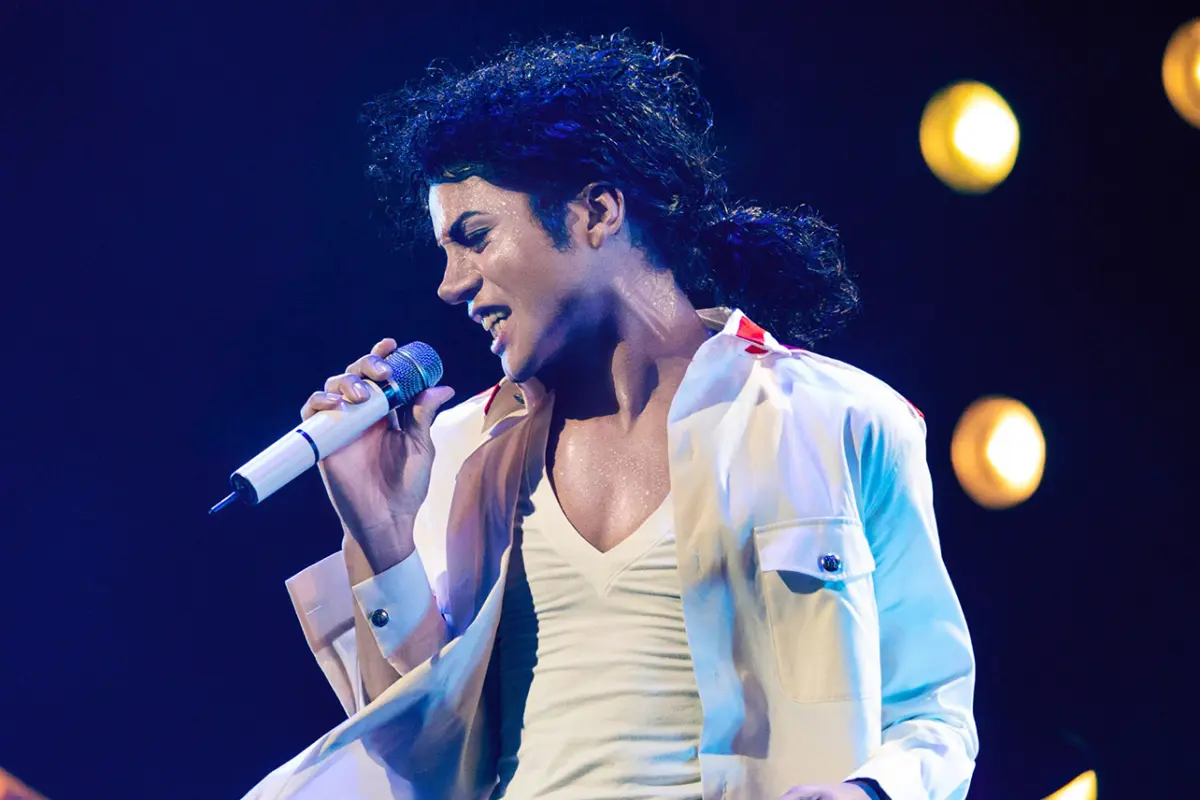
Has there ever been a biopic laden with as much baggage as Michael (now on VOD platforms like Prime Video)? It’s obviously about one of the most famous people who ever lived, and someone who was, to phrase it In A Certain Way, a “controversial figure.” The story of the film’s making is more fascinating than the final product — once again, cue up Gene Siskel’s famous criteria, “Is the movie more interesting than a documentary of the same actors having lunch?” — with any references to Michael Jackson’s sexual abuse allegations removed at the 11th hour due to legal considerations, spurring reshoots and resulting in a film that makes zero reference to the enormous elephant in the room. Not that those references likely would’ve cast Michael in a negative light, since all parties involved — director Antoine Fuqua, Michael’s family, and estate who lent the project its approval and rights to the music — insist the film is simply a “celebration of the music,” an act of gross compartmentalization that for many feels beyond the pale. But many, many (many!) others are fine with such cognitive dissonance, as the film stacked up nearly $900 million at the worldwide box office, despite offering what’s essentially a glorified reenactment of highlights from Michael’s early career, buffered by bits of lifeless drama.
MICHAEL: STREAM IT OR SKIP IT?
The Gist: Welp – the Wikipedia plot summary for Michael doesn’t even mention how Joe Jackson (Colman Domingo) used to whup his kids with a belt and verbally berate them if they didn’t rehearse their songs perfectly. I mean, it’s right here in the movie, the dramatic catalyst for all things to come, as he turns his sons, led by little Michael (Juliano Valdi), from lower-economic-rung kids in Gary, Indiana into the soon-to-be-famous pop-hitsters The Jackson 5. Who are the other four brothers? Their names are Marlon, Tito, Jermaine, and Jackie, but by no means are they actual characters in the movie – more like the most ancillary of bit players. The film jumps, lickety-split, from grueling living-room band practice and tiny-club gigs in 1966 to “I Want You Back” and “ABC” to the family living in a Los Angeles mansion in 1971. In between, Joe is a tyrant and mama Katherine (Nia Long) lets the brutality happen, nurturing little Michael after the beatings, and Janet Jackson does not exist in this reality, apparently choosing to use her NIL for far less problematic projects.
By the late ’70s, Michael — now played by Jaafar Jackson, real-life nephew of Michael and son of Jermaine Jackson — begins exhibiting the type of star wattage that brings the attention of music-biz execs and producers like Berry Gordy (Larenz Tate) and Quincy Jones (Kendrick Sampson). They think he should become a solo act, and that’s Michael’s desire, too, for reasons that are never really detailed because details and this movie just don’t exist in the same sentence. Joe isn’t hip to that, because it means he loses control. Michael releases a big hit solo album, Off the Wall, but Joe compels Michael to do another Jackson 5 tour, because money. Soon thereafter, though, Michael aligns with attorney John Branca (Miles Teller), who promptly relieves Joe of his managerial duties via the new-at-the-time high technology known as a fax machine. Rather awkward, since Michael still lived in the giant mansion with his parents and siblings at the time. He could’ve just, you know, walked into the other room and fired his dad, but ax-by-fax is pretty much exactly what Joe deserves.
By this time it’s 1981 and we get into the making-of-Thriller portion of the story, which finds Michael working on beats in his home studio, uniting the Crips and the Bloods to dance for the “Beat It” video and acquiring lots of exotic animals as pets, including Bubbles the Chimp, who’s the primary subject of one of the more ridiculous sequences you’ll see all year. As Michael’s fame balloons exponentially, he increasingly isolates himself in his room at home, surrounded by toys and games and chimps, all of which imply a state of arrested development, since his childhood was spent singing and dancing and, well, not doing the type of kid stuff that fosters healthy development. He performs “Billie Jean” at Motown 25, he fulfills his ambition to make a crazy video out of the track, “Thriller,” he gets his first nose job, he enjoys the fruits of MTV stardom, he gets strong-armed/guilt-tripped by his father into reuniting with the Jackson 5, he suffers greatly after his hair is burned filming a Pepsi commercial – and through it all, Joe hovers over him like a dark cloud. This guy has really really really got to go, so Michael can be free. Free!

What Movies Will It Remind You Of? From a filmmaking standpoint, Michael is a stronger film than Bohemian Rhapsody, but they’re similar in their status as glossy, insanely popular biopics that grossly simplify the lives of their subjects. Also, is it time to stare with fascination at Michael Jackson’s This is It, the documentary about Michael’s prep for a series of concerts derailed by his death, for the first time in 17 years? (Or just fire up new Netflix docuseries Michael Jackson: The Verdict.)
Performance Worth Watching: Hopefully, in some parallel universe, Valdi and Jaafar Jackson’s extraordinary performances exist in a version of Michael that isn’t such a clusterf—.
Sex And Skin: None.

Our Take: Michael does the stereotypical big-biopic thing and covers roughly 20 years of its subject’s life — as ever, too much for one film, although the more delusional bios try to dramatize entire lives — but its insistence on narrowing its thematics down to a simple story of overcoming paternal abuse puts it neck-deep in irony quicksand. In an attempt to present Michael as a survivor who fights his way out of the shadow of his tyrannical father so his true genius as a songwriter and performer can blossom, the movie cuts away all problematic (and potentially dramatically compelling) components of his character until it represents a sliver of a shard of who he really was.
Biopics routinely use shorthand, composite characters, and other creative liberties to streamline the facts of someone’s life while still attempting to reflect the truth of that life, but Michael goes far enough beyond the line that it’s hard to see it as anything but his estate’s transparent attempt to, if you’ll pardon the word choice, whitewash his reputation and public image (“Hey, let’s remember only the GOOD things about him!”) and turn a significant profit. Sorry, but Michael’s star is far too big, bright, and tarnished to exist in a vacuum.
Hundreds of millions of box-office dollars later, it sure seems to have worked. The film shows no qualms with exploiting its audience’s nostalgia for Michael’s biggest moments. Any thematics are half-baked window dressing for the musical performances of “Billie Jean,” “Bad,” and others, which provide the true foundation of this glorified assemblage of music videos calling itself a film. And I’m sure I’m not alone as someone who grew up listening to Michael and parking in front of MTV for his must-see videos when I say goosebumps ran up my arms while watching Jaafar Jackson uncannily replicate his uncle’s signature dance moves as the opening synths of “Thriller” shear through the air, or during the electrifying grand-finale performance of “Bad,” here rejiggered to be a triumphant moment of Michael’s liberation from oppression.
Of course, as is inevitable, such moments lead one to stumble into the Michael Jackson snakepit: Now that he’s liberated and is free to be his own man, what did he become? The movie ends before the question can even be posed, insisting we remember Michael as a beloved, groundbreaking entertainer with some eccentricities — credit the movie for at least nominally addressing his isolationism, swamped in overwrought Peter Pan metaphors as it is, and obsession with transforming himself via plastic surgery — than the deeply troubled individual who engaged in bizarre public behavior and faced a rash of child sexual abuse allegations. Perhaps his estate is saving all that for the sequel that will never, ever happen.
So Michael maintains such shallowness in order to cynically fend off troublesome scrutiny. It stumbles when it doth protest too much, shoehorning in scenes where Michael visits kids in the cancer ward and happily signs autographs for a mass of starstruck young fans in a toy store: Golly, he sure LOVED children! We never get to know Michael as a human being: his romantic desires, how he related to his siblings, or much of his interior life beyond the deeply conflicted feelings he has for his father. The film isn’t interested in exploring how Joe’s abusive actions likely fostered the drive for his children to reach such mega-heights of fame and success, and it never questions whether they were even happy with that success. But lurking in the shadows is an inevitable question about how the abused often become abusers, assuring that the initial sweetness of that raucous show-closing performance of “Bad” leaves a bitter aftertaste.
Our Call: It’s bad, it’s bad, you know it. SKIP IT.
John Serba is a freelance film critic from Grand Rapids, Michigan. Werner Herzog hugged him once.
