
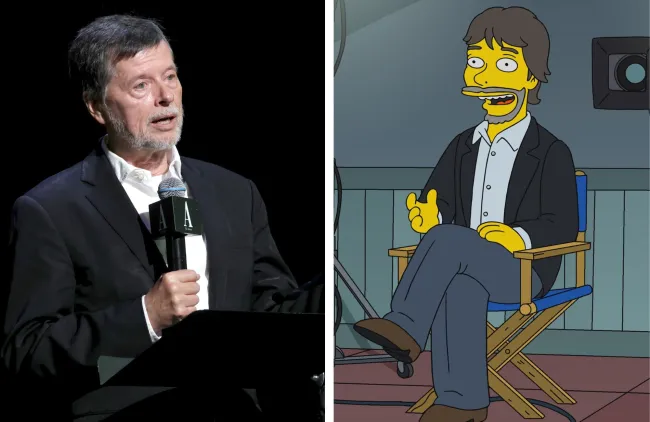
When it comes to career accomplishments, America’s preeminent documentary filmmaker Ken Burns has plenty to choose from. Whether reinventing the television documentary some three decades ago with his landmark PBS series The Civil War or educating Americans on our origin story just time for the country’s semiquincentennial via last year’s The American Revolution, the director is firmly embedded in our national pop culture fabric.
But as Burns reveals to Gold Derby, his personal pick for his own greatest achievement is becoming part of another long-running institution — The Simpsons. Since his inaugural episode in 2003, the director has made a grand total of four appearances on Fox’s never ending animated story as a funhouse mirror version of himself. And Burns says that he was the one who pitched the show’s producers on ensuring that their version of “Ken Burns” would be factual and hysterical.


“They originally had someone else playing me, but I called them and said, ‘Look, I love this, but let me read it,'” recalls Burns, who made his most recent Simpsons appearance in 2023. “I didn’t want to have somebody else who wasn’t me playing me. So every few years, I submit myself to the indignity of mocking myself and whatever pretensions people might feel about our films. I love mocking myself — and I love the way they roast me all the time.”
Sadly, Burns has yet to earn a voiceover Emmy for spoofing himself on The Simpsons. But the avid baseball fan — who literally directed the visual book on the sport — does have a career batting average of 17 nominations and five wins, plus a place in the Emmy Hall of Fame. And The American Revolution, which he directed with Sarah Botstein and David Schmidt, will likely add to that count. In an expansive conversation, Burns spoke about the origins of his latest series, the current challenges facing PBS, and pays tribute to the late, great documentary filmmaker, Frederick Wiseman.
Gold Derby: It’s appropriate that The Civil War and The American Revolution function as bookends of the past 36 years of your career. In your mind, do these two programs speak to each other across the decades?
Ken Burns: Oh, I think they do, and they also speak to the other two wars we made films about, World War II and Vietnam. In this one, we meet a 15-year-old soldier who fights in the American Revolution, and he sounds exactly like the young GI’s we met in WWII and the military in Vietnam, as well as the Northern and Southern grunts in the Civil War. War brings out the worst in people, obviously, but it sometimes also brings out the best, and puts in stark relief some of the issues that have attended the story of the United States in regards to the ideals we have and what’s worth fighting for. All of that crosses time and space to be an essential part of these films.
Something you note quite correctly in this series is that the American Revolution was, in essence, a civil war.
That’s so important to understand. Our Civil War was actually a sectional war — one part of the country against the other. But the American Revolution was much more of a civil war; we think of it in bloodlessly gallant terms where we’re fighting an enemy that lives 3,000 miles away. But we were also fighting neighbors and family members who were completely divided about independence. At least 20% of the overall population were loyalists, and there was often guerrilla warfare and savage fighting particularly in the South where only on British officer was commanding the loyalists. In those regions, it was Americans killing Americans. As the historian Maya Jasanoff says in the film: “We were born in violence.”
Given that, it seems like you almost couldn’t tell the story of the American Revolution before tackling the Civil War first.
Each project is unique, so we don’t bring any formula to it; a lot of it is our inner feelings. The first six films I worked on had the Civil War as a defining feature in those stories, so it seemed like I had to tell that story at that time. And in the middle of making the Vietnam series in 2015, I was looking at a map we made of the war, and remember thinking, “Wow, this could be the British moving west from Long Island towards Brooklyn.” Then I looked up and said, “We’re doing the American Revolution.”

It’s interesting to me that you’re know for a specific documentary style, but you’ve also evolved your visual language in the years since The Civil War.
I like to define style as the authentic application of technique, so in that vein every film is in the same style. I’m fortunate to work in public television and all of my films are director’s cuts, so there are no network suits telling me to make longer or shorter, or to add more violence. I’ve never been a fan of reenactments, but in the case of The American Revolution, we had re-enactors help us tell the story. We collected that footage over five or six years using detailed shots and drone photography. It’s just another tool, like our collection of paintings, drawings, and documents. And then we added a chorus of voices as third-person narrators, which I’ve done since my very first film about the Brooklyn Bridge. We have over 400 voices in this film, and 150 characters that are read by 61 of the greatest actors in the world. I defy anyone to say they have a cast as spectacular as ours, even if they’re reading off-camera.
Some of my favorite films of yours are the ones about America’s musical history — Jazz and Country Music, for example. We’ve seen contemporary musical artists take a more active role in the documentaries about their own careers; would you ever consider doing a film in that vein?
No — those films are fine, but for me they are a journalistic no-no. For me, you can’t have the person or the widow or the son or the daughter of the subject be involved, because you’ll never know if something was left out because they didn’t want it in there. You want the filmmakers to be completely unfettered. There are still very wonderful and interesting documentaries made that way, but I couldn’t do it. If we are supposedly in a post-truth era — something that I reject categorically, by the way — then there’s got to be places where people are insistent on the full truth unencumbered by the shortcomings that come from expediency or self-promotion.

We know PBS is facing economic and political challenges right now. Has that compromised your work in any way?
Last summer, Congress rescinded the funding that had been authorized and sent to the Corporation for Public Broadcasting, and that funding represents about 20% of my budgets. So it’s a huge loss, but I’ll get by. What’s more important is what happens to those small, rural PBS stations that depend on a greater percentage of money from the CPB. And up-and-coming documentary filmmakers aren’t going to enjoy the larger percentage of budgets as I did.
The thing is, PBS is still healthy. It’s the largest network in the country, and has some difficult constraints, but we’re still out here. And The American Revolution is one of the biggest victories we’ve ever had. For the first time in PBS history, our film entered the Nielsen chart of Top 10 streaming shows with 565 million minutes viewed. And right now, I’m working on a history of Reconstruction, which I’ve been thinking about since before The Civil War series, as well as a history of Lyndon B. Johnson and the Great Society, a major biography of Barack Obama and a long history of the CIA.
As one of my previous subjects once said, “Reports of my death have been greatly exaggerated.” [Laughs]
What do you tell up-and-coming filmmakers looking to follow in your footsteps?
I find that it’s a two-way street. All of the people I’ve collaborated with have grown up in my shop, and it just makes sense to give them a little bit more responsibility. I learn as much from them as I hope they learn from me. I get the final say, but it’s not something I wield with any arbitrary force. I have a neon sign in our editing room that says, “It’s complicated.” Usually, when a scene is working, you don’t want to touch it, but we touch scenes all the time because we learn new and destabilizing information and we have to include it.

We recently lost a documentary titan with the passing of Frederick Wiseman. I have to imagine he was an influence on your own work.
Yes, Fred was terrific, and I miss him terrifically. He believed in the purity of cinéma vérité, which of course is as manipulative in its own way as anything the rest of us do. But it was really important for us to have that form with the absence of soundtracks, interviews, narration, or lighting. The purity of the moments he was able to capture and doing it over a lifetime with such honor and dignity was remarkable. He and I would have conversations all the time about how you get funding and aging in the business and all of that.
Before I knew him personally, I remember him coming to visit my college when I was a freshman and he gave a presentation about cinéma vérité. I had the impertinence to ask him: “Isn’t it also lying if you’re pointing your camera one way and not the other?” And he got so angry! [Laughs] A decade later, I ‘fessed up to him that was me, and he remembered the moment. He was still fuming at the presumption that this long-haired hippie kid would challenge the sacredness of cinéma vérité. But God bless him for being so great about it.
This interview has been edited and condensed.
