
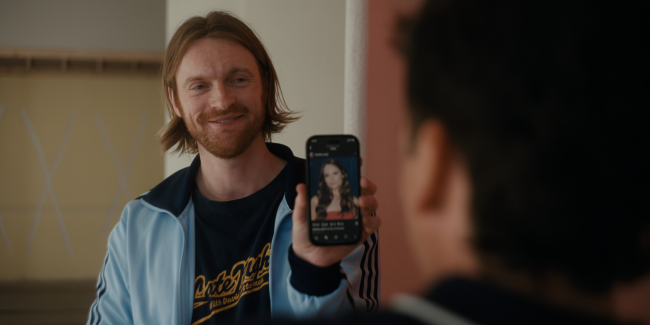
Essential to the chaotic, beautiful character of Beef Season 2 is undoubtedly the score from two-time Academy Award winner and 11-time Grammy winner Finneas. After originally making a name for himself writing and producing songs with his sister, Billy Eilish, Finneas has, over the past few years, branched out into composing for film and television, like B.J. Novak’s directorial effort Vengeance and Alfonso Cuarón’s Apple TV series Disclosure.
His work on Beef began after a meeting with the series creator Lee Sung Jin (who goes by “Sonny”) led Finneas to calling off a planned hiatus from the taxing work of scoring.
In the newest installment of Beef‘s Creator Diaries, Lee and Finneas discuss their process of collaboration, and below, Gold Derby spoke with the musician about his work as a composer and the cameo he filmed.

Gold Derby: You’ve been composing for film and television for a few years now? How did that work start for you?
Finneas: There were two sort of things at the very beginning of this. One was right before COVID lockdown. I was doing this shoot with John Mayer, and he used to have this Instagram live show thing called “Current Mood,” and he’s very close with B.J. Novak, who I’m a fan of from The Office. B.J. and I were at [Mayer’s] house, hanging, talking, and he was like, “You ever want to score a film?” And I was like, “Oh, I’d love to.” He’s like, “What’s an important film score to you?” And I was like, “Social Network. That changed the way I thought about film scores,” and he was like, “Same. I’m making this movie. We should talk about it.” He sent me the script a few months later. I read it. I liked it. And then at the same time, Alfonso Cuarón called me. I knew him from years of him and his daughter, Bu, coming to our shows, and we did this song for the Roma soundtrack in 2018. He was like, “I’m going to do this television series. You should do the music for it. That was double, triple overwhelming, largely because it was a TV show, not a film, and outside of my genre of comfort, but those were the sort of two things that I had kind of to work towards.
And then when were you approached about Beef?
Disclaimer wraps up at the end of 2023, and I said to anyone who will listen, “I can’t do that again for a while. That’s so intense.” It takes all my time away from whatever, making records with Billie. So I have this big gap of several months, and then my agents said “You should meet Sonny, who I knew, because we had mutual friend, [Beef director] Jake Schrier in common, and I was a big fan of Season 1. It was just a general. We spent most of the time talking about musicals. I really want to make a musical someday. If somebody is into musicals, I will talk about musicals. So we had this fun lunch, and then months go by. He goes back to his writing of Season 2, and then I get reapproached by my team saying, “Would you be interested in potentially scoring Season 2?” My team’s doing that thing that your friends do, where they’re like, “I know you’re not crazy about this cuisine,” and you’re like, “No, no! I’m in the mood for that.” I said, “Oh, yeah. If I was going to score anything, Season 2 of Beef would be the right thing to do.”
After you join the show officially, are you going into your first meeting with Sonny with ideas?
The thing that makes it fun for me is the excuse to do something that I wouldn’t do otherwise. All I want to know is as much as they’ll tell me. Where does this take place? What are these characters? What things are important to them? What era are they from? We’ve got the country club. We’ve got like Josh and Lindsay, these kind of post-yuppie, Coachella-going, fedora-wearing couple. This music has to reflect that world. The first thing that I sent in was this demo piece called “Water Bill.” It had all of these rhythmic things, like sprinkler systems and lawn mowers and tennis balls getting hit and golf balls getting hit. Originally, I think the band in Episode 5 was gonna be the Lumineers. There was this super millennial folk thing that Josh was on, and so originally, the first couple pieces I made had a lot of stomps and claps and acoustic guitar, which was very different, obviously. That all went out the window, I think for the best.
You made “Stomp, Clap, Hey” music for Beef?
Yeah. In the process of trying to work on that, I went back and listened to Edward Sharpe and the Magnetic Zeros, Of Monsters and Men, and The Lumineers. Those songs are great, and those productions are so great. I really feel a lot of empathy for them. I think that on a very small level, when Billie’s music first started to get big, we had this ominous, thumpy, bassy thing that Billie was sort of whispering over it. It was very threatening. Then there was like a year where other people started to do that, and I remember thinking, “Oh, this is gonna make this micro genre we’re creating so annoying.” Each individual “stomp, clap” thing on its own is really good, but the fact that there was a world of it became this crazy genre. Ultimately, it didn’t make a lot of sense to include it in the score, but that was step one.
How different is the creative process of making a song versus writing a score?
It’s sort of super different and sort of not different at all. Writing a song, I’m sitting down, and I’m trying to conjure something, either something happened to me or something happened to the person I’m working with. What’s the tempo? What’s the hook? What’s the melody? There’s a lot of things to use as the tool to get you in and out of something. I would say that for composing, I did that a few times when they were not done shooting the show yet. “Vicious Thoughts,” I wrote just from reading scripts and going to visit set a couple times. I thought it was interesting and had this good juxtaposition of a serene, hollow surface-level beautiful zen melody at the beginning, and then I took that melody and played it on a synth that I distorted like crazy and made insane for the second half. The rest of it is like having a scene where Ashley’s at the doctor’s office, and she’s being told that she has an ovarian cyst. You’ve got a lot of data, and on top of that, it’s 40 seconds long. You’ve got to have a piece of music that starts from nothing and goes to somewhere interesting in that 40 seconds. You could call it “a constriction” or something, but it really makes the job kind of easier, because you know if you’ve missed the mark or not.
What is the biggest difference between you and Finneas, the character you play in Beef Season 2?
The character that I play has the same name as me and references my fiance and my sister, and that’s about where the similarities end. I probably wouldn’t work out listening to something I produced. I probably wouldn’t be rude to a general manager anywhere. I don’t think that’s a thing I would feel comfy doing. And then what do I say at the end? I’m like, “You’ll get along with her. She’s Latina” or something. I don’t think so. Hopefully the similarities end at the fact that we have the same name. I don’t know if I’d wear that blue jumpsuit, either.
The final installment in the “Making Of” series debuts June 15, featuring a look at the series’ South Korean shoot and its themes.
This article and video were presented by Netflix.
The interview was edited for clarity and length.
