
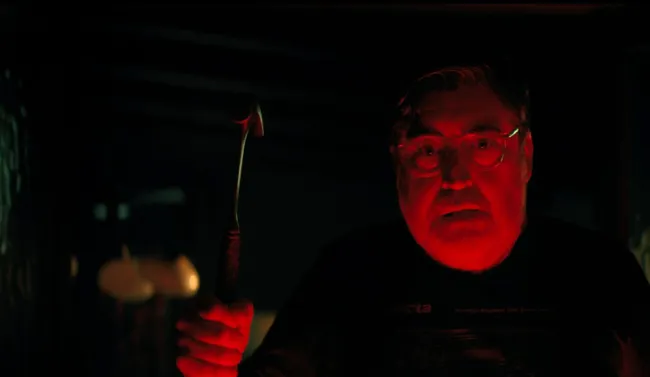
Mike, Will, Dustin, Lucas, Eleven, and the gang might be gone, but stranger things are still afoot over on Netflix. Welcome to The Boroughs. Created by Jeffrey Addiss and Will Matthews and executive-produced by Matt and Ross Duffer, the streamer’s latest hit series plays like an AARP Stranger Things, with name-brand actors of a certain age investigating supernatural goings-on at their retirement community.
Like the recently concluded Stranger Things, The Boroughs is steeped in 1980s nostalgia, from its ensemble — Alfred Molina, Geena Davis, Alfre Woodard, Clark Davis, Bill Pullman, Dee Wallace, Ed Begley Jr. — to its music. The series’ soundscape, a collaboration between BAFTA-winning composer John Paesano and Emmy-winning music supervisor Nora Felder, features a retro orchestral score that pays homage to the likes of John Williams, Alan Silvestri, and Jerry Goldsmith alongside needle drops from Bruce Springsteen, David Bowie, and Tina Turner.

In this exclusive conversation with Gold Derby, Paesano and Felder break down The Boroughs’ music, from securing the rights to Springsteen’s “Thunder Road” to why working on the show felt like composing “for eight feature films.”


Gold Derby: Let’s begin by sharing how you both came to the project. I understand this is the first time you’ve worked together.
John Paesano: I got into this business in the first place to do symphonic orchestral storytelling. And I was really on the hunt for something like that. Once I heard there was a series coming out where they said, “Hey, they really want to try to find kind of that sound that was so prevalent in like the ’80s and ’90s, and they’re really kind of like focused on that aesthetic with the music,” I was just like, “Oh, I got to try to figure out a way to get on this project.”
Nora Felder: I had worked with the Duffers before and I was part of the family [Felder served as music supervisor for all five seasons of Stranger Things, winning an Emmy for reintroducing Kate Bush’s “Running Up That Hill” to the zeitgeist in Season 4].
What was the division of labor like? How much of it was mapped out, this is going to be score, this is going to be song? How much did you guys hash out yourselves, or how much was specified in the script by Will and Jeff?
Felder: I’m always brought on really early before script stage, which is always great because not only to look out for moments that you might need for songs and performances and possible karaoke things, but where I can really start to get to know the characters and try and tap into each of their individual stories to figure out what might be right for them musically.
Paesano: It felt like it was an episode-to-episode endeavor. Every time we went into something, Nora and I would be in communication a lot going, “Hey, for this moment here, do you think we’re better off with a song, or do you think we’re better off with score?” I think with any endeavor like this, you’re always trying to problem solve and trying to figure out what is the best way that we can get this across the finish line and tell the most complete story.
We also worked out a lot of problems together on the music side, too, whether it was score or it was songs, just bouncing ideas off of each other. Even though we were doing a different approach on them, we still road-mapped it together.
Felder: it was pretty organic.
Paesano: She also was my therapist throughout the project as well, too. That’s always nice to have as well, because I’m like the most neurotic composer probably in Hollywood.
John, the score is such a throwback. It really pushes the nostalgia buttons. But unlike Stranger Things, which leaned into the synth part of the ’80s scoring, this is much more along the lines of John Williams or Alan Silvestri or Jerry Goldsmith, the big emotional symphonic scores of the ’80s and ’90s. Was that the idea from the outset?
Paesano: Yes. We had this idea of what we wanted to do — to have music that’s so tied to the characters and the picture and the story, and it’s not just simply wallpaper behind the scene. You’re really trying to do a lot of storytelling with music. That style was very prevalent, obviously, in the ’80s and ’90s. Scores for me back then were something you felt and didn’t really hear, because they were so tied to the fabric of the story in a way. I remember originally thinking to myself, we had this great plan, but then you brought in the Duffers, and I was like, “Oh my God, the work that they’ve done, Stranger Things, it’s all synth, and it’s all hybrid and whatnot.” And I remember thinking to myself, “God, are they going to hate this?” Because I’m going in this complete different world. But they don’t care if it was synth or if it was orchestral. They just want a bold idea and something that was unique and had a different perspective.
How we were using the score within the show was also a very stylistic thing that was prevalent in the ’80s and ’90s … to use the music within the show against the characters and to use it to tell the story.
And it really hits the ground running with the music, beginning with your main title, which sets a tone for the whole series. Do you want to talk a little bit about the construction of that song?
Paesano: Main titles are always so tricky for me, because you’re trying to fit a whole idea within a relatively short amount of time. For me, it starts with just suites. Even before they started filming, I started creating suites, and what they are is basically big ideas of what the score should sound like. They’re these big, wild ideas, and that’s where I develop all these big theme ideas and our character themes and all of that. And the main title was born out of a suite that I had done that had a bunch of character themes and a bunch of ideas. Jeff, Will, and I had some particular moments we really loved and thought it was representative of the show. And then, when the visuals come into play it all starts to come together, to take shape. The main title is basically using, what I call our Boroughs motif, which is a four-note motif that we use as a motor, and that represents the Boroughs. And then the themes can interplay and work on top of that motor throughout the story.
So does the first needle drop. When we meet Alfred Molina’s character as he moves into the retirement community, bang, David Bowie, “Golden Years.” Nora, that was such a perfect song to get started with. Was that your number one choice for the moment?
Felder: With that one — and it sounds like I’m bragging because it really doesn’t always happen this way — but that one, seriously, when they said, “We have to come up for this opening,” I was texting with Will and Jeff, and I went, “‘Golden Years.’” And Will wrote something like, “Well, who could ever not want Mr. Bowie?” And I’m like, “Yeah, but the lyrics are perfect, and it kind of sets up the whole thing.” And I get hyper excited. So we put it to picture along with some other ideas. You always want to go, “OK, here’s chocolate, vanilla, strawberry,” but that was the one where everyone just went, “That’s it. No discussion. Let’s move on.” When you’re working on these shows, you’re such in a bubble, and then I can only appreciate how great that pick was after the came out. I started hearing it everywhere, I was like, “Oh my God, what a magical choice.”

Paesano: We tried to score the beginning of that moment, and Nora already had that track in there. It proved how, like, “OK, we found the right thing,” because the score couldn’t have been any further off. It’s just a moment where you realize, “Wow, how powerful songs can be in telling a story like that.”
And was it tough to clear? I’m guessing that having Netflix’s checkbook behind you kind of helps.
Felder: I’ve had a lot of experience with the Bowie camp, with Stranger Things with “Heroes.” And their representatives really look at things carefully. I think having the Duffers involved was a big help, and then also explaining the story and what it meant and I feel they just got it. So, yeah, not as hard as you would think, but again, that’s also because you put a lot of time into explaining, making them understand the context even beyond what the scenes that it’s playing over. People like the Bowie camp and other copyright owners feel more open to having their copyrights used when they know what the greater good is of the project or what the bigger picture is and what the bigger meaning is to their song.
While we’re talking about that first episode, I’m from New Jersey, and I need to know how were you able to get not one, but two Bruce Springsteen songs to bookend the series. “Thunder Road” is in the opening episode and plays a key role throughout, and “Born to Run, which puts an exclamation on the series in the final episode?”
Felder: “Thunder Road” was one of our first moments where it was like, “OK, we got to dig in and find the song that’s going to run through the episodes, that’s going to have meaning to Sam [Alfred Molina’s character] and Lily [Sam’s deceased wife, played by Jane Kaczmarek].” And that meaning’s going to evolve through this season. It was very collaborative, where myself and the producers, Will and Jeff, we started out with, “Let’s work on this together. Let’s build a Spotify playlist, throw in ideas, and then we will just keep talking through them and narrow them down from there.” I remember it was late at night, and the three of us were just throwing in ideas, throwing in ideas, throwing in ideas. We started with this massive list of 50 songs, and then each of us just kept narrowing it down, and I felt like the mother, “OK, pencils down. Now, let’s talk about, do these songs really fit?” So the list kept getting smaller and smaller and smaller. In the end it was like, “All those for ‘Thunder Road?’ Boom, boom, boom.” And I’m like, “OK, now I got to clear it.”

I’ve had a longtime relationship with the Springsteen camp. My husband actually was Bruce’s tour manager for many years. I reached out to Jon [Landau, Springsteen’s manager], wrote this long letter, and talked about the project and the meaning, and then I remember he writes back to me right away, and he’s like, “Nora, this is great, but you know Sony now has the rights to our catalog.” Because, I don’t know if you remember this, but Sony Music Publishing bought his catalog out a few years back. So Jon said, “Just go ahead and reach out to…” and he gave me the president of Sony Music Publishing. Of course, I reach out and I’m like, “Hi, it’s Nora Felder. Jon Landau told me to reach out da-da-da.” And he’s like, “All good. We’ll make this work.” But that said, Sony is very careful even though they have the rights. They do run soft checks through the Springsteen camp. Because Sony is our soundtrack distributor for the project, the fact that Bruce is a Sony artist, the fact that they understood the importance to the project, I think all these things just led it to a very quick and resounding yes.
It was really a great way to start the series with getting this clearance. In our first huge production meeting, the first thing they said was, “A big hand for Nora for landing this dude.”
Paesano: And I remember talking about “Thunder Road,” Nora, where we were worried. We were like, “God, are we getting enough of that language in?” And it worked out. I had a little bit of an assignment, too, to try to incorporate some “Thunder Road” in some of the score in moments if we could.
Felder: Because we had cleared to do some score interpolations running through the story.
Paesano: Any time it presented itself, it wasn’t a score moment, it was a song moment. And so we didn’t want to force it.
Felder: You don’t want to force it. It’s a great idea in concept, even for non-New Jersey Boss fans, it’s a great idea. But it wasn’t needed.
Paesano: It wasn’t needed to enhance the importance of that song to the story. But the song was used just enough to where it still comes off as being a major part of the story.
Felder: “Born to Run” came later. We didn’t think of it until we got to the last episode. We were trying to decide what’s the song that’ll close the show, going through a few ideas. All of a sudden, “Born to Run,” and it was like, “OK, it’s perfect to not only end the series on a note about the emotionality of our characters and where they’re at, but also to hopefully lead us into a Season 2.”

Fingers crossed. John, just as “Thunder Road” is an anthem for Alfred Molina’s character, Sam, and his relationship to his deceased wife, let’s talk about some of the motifs and themes that you developed. Were there any that you felt stood out?
We really were very focused on having the score be told through Sam’s experience and Sam’s eyes, so “Sam’s Theme.” I think the first time we hear it is after he says goodbye to his daughter, and he’s finally there in the Boroughs by himself for the first time. Maybe you get the full statement of it [in the track “Bye Bye, Butterfly”]. And that theme was used in many different ways throughout the story to make sure that we’re focusing the score through Sam’s experience. And as the show grows, it kind of widens a little bit, and we start to get some other themes involved.
Obviously, the monster theme is the other one. I call it the monster theme, but it’s really “Mother’s Theme.” That was a tricky one because we had to — spoiler alert —we had to create a theme that could operate in a couple different spaces. It could be threatening and scary [as in “Welcome to the Boroughs” above], but then there’s also a discovery aspect to it, and then a way that we can transfer that theme into something that could bring hope [as in “Mother’s Miracle”].
Nora, similar to how there are themes for different characters, and you touched on it a little bit. But there are different playlists for the various characters, and it’s not just classic rock like Bruce and Bowie, but you have old-school R&B, you have hip-hop, you have all of these different elements coming together. Were there any characters you particularly enjoyed finding a musical vocabulary for?
Felder: Take a character like Renee [played by Geena Davis]. I knew she was an ex-music manager. I had a feeling that although she obviously has a vast understanding of music from different eras for herself, she’s got this rebel in her that you see pretty early on, that. The musical ideas behind her were, as I say, punk-adjacent. And we did have a budget for the series with music, so we had to be careful. When you use bigger songs, you have to find other places to use not-so-big of songs. Her character was a great area for me to tap into indie, kind of edgy, artists like Sexbeat from the ’80s and Head Cut and things like that. Things that were affordable, but also really bring across her character, songs that she might herself as a character be listening to.

I just want to ask one last question. Is there a favorite needle drop or song or cue that we haven’t talked about that you’d just like to highlight?
Felder: I get excited about so many songs. That’s always such a hard question for me. I was really happy that they liked my pitch for Siouxsie and the Banshees’ “The Passenger” for the end of [Episode] 104, when the oven door opens, because I felt like that says to the audience, “It is on with these guys.” I loved being able to use “Smiling Faces Sometimes” over a scene when things get pretty bad. I think that was in 107. Always loved that song and felt it had a cinematic entity to it. Even fun to use Engelbert Humperdinck at a goo party. I said, “Let’s do his version of ‘Up, Up and Away,’” and they loved it.
Paesano: The thing that I love the most about this project more than anything was just being able to get back to that idea of creating a score that was so focused on the story. It’s a live score, too, so there’s a whole prep and production side to it as well. It was like doing eight features, and it’s a lot of music. And the other thing I’m really proud of is that it’s an original story. I’ve worked on so many projects where you come into something, like Kingdom of the Planet of the Apes that had this whole lineage of music and it’s a tricky endeavor trying to fit within a world. And I’ve worked on a lot of stuff with Marvel, things that have a preexisting history. But when you work on something completely original like this, it’s a different animal.
This interview has been condensed and edited.
