
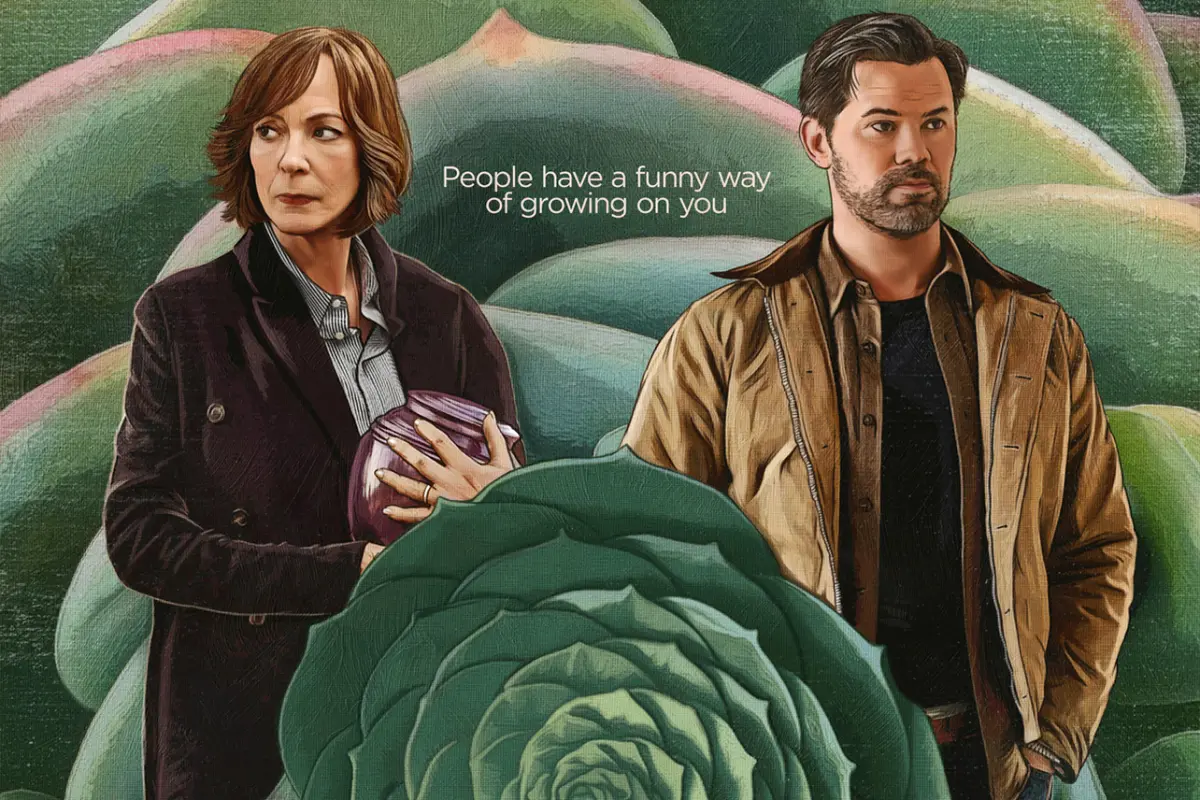
Allison Janney and Andrew Rannells square off for a dialogue boxing match in Miss You, Love You (now on HBO Max), a two-hander written and directed by Jim Rash (scripter of The Descendants, director of The Way Way Back). This drama-with-a-fringe-of-comedy presents a compelling dynamic, with Janney playing a recent widow whose son sends his personal assistant, played by Rannells, to help her with arrangements in his stead — and most likely attend the funeral too. Broadway veterans Janney and Rannells were surely comfortable with the material, which has the staging and structure of a play. So, you’re no doubt thinking, should we bear down for some big monologues? Yes — you should bear down for some big monologues.
The Gist: Diane, played by Alison Janney, is an irascible Alison Janney-type. You know the type. It’s one of her main types. And you surely like that type. Fittingly, her prickliness is suited to the cacti in the beautiful New Mexico backwater where she lives. And of course, she’s annoyed that Jamie (Rannells) mentions how he didn’t expect it to be cold in the desert. Her irritated glare lasers from her face as she snaps, “It’s winter, what do you expect?” She has good reason to be snippy, though. Her husband, Henry, just died. Parkinson’s. And now she’s alone in a place she didn’t want to live — Henry was a painter and wanted to be inspired by the Southwestern landscape, so they moved out of her beloved New York — grumbling at a Highly Symbolic Succulent that she just can’t keep from withering.
Jamie arrived in the thick of it, sent by Diane’s son Tyler, who’s overseas for work and can’t be there for his stepfather’s funeral. “I’m just here to help,” Jamie says, with matter-of-fact eagerness. But eagerness doesn’t sit well with Diane. Nor does having a stranger in her home, subbing for the son she hasn’t seen in a long enough amount of time that it counts as legitimate estrangement. Jamie gets texts from Tyler and she doesn’t, and her eyelids narrow with every Highly Symbolic Chime of His Phone. Not that she’ll let him turn it off, mind you. She wants to know things. Like, in Jamie’s words, “the subtext of a text.” Jamie asserts that there’s a “cone of silence” around an assistant and the person being assisted, but she has no respect for any unwritten Personal Assistant’s Code. “Do you think Tyler’s doing the right thing?” she asks. Pointedly.
But frankly, Diane could use the help, and Jamie’s good at helping. The hospital bed is still parked in the living room next to her late husband’s Highly Symbolic Unfinished Painting, there’s a luncheon to plan and various donated casseroles to eat, and maybe Jamie can keep that damn succulent from croaking. There’s a gradual thaw, or maybe a cooling down — let’s call it a regulation of temperature, and don’t forget the winter in the desert, Highly Symbolic of course, that’s happening here — on Diane’s part, and a gradual revealing of the nature of her relationship with Tyler. Oh, and a gradual revealing of the nature of Jamie’s relationship with Tyler. Relationships are difficult, is what we’re getting at here. Doesn’t matter if it’s mothers and sons, wives and dead husbands, a gay man and another gay man, or a grieving widow and her son’s assistant.

What Movies Will It Remind You Of? Recent stagey two-handers playing out in dramatic bubbles: Malcolm and Marie, Daddio, Good Luck to You, Leo Grande, What Happens Later and, sure why not, The Lighthouse.
Performance Worth Watching: It’s enjoyable to see Janney choose violence — Trial by combat! No swords, no guns, only withering dialogue! — and to see Rannells go the distance with her.
Sex And Skin: None.

Our Take: The absence of two crucial characters defines the drama of Miss You, Love You. Henry and Tyler live in the same space with Diane and Jamie, making their presence known via some of the Highly Symbolic elements Rash wields with a well-meaning but heavy hand. The screenplay is calculated in its construction and obvious in its intent, but it’s nevertheless effective with the right actors, and there’s little arguing that Janney and Rannells are precisely that. This is a performance-driven character drama featuring two well-matched stars who know how to exploit cadence and subtle physical movement for comedic and emotional effect. And if the result isn’t quite distinctive or profound in its observance of human psychology amidst quiet turmoil, it’s undoubtedly well-executed and engaging.
Rash engineers the story as a series of small reveals arriving via slow trickle, eventually building to a somewhat revelatory portrait of these people — corporeally present or otherwise — and the nature of their relationships. Within that, the film interrogates what it means to share and withhold truth, and explores the fallout of either. There can be duplicity and nobility within either action, with “cones of silence” and, more directly, “subtexts of texts” representing how layered and complicated human communication can be. Verbal especially, and that’s the film’s primary dramatic ammunition, even when it periodically deviates from its two-hander status — e.g., comic relief via Bonnie Hunt, playing a neighbor and great annoyance to Diane who, as leader of the church choir to which Henry belonged, is in charge of the funeral music. She forgoes Henry’s preferred Barry White for traditional hymns, and Diane bristles, but it really doesn’t matter. Life is for the living and the present is for those who are present, a truism that Miss You, Love You underscores with modest poignancy.
Our Call: Again: Janney and Rannells are an inspired pairing. STREAM IT.
John Serba is a freelance film critic from Grand Rapids, Michigan. Werner Herzog hugged him once.
