
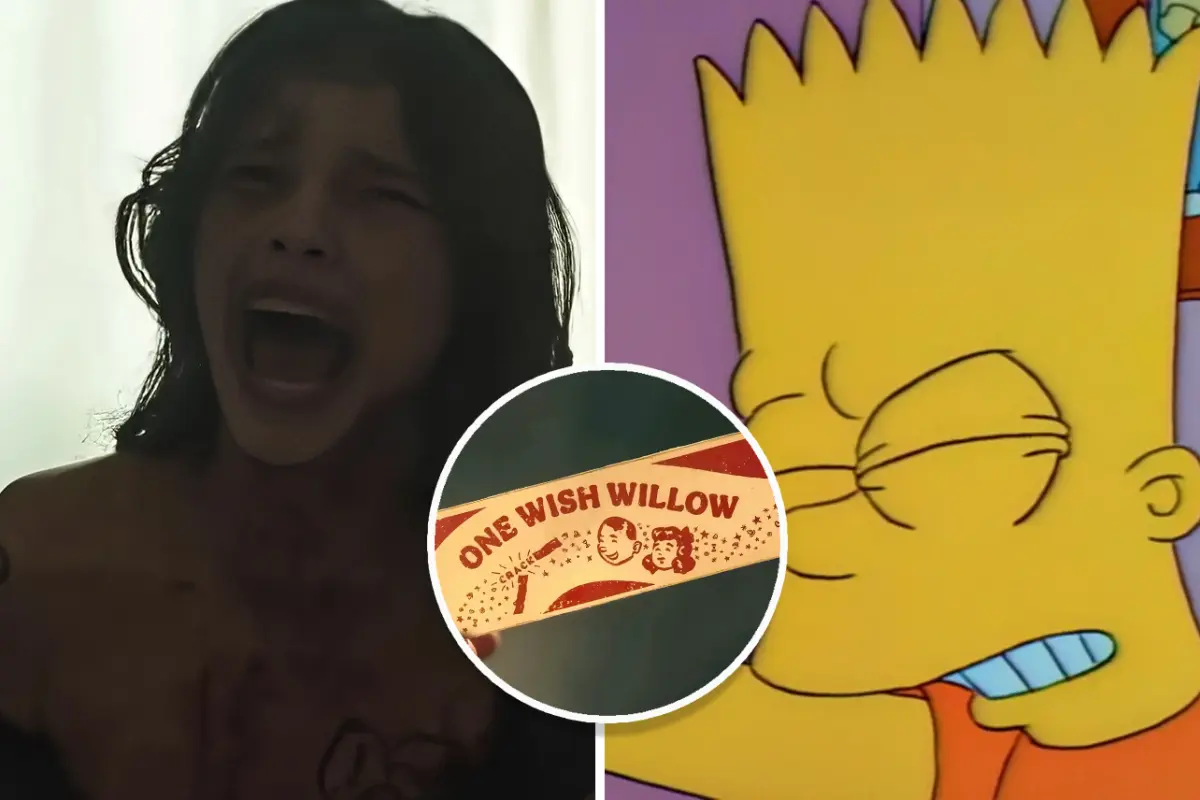
Obsession is shaping up to be one of the biggest hits of the summer and maybe the most surprising blockbuster of the year — a $750,000-budgeted, star-free horror movie about a wish that goes wrong, now projected to make as much as $300 million worldwide. Last fall, when the movie premiered at the Toronto Film Festival, writer-director Curry Barker mentioned another unusual aspect of its origin: He was inspired in part by an old Simpsons episode.
In Barker’s movie, a young man wishes on a novelty toy for his crush to love him more than anyone in the world. The wish comes true, but in classic “be careful what you wish for fashion”: His crush becomes possessed with a fixation on him, so rather than experiencing a real person’s love, the wisher experiences his own selfish desires, redirected back at him with dangerous, eventually violent obsessiveness.
There’s not a Simpsons episode where this happens to Homer, Bart, or even Milhouse. (Nobody likes Milhouse!) But there is an episode, specifically a segment of the show’s annual Halloween anthology, that offers a concise seven-minute lesson in “careful what you wish for.” Barker was reportedly already thinking about the idea of obsession when he happened upon that Simpsons rerun. As he told Variety:
“Bart gets a monkey paw and causes a bunch of chaos. I was thinking that I’ve never seen a straight crazy horror where … we’ve seen ‘Be careful what you wish for’ tons of times. But we’ve never seen my version of it. I instantly started thinking about what I could do with that.”
He’s describing the first segment of “Treehouse of Horror II,” the show’s second of many Halloween specials, from all the way back in 1991. (For a bit of perspective, the first time this episode aired, Barker himself was…negative eight years old.) It’s actually Homer who purchases the monkey’s paw, and four family members precede to make one wish apiece (sorry, Marge). The first comes from baby Maggie, who the family thinks has conjured up a life of luxury, or at least a fancy car, until it becomes clear a limo has only arrived to deliver her a new pacifier, seemingly identical to her old one. Notably, however, this is the only wish that doesn’t seem to backfire (at least as far as we see). Bart then wishes for actual luxury, making the Simpsons instantly rich and famous, which turns into sly commentary on the show’s first-season boom in popularity (and attendant merchandising). As such, the world quickly tires of their antics. (“At first they were cute and funny, but now they’re just annoying!”)

With the family stung by this reaction, Lisa then wishes for world peace, which eventually leaves the planet vulnerable to an attack from Halloween special mainstays Kang and Kodos. Finally, in his frustration, Homer uses the final wish to ask for a turkey sandwich. Tragically, the turkey is “a little dry.” Even more tragically, Ned Flanders then gets ahold of the discarded monkey’s paw, which resets for him, and allows him to wish away the aliens as well as a new castle next door to the Simpsons.
Watching the segment again, it’s funny to think of it inspiring the genuinely gruesome misfortunes of Obsession, because the Simpsons’ misfortunes barely qualify as horror, especially compared to other “Treehouse of Horror” stories. Of course, it’s not The Simpsons that invented the idea of a cautionary wishing tale, or even specifically using a monkey’s paw to tell it. “Treehouse of Horror” episodes, especially in the show’s early years, often draw upon shows like The Twilight Zone or The Outer Limits, doing comic glosses on speculative or horror-related concepts. In this case, there’s an Alfred Hitchcock Presents episode that tells the monkey’s-paw story, which may have gotten it into the Simpsons writers’ heads, just as they got it into Barker’s.
But the whole idea actually traces back to “The Monkey’s Paw,” a specific short story from 1902, written by W.W. Jacobs. It was published in Harper’s Bazaar, and was subsequently adapted into a number of plays, silent and sound films, radio episodes, and TV installments. In fact, just a week before the Simpsons version aired on Fox, an adaptation of “The Monkey’s Paw” kicked off a millennial-beloved Nickelodeon series as the pilot episode of Are You Afraid of the Dark?
So as much as those familiar with the story might roll their eyes at Barker describing the monkey’s-paw concept as something he saw on The Simpsons, it falls within a rich tradition of familiar stories conveyed to a new generation through their adaptations or parodies. By this point, countless people have likely first been introduced to shots, plot points, or ideas from movies as well-known as Citizen Kane or The Godfather through The Simpsons, just as Looney Tunes introduced so many later generations to caricatures of Humphrey Bogart or Peter Lorre. A South Park character once relentlessly cried “Simpsons did it!” at seemingly every possible plotline, reflecting the show’s influence. In a way, that’s true – but in large part because The Simpsons itself has been able to draw on such a wonderfully deep and wide pool of culture. This, in turn, will conitnue trickling down to other creators for generations to come.
Stream The Simpsons on Disney+
