
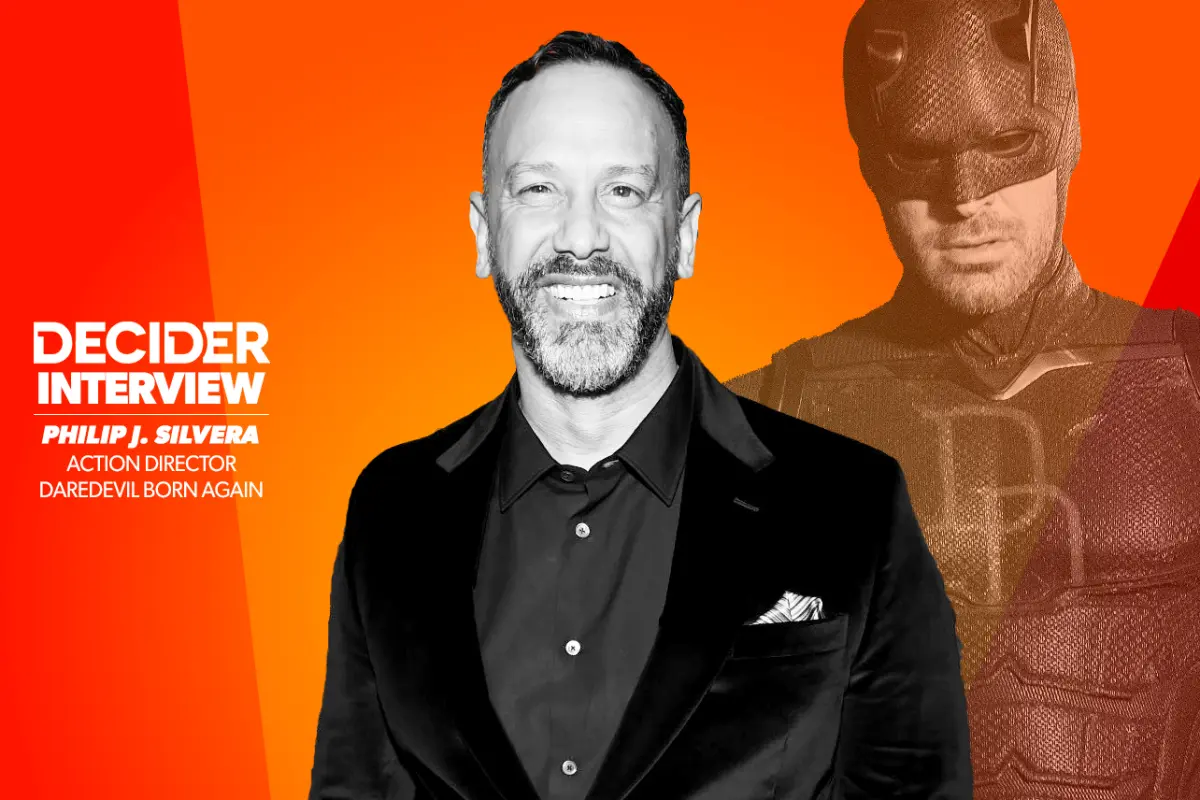
Daredevil: Born Again action director Philip J. Silvera knows a thing or two about coordinating a fight, and he’s putting one together to try to garner the series an Emmy nomination.
After Season 2’s debut earlier this year on Disney+, Silvera — who earned an Emmy nomination back in 2016 for his work on the original Daredevil Netflix series — the stunt professional is hoping that voters in the Academy of Television Arts and Sciences recognize the tremendous amount of work and collaboration that it takes to make Matt Murdock (Charlie Cox) and Wilson Fisk (Vincent D’Onofrio) seem superhuman.
“What we’re always doing is we’re trying to make a feature film in three to four days, so we usually get about three to four days to design and stunt sequences where I’ll shoot and edit the sequences, much like we’ll shoot them on the day,” Silvera explains in an FYC interview with DECIDER. “Each shot is its own little mini movie.”
At an hour apiece, each episode of the Disney+ series really does pack a punch (pun intended) and Silvera is hoping that the hard work is recognized. According to the stuntman, it’s a matter of the world just knowing what it takes to bring a comic book legend to life and making it look effortless.
To hear about how he planned out Season 2’s biggest scenes and the creative process behind his job, check out DECIDER’s full interview with Silvera below.
I heard that there was a little bit of a delay because of Season 3 stuff. How’s that going?
PHILIP J. SILVERA: As big as it was in Season 2 — 1 and 2 — if not bigger. I’m excited to return to the world with some of our fan-favorite characters and characters that we know are coming back to the world.
Season 2 certainly had some big moments and scenes. What has the response been like for you?
It is a magical feeling. For me, I am a fan. But Season 2 kind of brings it back to the nostalgia when people first saw Daredevil back in 2014. It hit the scene in such a different and unique way, and I felt like this was a return to form with an evolution of the world and who the characters are today.
Talk to me a little bit about the action this season and how your own relationship to the show and the characters has evolved over the years.
I think it’s an overall evolution. And number one, it’s probably one of the shows that is the most collaborative in all of my years in film and TV. From the actors to the writers, the showrunners, the producers, every department head from VFX, special effects, wardrobe. This is definitely one of the biggest collaborative projects. And passionately so for everyone as well. So it’s a true treat for everyone because I think they know how special this show is. And I love that, you know, from its raw form, from early concept design, we have these conversations where the action on the show has always been emotionally driven. So if the action doesn’t come from those places and the design doesn’t come from those places, it really is just punches and kicks and not too many people care about.
Do you have a favorite moment from Season 2 that you felt the emotionality driving behind it?
Yes, the non-verbal dialog, the action sequences, which is what I love to use a lot.
What is the creative process like of taking a script and then conceptualizing fight sequences that require so much care and planning?
The good thing is our creatives at the top already have a goal of where they want to take the characters so it starts there. And once we read a scene, I’ll have the conversation with [producers] Dario and Sonja about the tone they want to hit. Then there’s creative conversations with the first unit directors, and then beyond that, then I go into our rehearsal space, and I have a phenomenal stunt team that are great filmmakers as well. So so we go into the design of a sequence where we’re using the psychology of the character, where they’re at emotionally, and then we start blocking it out within the reality of the space. And what we’re always doing is we’re trying to make a feature film in three to four days, so we usually get about three to four days to design and stunt sequences where I’ll shoot and edit the sequences, much like we’ll shoot them on the day. So that’ll be our roadmap to this is how we get all these type of shots in a short time on our shoot days.

How do you land on shooting scenes with different angles, steady-cam vs handheld, etc.?
The camera lens for certain people is usually reflecting the emotion. If Matt Murdock is going through a rage, we want to be handheld, a little more subjective of him. If Vincent D’Onofrio is a bit more commanding or in control, we keep it steady until the moment where he just loses it altogether. And one of my favorite camera angles to create was for Wilson Bethel. But with Wilson Bethel and his fighting style and the way he uses objects, we spoke about creating a very specific camera language that hints at what they did there and then evolved with it. Like in the diner, the way will follow the blades moving in and out, or in Episode 8, where we do that special trick shot. That is one of my favorite scenes, by the way.
I saw a video on Instagram breaking down one sequence. What’s it been like to get to show the behind-the-scenes of how these sequences come together?
I think there’s a level of appreciation that it has come from going behind the scenes on all things, not just the show. It’s helped push stunts forward. Even at the Oscars and the Emmys, stunts has been an umbrella term that has been hidden for too long. I think now people are understanding the emotional design that comes from action design and stunts coupled together and storytelling and the narrative we use for storytelling.
And how was it getting Krysten Ritter back into the mix for this second season?
I never had a chance to work with Krysten, I wasn’t part of Jessica Jones or The Defenders, but that being said, I got to collaborate with her for the first time. She is absolutely amazing. I think the first sequence, you know, when we establish her back in the world in the warehouse scene, I think in Episode 6, like we really want to show how powerful she actually was. Now her powers are fading in and out, but we got to see Jessica Jones actually use her strength. And then in that hallway scene, the juxtaposition is her strength is slowly starting to come to again, and you feel how strong she’s becoming. She is so awesome to work with. Her and Charlie have such a great shorthand and the chemistry together, it’s nothing but laughs between the two of them.
It is another moving piece. Looking back, what are the scenes or moments that you feel especially proud to have pulled off this year?
I think the oner, for sure, that’s such a massive collaboration. It’s a shared oner between Charlie Cox’s Daredevil and Tony Dalton’s Swordsman. All the elements and how everyone had to be on cue for how we stitch together this amazing sequence, it was all done in a very short amount of time with some amazing filmmakers on this one.
It’s an amazing scene.
Each shot is its own little mini movie. There’s some big elements happening in every shot from a massive rack focus. So we get a sensory shot to pulling in bass stitching and out coming through the wall, changing locations as we go from the hallways into the big prison. That was a big location change and a very simple and tricky stitch to pull off. And then every shot has an element from wire gags to VFX to organic fight beats, and then you have the actors performing within each one. So it’s so many things that you have to understand each shot. It’s its own little mini movie, and it has to be just right to connect it to the next piece all the time. Because this is a stitched-oner and it’s still very hard to pull off. Everyone did an amazing job on that one.
What would it mean to be nominated for Daredevil: Born Again Season 2?
I think the nomination is an honor. I was blessed that I was honored for Season 2 of Daredevil on Netflix. So to have a level of the community that finds our work respectable enough that they would nominate us is a massive shout-out to the stunt community that has worked on the show from the East to the West Coast. And all the hard work that everyone has put into it, for it to be acknowledged the way it is and even just nominated, is, I think, a true blessing for everyone’s involvement on the show.
Is there anything else you want people, perhaps Emmy voters, to know about the work that went into pulling this season off?
I have a stunt team and a great stunt community here, but a stunt team specifically that works around the clock, 24/7, delivering these hard-hitting sequences that make it unique and safe for the actors. We have a lot of practical stunts that we’re always doing with massive special effects and massive fight scenes that are happening 24/7. My main stunt coordinator, our fight team that are also doubles on the show, our lead Daredevil double, like he has done some hard-hitting action to keep Charlie safe and prep for him and our lead riggers. We have done some phenomenal rigs in a very short time, and we’re doing these every day. We’re doing four big sequences and it’s a constant turnaround. So the fact that they can pull off the quality of work they do in the very short turnaround time that they do, is always very impressive with how much they work and how hard they work for both unique action but also keeping it safe 24/7.
I know you can’t spoil anything but how are you making things bigger and better in Season 3?
As long as we’re telling the story of the characters, we’re doing the right job. It’s not so much about the escalation, it’s more about staying true to who the characters are within the moments and the stories that we have them in. That being said, there’s still some really big moments to come in Season 3, that’s all I’ll say.
Daredevil: Born Again Seasons 1 and 2 are now streaming on Disney+.
Disney+ offers a number of subscription options, so you can find the one that works for you. With ads, a subscription costs $11.99/month; without ads, it’s $18.99/month or $189.99/year.
There are also Disney+ bundles with Hulu, HBO Max, and ESPN+, so you can subscribe to up to three services at once and save over 40% every month. The bundles are available in a few different configurations, starting at $11.99/month for Disney+ and Hulu with ads, and going up to $32.99/month for Disney+, Hulu, and Max ad-free.
