
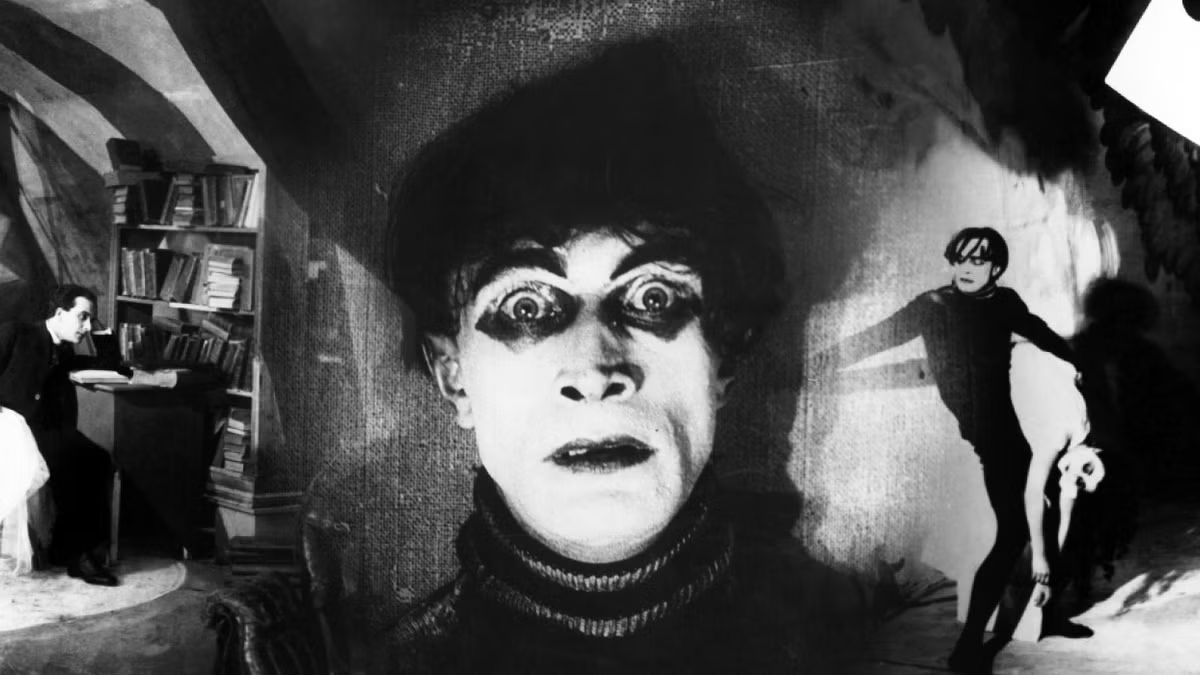
When the topic of studio interference comes up, it sounds almost exclusively like something that happens now, in the present day, especially with large-budget films. “Creative differences” is usually the term that gets thrown around, and that’s often the polite way to say the director wanted to make their own movie, rather than what the studio wanted them to make.
So while studio meddling isn’t exactly an uncommon occurrence, especially in modern franchise movies, you’d think it wouldn’t have been a concern during the production of a movie that’s over 100 years old. Well, that’s where you’d be wrong, because studio interference happened as far back as the silent-film era. And, in fact, one of the earliest and most influential horror films ever made — The Cabinet of Dr. Caligari — fell victim to studio interference.
The Influence of ‘The Cabinet of Dr. Caligari’ in Pop Culture
Released in 1920, the German-made The Cabinet of Dr. Caligari was directed by Robert Wiene and follows a young man named Franzis (Friedrich Feher) who goes to a carnival and witnesses Dr. Caligari (Werner Krauss) and his hypnotized sleepwalker Cesare (Conrad Veidt), who can supposedly see into the future. Cesare proclaims that Franzis’ friend Alan (Hans Heinrich von Twardowski) will die. When Alan does, in fact, shuffle off this mortal coil the next day, it becomes a question of who did it and how, and Dr. Caligari is the one everyone’s fingers point to in unison.
The Cabinet of Dr. Caligari is one of the most iconic horror films ever made, due exclusively to its set design and visual aesthetic thanks to the art direction of Hermann Warm, Walter Reimann, and Walter Röhrig. German Expressionism is the name of the game here, and to all the fans of old-school Tim Burton (as well as the early 2000s emo kids who loved My Chemical Romance‘s The Black Parade album, The Cabinet of Dr. Caligari was the pioneer that laid the groundwork with its moody lighting and abstract and jagged environments. Despite the film’s more lurid visuals and violence, the aesthetic wasn’t what caused the studio to step in. Actually, the opposite is true, since the gothically imaginative imagery was a strong selling point to market it as an “art film.” No, the thing that got under the producers’ skin was the message of the movie.
The Cabinet of Dr. Caligari was released post-World War I. It was written by screenwriters Hans Janowitz and Carl Mayer, who were pacifists who opposed both the war and authoritarianism, and they wrote the film to convey that message. The titular doctor has been interpreted by film scholars as being an authority figure who forces a brainwashed individual to cause acts of violence and murder with blind adherence, much like a soldier listening to his commanding officer. You could almost say Cesare is just following orders. This is where the studio took issue. The producer, Erich Pommer (allegedly following the advice of Fritz Lang), decided to add the framing device of Franzis telling the story to bookend the narrative. The underlying point in this change is the reveal that Franzis is a patient of an insane asylum, and his story is entirely fictitious, with Dr. Caligari actually being a doctor trying to treat him.
30 Scariest Japanese Horror Movies That Will Make You Sleep with the Lights On
These movies will keep you scared long after the credits roll.
The Significance of ‘The Cabinet of Dr. Caligari’s Changed Ending

The change was made due to the belief that the anti-authoritarian stance would turn off a broad audience, and it didn’t go over well with Janowitz and Mayer, who believed that the change was completely antithetical to their intent for writing the story. Instead of Franzis being portrayed as a protagonist trying to stop an evil and nefarious man who’s causing the deaths of others through manipulating a highly susceptible and vulnerable individual, Franzis becomes a raving lunatic who’s rejecting the help of a qualified and intelligent man who’s just out to do what’s best for his patient. The message of the final film is that authority figures are the ones who know best, regardless of how scary they appear, and we should submit to do what we’re told — which is definitely not what the writers intended.
It’s wild to think that while film as an art form was practically in its infancy at that point, having only been around for a few decades, yet even back then there were movies being released — in the foreign market and outside the Hollywood system — that were put under scrutiny by producers and studios. They weren’t dealing with budgets that were as massive as today. But movies were still being run like a business, and producers were taking into account what moviegoers would and would not want to see, even if it was at the expense of the screenwriters’ original vision of the project. It seems that the more things change, the more they stay the same. Still, even his change to the story doesn’t take away from The Cabinet of Dr. Caligari‘s importance to the horror genre and film history in general.

The Cabinet of Dr. Caligari
- Release Date
-
February 27, 1920
- Runtime
-
67 Minutes
- Director
-
Robert Wiene
- Writers
-
Carl Mayer, Hans Janowitz
-

Werner Krauss
Dr. Caligari
-
-
-
