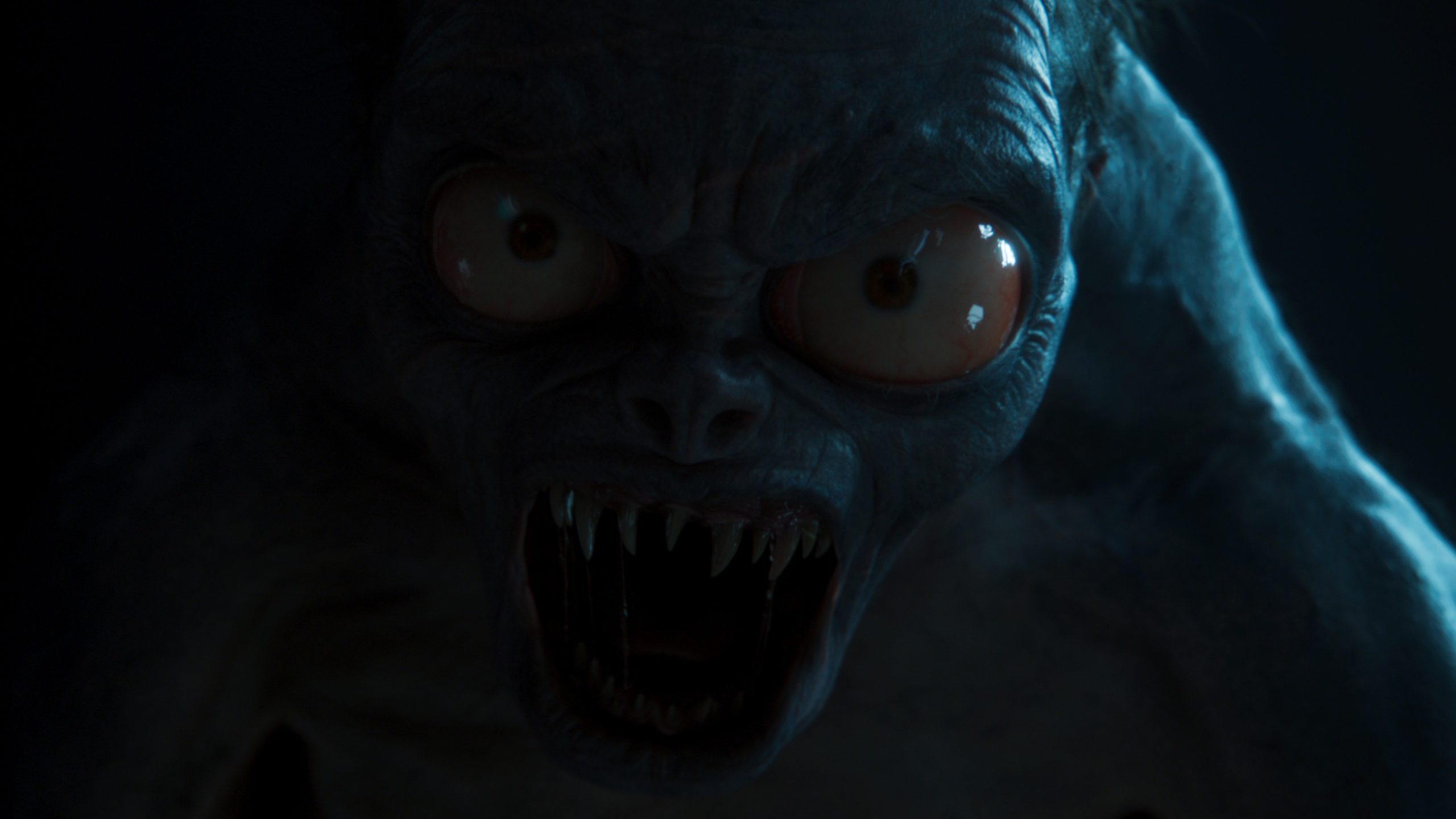
Picture Credit: Netflix / Mr. X
Mr X’s VFX supervisor Mark Hammond is no stranger to monsters. Over the years, he’s worked on several creatures for the big and small screen, including for Guillermo del Toro’s Cabinet of Curiosities and Wednesday. MR. X got involved in season two of the Tim Burton-produced series, featuring MR. X’s work on bringing Thing, a head full of snakes, and more of Nevermore to life.
The monsters are a visual gothic treat – even including the lumbering, sorrowful big bad, Hyde. Hammond wanted the creature, as well as its mother, Mama Hyde, to carry more heft and pain in season two of the hit series. Recently, while promoting his and Mr. X’s work on the show during Emmy season, Hammond spoke with What’s on Netflix about the art of the Hyde.
VFX is not a standard 9-5 job. Say on season two of Wednesday, what does a schedule entail for you?
Season two goes in ebbs and flows because when we were doing previs — previs is that weird time when we have so much time because everything kind of seems up in the air because they’re filming. And then as soon as things turned over, it quickly became chaotic. The amount of previs they allowed us to do on this show was actually awesome.
There were full sequences where they went and lit out the set beforehand, and then we got to animate on the scans. When they finally shot it, the shots we got back were almost exactly what we’d already animated. They 3D printed, too. They took our model of Hyde and they 3D printed the hands that would go around Marilyn Thornhill’s (Christina Ricci) neck. And so, when we got the shot back, we’re like, “Okay, well we know proportionally this works because they used a giant blue 3D-printed hand to do the motion.”
Stuff like that actually made it pretty efficient. They kind of know what they want. Season finale, when we start doing fight sequences with two CG creatures, then it starts to become complicated.
You did some motion-capture for that fight, right?
We did a lot of mocap. We literally do the mocap in the kitchen at the studio here. We just throw the suits on and tackle each other a few times and figure out. The nice thing is, I’m six-five. I’m a big guy. So when you’ve got Mama Hyde and you’ve got a little one, I would just find whoever the smaller person in the studio is and we would figure out how would this giant person mangle with this smaller person.
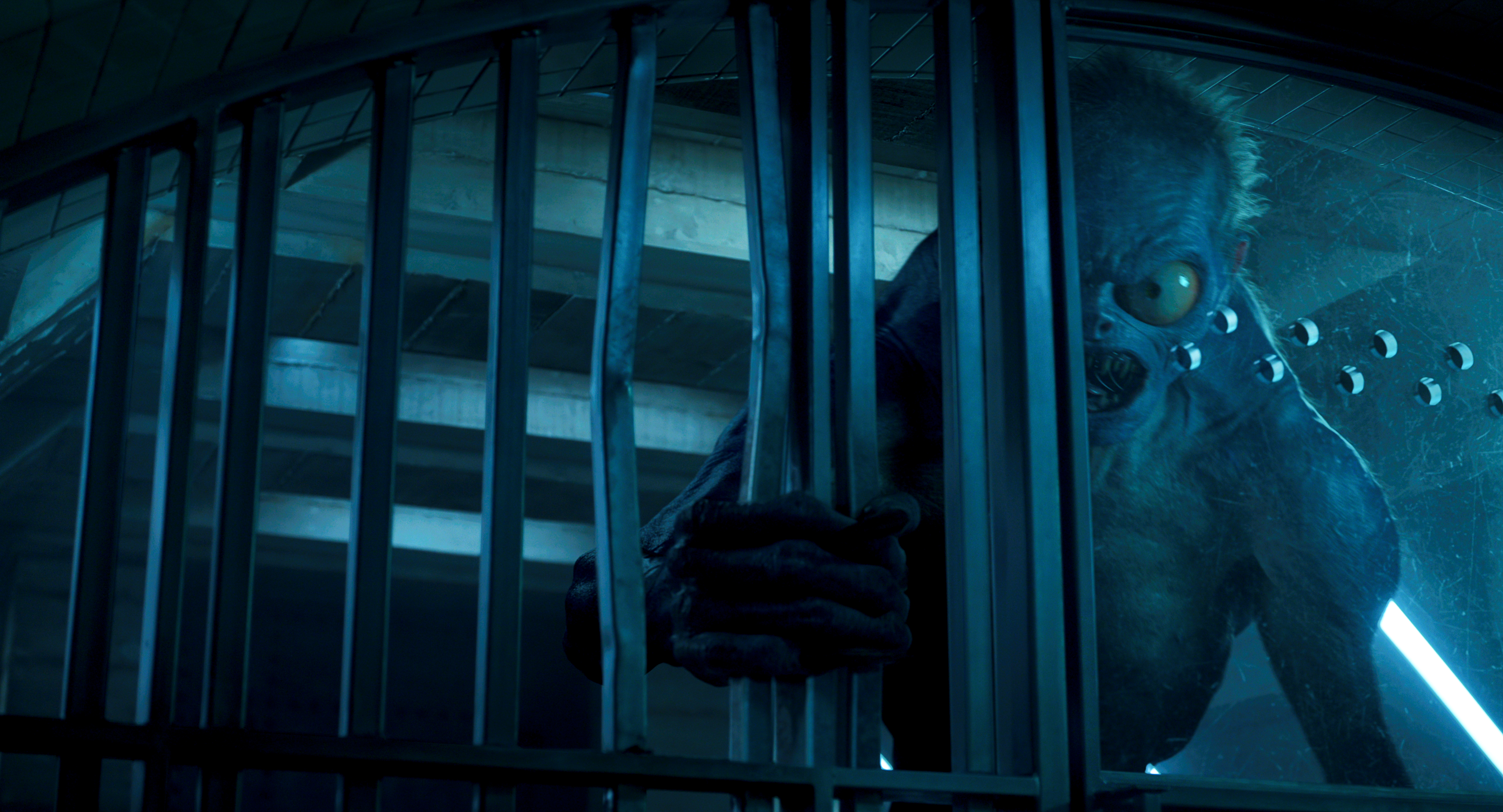
Wednesday. Episode 204 of Wednesday. Cr. Courtesy of Netflix © 2025
There’s a fine art to a motion-capture performance. When you are playing a Hyde, what do you keep in mind in terms of movement?
The heaviness of it. I’m not going to lie, I’m not the greatest person on those hand stilts. Luckily, once a lot of the fight sequences, they were kind of upright and they were kind of more bipedal once they started swinging at each other. You can kind of get the timing of what that strike would be and where the head would go. It gives you a good basis.
Then there’s a lot of animation work to clean up from where the mocap was. The mocap’s, I think, more or less give us timing and ideas. Then the animators are doing a lot of work to clean that up and make it work, especially creatures with giant long arms.
The transformation scenes for a Hyde are well done. How do those sequences begin and evolve?
Those developed a lot over the entirety. Normally, the actor that played Tyler, they would always shoot him to start the performance, but then… There’s the one through the cage where Tyler is fully transformed in a shot, which they hadn’t really done in season one. They always kind of did the hair growth or the hump growth or the arm, and they’d do it kind of over the shoulder to hide it a little bit.
I’d have to be corrected if I’m wrong, but I think that was the first time [in season two] you see him fully transform. We tried to do a lot of tricky things and there were a lot of versions on that shot. In the end, we ended up building a fully CG version of Tyler and we did a fully CG, obviously, version of Hyde.
That one was really tricky, but that was a fully CGI Tyler to a fully CGI Hyde and then all the in-between shapes between it. There was also, I think, one over the shoulder too,. steps back and then there’s this big back shot where he almost fully transforms. That was again, a full CG Tyler-to-CG Hyde moment. A lot of shot sculpting by our creature department.
Atilla [Ceylan], our head of creatures, he did a lot of shot sculpting specifically on all the transformations. He had to do a lot of work.
When it comes to building a monster, like a Hyde, how do you land on skintone or even the amount of bones in the body?
It’s interesting because it’s actually a thing that’s transitioning right now as we’re preparing for season three. MR. X didn’t do the Hyde in season one. We took him over for season two, and the main thing was like, he’s established, we can’t change him, but we want him to look better.
And so, we did a lot of that with rebuilding his entire eye system to be photoreal. So it’s got every part of the glass, it’s all built correctly, gives you a lot more reflectiveness and gives you that nice feeling to it.
He had no internal structure in the first season, at least in the model that we had received. He was kind of just a shape. What we did was we actually gave him a full anatomy. It’s a full skeletal structure, full muscle structure.
And you’re twerking it right now?
We’re actually still even right now kind of tweaking it a little bit because the anatomy of Hyde is hard. Especially his back hook, because if you look at it where the shoulder blades retract, it’s really hard to anatomically make that make sense. So we started the season one way and then we ended the season in an entirely different way. We shrunk the scapulas and made it more muscular, almost like a tumor on his back that could then also be influenced and pushed up and down a little bit by the scapula.
When we started, it was just giant shoulder blades, which we thought would work until we started making him run. Then you realize it falls apart pretty quickly. So, that was one of the big upgrades we did. Fully anatomically, he’s all there, everything is correct so that every time he pounds his fist, you get a jiggle. We can bring the jiggle up or down.
What about Hyde’s skin?
We did a lot of figuring out the right subsurface levels, because it’s technically human skin, right? And that’s what it’s supposed to be, like this stretched Hyde. But you need a roughness or else it starts to look really goofy. I honestly think it was kind of a scene-by-scene tweak because different lighting was making it more readable or less readable.
The Hyde looks like he is in pain. When it comes to the bone structure, did you and the animators want the creature to look gangly, uneven in ways that suggest pain?
It was brought up quite a bit about how they’re not supposed to be comfortable. It is almost like they’re pained the whole time. It is supposed to be a bit like a human stretched over an enlarged torso. Obviously, there’s a little bit more to that, but if we think about that, that’s why if you look at Hyde, there’s almost no moment where Hyde’s mouth is not open. He’s angry. His eyes go from bulging to bulging more. It’s to go along with the rage, but I think there’s a little bit of – you’re right – pain behind the rage too. We always have that in the back of our head.
Of course, the big eyes are very Tim Burton, but as the visual effects supervisor, what do you want those big Hyde eyes to accomplish when it comes to selling the character?
It helps ground him more. The eyes are almost one of the most important things in all the creatures we do. Your creature can fall apart pretty quickly if you don’t have it. Luckily, eyes are eyes. They tend to all work in a similar way. Hyde’s eyes are human – they’re just very large. And so once you know the anatomy for it, it’s the way light interacts with them. It’s the way when an eye moves side to side, you need those layers of translucency to make it feel photoreal.
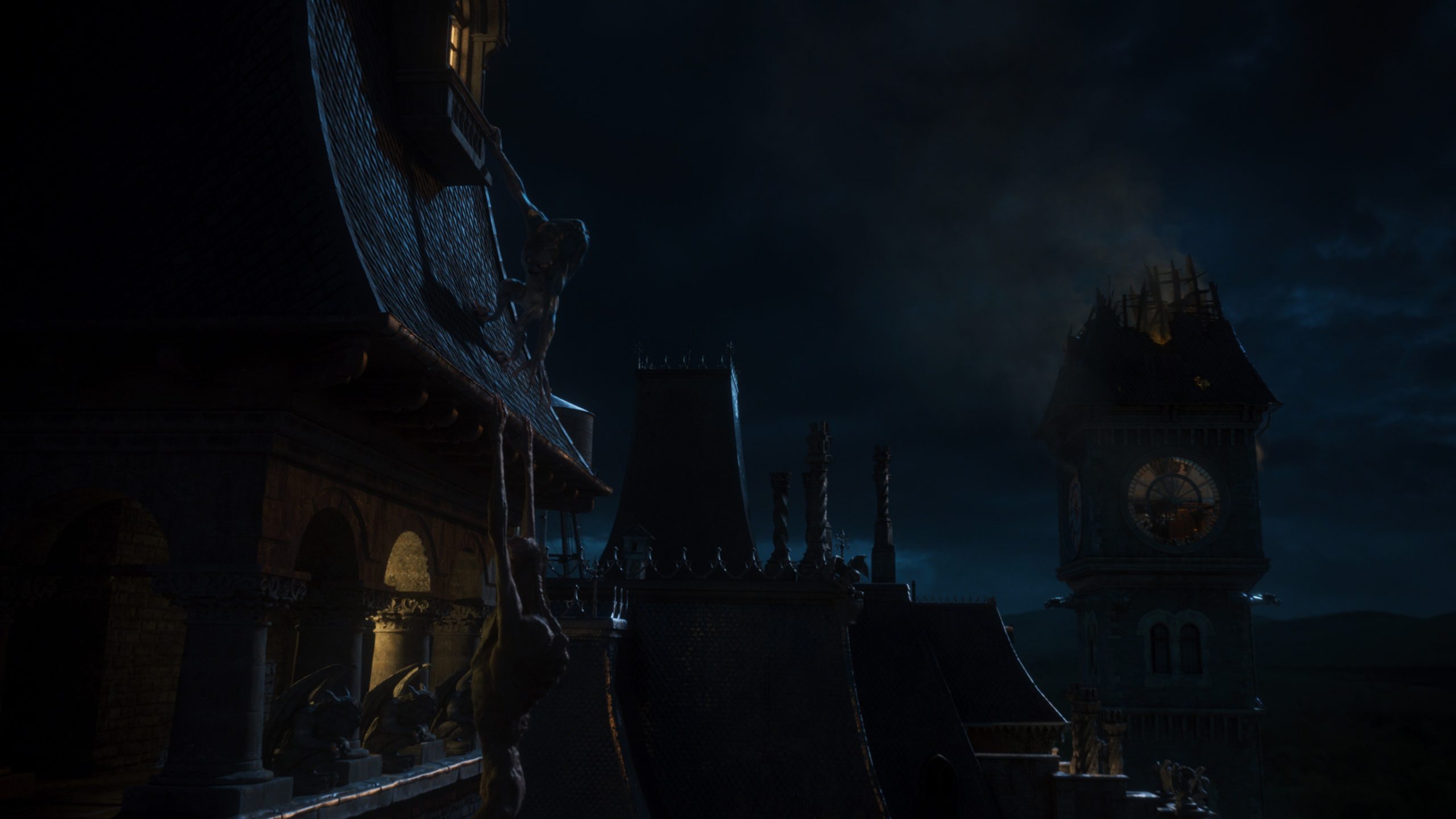
How much does the Hyde weigh?
Our estimate was always that the Hyde is somewhere between six and 800 pounds. Mama Hyde, we always said, was twice as big. I don’t know if we ever actually put a weight on Mama Hyde. We always assumed it’s very heavy. She is thinner than Hyde. She’s not as muscular, so probably not as much. I’m not sure. She’s got to be pushing a ton though. Must be.
Whether working on something like Cabinet of Curiosities, a Guillermo del Toro film, or Wednesday, what do you always hope to accomplish with monsters?
It totally depends on the director or the showrunner. Concepting a creature for Guillermo is totally different than concepting a creature for Wednesday because the aesthetics are different. Wednesday is obviously not R-rated, it’s not Frankenstein, right? There’s a limit to how grotesque and how over the top you want to do it.
It’s its own art form to figure out how far we can push it. It has to still be scary, but there has to be a cutoff point. We don’t want it to be adorable; it needs to be scary, but we don’t want it to come across as childish or that kind of thing.
The Mama Hyde concept especially was interesting to play in because you had Hyde from season one and you’re like, “Okay, he’s this. “What would a middle-aged version of him as a woman look like? Okay, we’ll figure it out.”
We did a lot of different sculptures before we landed on where we landed. Actually, we started on her sculpt and concept before we even knew who the actor was going to be to play her. And then once they showed us her and her hair, we were like, “Okay, we’re going to tweak this.”
Again, the Hydes are kind of interesting because they’re a bit of a caricature of the character. I mean, Tyler was a little different because I feel like they had to hide him in season one. With Mama Hyde, we didn’t have to hide. You could make her look like his mother. We got to play a little bit more with really accentuating her nose and accentuating the jawline, trying to make it a bit more believable that this is his mother’s Hyde.