
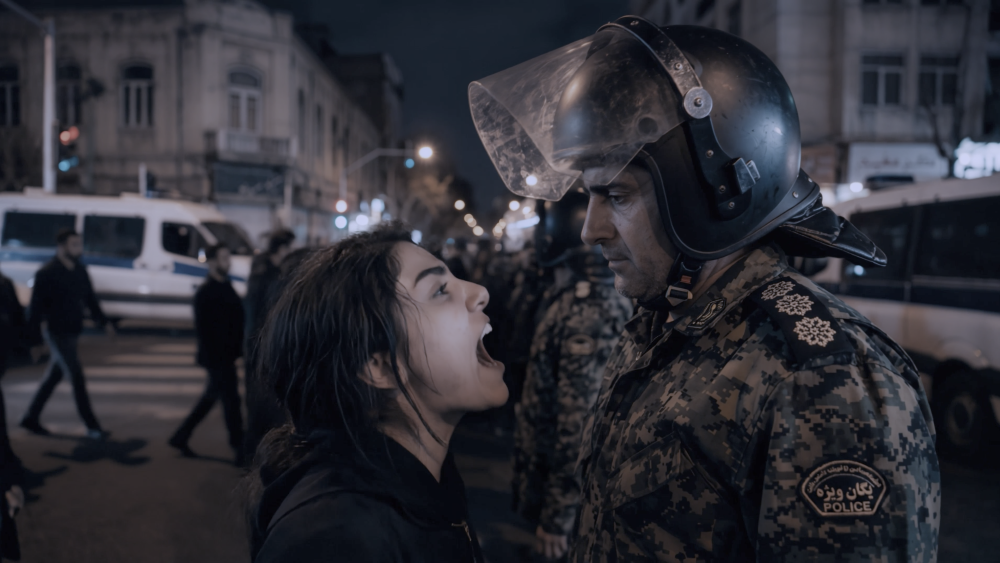
The 2026 Tribeca Festival has set the world premiere of “Dreams of Violets,” a fully AI-generated film produced by studio Fountain 0 aimed at showcasing Iranian civilian resistance.
The film’s premiere at Tribeca marks the first full-length, live-action film generated by AI to be accepted by a marquee film festival, according to Fountain 0.
The film, which will premiere June 10 during the festival’s 25th anniversary, is a 75-minute docudrama inspired by the protests that swept Tehran in January, highlighting five Iranians who meet in a Tehran alley before they’re executed, all witnessed from a window by Amir, a 10-year-old boy with cerebral palsy. The clashes reflect the real-world protests between Iranian authorities and civilians, which left at least 7,000 people dead and more than 50,000 people arrested, according to the Human Rights Activists News Agency.
Tribeca co-founder Jane Rosenthal called the film “a powerful example of how emerging technologies like AI can be used not simply as tools of innovation, but as vehicles for deeply human storytelling.”
“At this time in history when both artificial intelligence and Iran are central to global conversation, this film offers audiences a rare and intimate perspective into a conflict many have not been able to fully see or understand,” Rosenthal said in a statement. “What moved us was not just the technological achievement, but the emotional immediacy and urgency of the story itself.”
Director Ash Koosha, who is from Tehran, said in a statement that work on the film began shortly after he read reports on the massacre. He wanted to create a human-focused film, he said, but without access to a crew, actors or Iran itself, he opted for AI. The feature-length film cost about $2,000 to make, according to Fountain 0.
The project took three months — built entirely using tools such as Kling AI for video generation, Anthropic’s Claude AI for language-related editing, Google’s Gemini and Nanobanana for research and imagery and Fountain 0’s own technology for blocking and frame accuracy, according to the company — all from Koosha’s home in London. The film was “not a technological exercise,” Koosha said, but a bid to “create a memorial film for an event that happened behind a wall I cannot cross.”
“I understand that an AI-generated film about people who actually died raises difficult questions,” he said in a statement. “I have thought about those questions for every minute of every day I have worked on this film. My answer is that the alternative — silence, forgetting, the regime’s preferred outcome — is worse. The film exists because the dead deserve to be witnessed and because the families inside Iran, who cannot speak, deserve someone outside who refuses to forget.”
Fountain 0 is a production studio that “blends traditional creative principles with frontier technologies to produce previously impossible movies and TV shows,” according to its website.
Film festivals, and Hollywood broadly, have allowed AI-generated films to screen on the periphery of their programming. AI startup Higgsfield AI debuted 95-minute action-adventure film “Hell Grind” at the Cannes Film Festival last week — but through the Marché du Film, the festival’s marketplace for films, rather than as part of the festival’s screening lineup. Cannes organizers banned AI-generated films from the festival’s official competition.
The 2026 Tribeca Festival runs June 3-14 in New York. Jurors include the rapper Nas, Oscar-nominated director Mira Nair, actors Tommy Dorfman and Haley Lu Richardson, and New York magazine editor David Haskell.
