
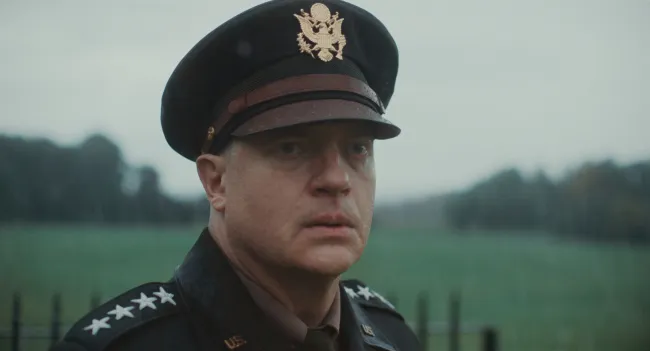
When Anthony Maras set out to film Pressure, a historical drama about the agonizing, weather-dependent countdown to D-Day, the filmmaker knew capturing the volatile English climate would be a challenge. But he didn’t realize just how much life would imitate art.
In an interview with Gold Derby, Maras reveals that, despite weather apps and high-tech forecasts, the production was at the mercy of Mother Nature, causing much behind-the-scene chaos.
Based on a true story, the film is set in the 72 hours before D-Day, as Allied forces prepare to launch the largest seaborne invasion in history. With the fate of the free world hanging in the balance, Pressure follows Gen. Dwight D. Eisenhower (Fraser) and world-renowned British meteorologist Capt. James Stagg (Andrew Scott), as they confront an agonizing choice: proceed with the invasion despite volatile weather conditions, or delay and risk catastrophic failure. The Focus Features film also stars Kerry Condon, Damian Lewis, and Chris Messina.

The core conflict of Pressure is predicting the unpredictable, and Maras found himself living out that exact storyline during the shoot. They were scheduled to film the D-Day sequence on a Monday. On the Wednesday prior, very much like what happened in history and in the film, they had a big table with 30 people sitting around it. Just as the Allies did 80 years ago, Maras’ team had to rely on a massive network of specialists. They deployed three teams of meteorologists and marine specialists who spent a month measuring sand dunes and tracking water levels with lasers just to see if filming on the beach would even be safe.
The team then received a devastating message. “On that Wednesday, we got the worst news of our life. They said there is going to be 50-plus knot winds. There’s going to be 6-foot waves. There’s no way you’re going to be able to film this next week. And we’re going further into an English winter, which just gets more and more brutal,” says Maras. “And I remember thinking, ‘Well, we’ve got to call it off. There’s no point in picking up, leaving the location where we can film inside and going to a beach and just sitting there for a week.'”

Ultimately, Maras and his crew decided to roll the dice and delay the shoot by a single day, holding back until Tuesday. The gamble initially looked disastrous. On Monday, a massive storm came in and washed away all the production design. The crew went out at 3 a.m. Tuesday and started again from scratch.
Then, the miracle happened. “As we got there to film, like in the film, the clouds parted, the sun came out and we got the weather we needed for D-Day and we were pinching ourselves the whole way through it,” Maras recounts. “No 6-foot waves, no 50-knot winds. It was as we needed it. And that continued throughout the whole film. The weather miraculously was on our side. And even veterans, even people who’d worked in the industry in England for 30 years, they go, ‘Mate, we haven’t seen the weather turn in anyone’s favor like it has on this film ironically about weather.'”

Considering the challenge of trying to read the spontaneous Atlantic weather patterns with modern technology, Maras expresses awe for what the real-world figures achieved during WWII without computers or cellphones.
“I don’t know how the hell they did this in 1944 where they had no computers, no mass communications, no text messages. It was physical bodies going out in the wind and the snow and the rain and the sun living up thousands of air balloons in enemy territory,” he says. “They had people in France in the resistance with little weather kits setting up balloons so that they could get insights to try and decode nature because whoever had the key to unlock nature’s secrets might get the upper hand and they did on D-Day.”
