
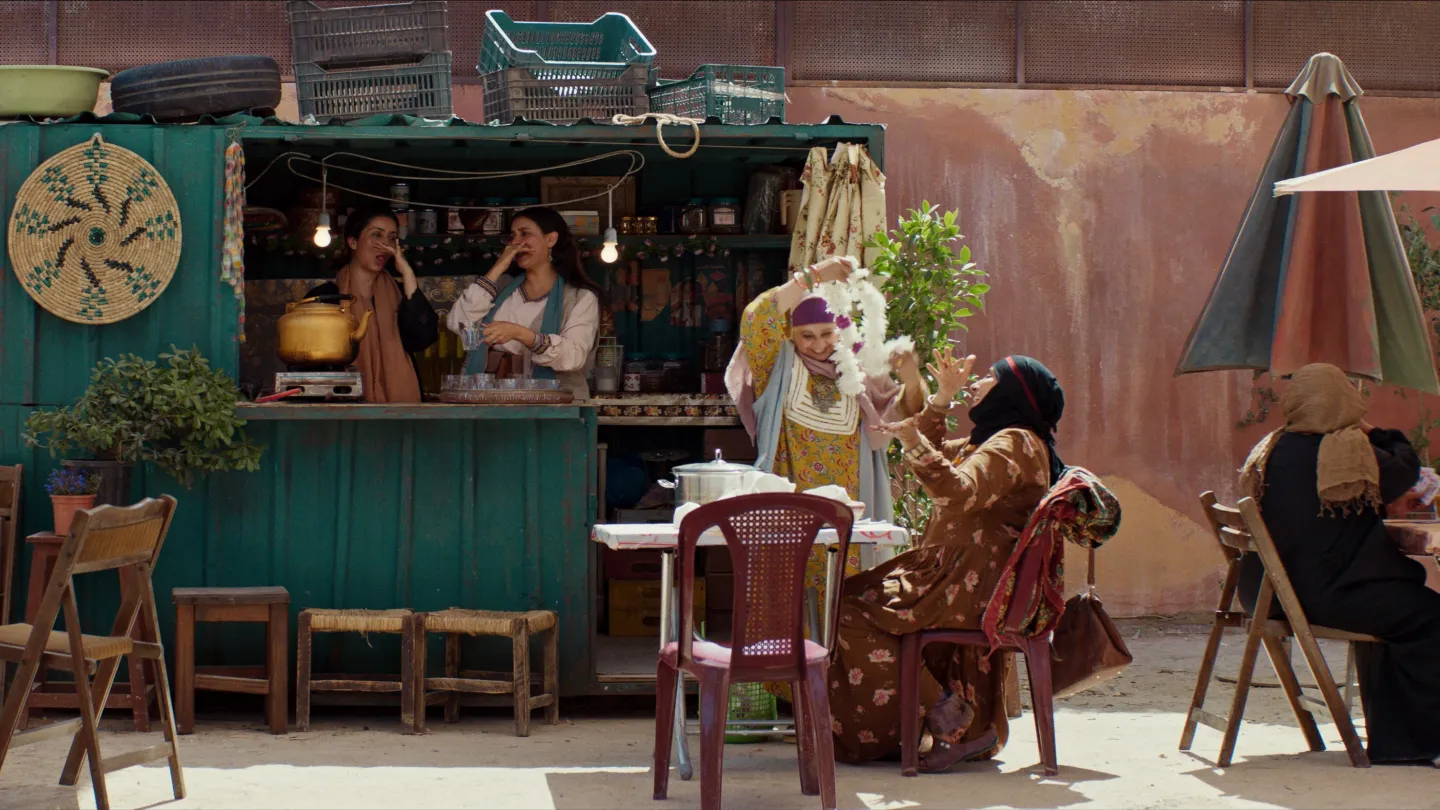
“No Men. No Weapons. No Politics.” So reads a sign that we see in the opening moments of The Station (Al Mahattah), the debut fiction feature of Yemeni-Scottish director Sara Ishaq (documentary The Mulberry House).
Its simple story is set in a complex world. “Layal runs a women-only petrol station (aka a gas station in U.S. English) in Yemen, a safe haven in a war-torn country,” highlights a summary of the film. Its rules are listed on the just-mentioned sign. “When Layal’s younger brother faces enlistment, she reunites with her estranged sister to save the one life they still can.”
The film, which Ishaq co-wrote with Nadia Eliewat, world premieres on Sunday, May 17, as part of the 65th edition of the Cannes Critics’ Week, the sidebar that runs alongside the main Cannes Film Festival.
Manal Al-Mulaiki, Abeer Mohammed, Rashad Khaled, Saleh Al-marshahi, Fariha Hassan, Amal Esmail, Shorooq Mohammed, Randa Mohammed and Fatima Muthanna feature in the cast. The cinematography was handled by Amine Berrada, the editor was Romain Namura, and Paradise City Sales is handling sales.
Ishaq has, since 2015, trained filmmakers in Yemen. Since 2022, she has managed the International Coalition for Filmmakers at Risk in Amsterdam. Ahead of The Station‘s Cannes premiere, Ishaq talked to THR about the inspiration for and production of the film, the casting process, as well as how it fits into today’s world.
Why did you decide to make The Station, a fiction film, rather than a documentary, given your background in news and doc work?
In 2015, when the war in Yemen was happening, I was in the capital, Sanaa, my hometown. I’d already made a couple of films, and I was working in journalism for different outlets and as a local producer and co-director for different TV-related documentary projects. And I had just received the [best documentary short] Oscar nomination for Karama Has No Walls. There was so much hype around the documentary.
And when the war happened, and the borders closed, foreign journalists were kicked out. So, there was really nobody reporting. And people who were inside Yemen were divided. There was a lot of political polarization, and it was really hard for people to understand what was happening. So, once people knew that I was inside Yemen, there was this pressure to document, document, document, document. It was just me and a camera, and I became burned out very quickly. There was a civil war and also bombs being dropped by other countries, so it was such a confusing time.
It became so overwhelming, and I thought about how I could create a narrative of what was happening to real people. People say nowadays that Yemen’s war is the Forgotten War. But actually, it was just an ignored war. Nobody cared. I had already gone through years of covering the uprising in Yemen, documenting massacres, human rights violations – all kinds of things. And it was falling on deaf ears. No, the only narrative that was coming out of Yemen was about famine and poverty. And that creates the image that people from Yemen have always been suffering. For me, that was just so infuriating.
I want to change the narrative. I want to show people what I’m experiencing when I’m at home, even when the bombs are falling. I want to show them how much we’re actually laughing, even if out of hysteria or out of panic. We are talking about stupid things and smoking shisha when our house is shaken by bombs. And you have a neighbor who is not on the same side politically, but they would still come and bring you bread.
What happened to all the footage you shot inside Yemen if that didn’t go to TV networks?
I started filming on the street, in hospitals and in neighborhoods that were bombed. I have never shown it to anyone until this day, which is heartbreaking for me, but I didn’t want to package it as a product that could be misused or abused. These are stories that people told me – their testimonies. That has to be presented in a way that honors their humanity.
What inspired you to make The Station?
I got quite depressed, and I started staying at home a lot. But in Yemen, there’s a lot of socializing. After lunch, women sit together and they chew khat, or they smoke a shisha and chat. All of these conversations I heard every day were incredible. One woman was talking about giving birth while they were bombing the hospital, and they were talking about that, but laughing at the same time. I recorded them – they didn’t want to be filmed. These women’s anecdotes were really heartbreaking, but also funny, and in the background, you could hear the bombs. And they were like, “You know, the one good thing about these bombs falling is that the stress has made me lose five kilos. It’s really good for your metabolism.”
They were in this bubble inside the house, trying to distract themselves. “How much did you buy your cigarettes for? Where did you get them from? What’s this new makeup? Who smuggled it into the country?” And whenever a plane flew overhead, or they would hear bombing, they would say, “Don’t worry, it’s not here.” They somehow detached themselves from the reality of the war that was happening outside.
‘The Station’
Courtesy of Critics’ Week
I hardly ever saw any men. They became a blur in the background. Then I went, with my sister and her friends, to this women-only petrol station. And I was really surprised by this. I was really surprised that there was something so elaborate and so well organized in the middle of the city.
I thought this was very progressive. But then I realized it’s because a lot of the men weren’t there anymore because they were either at war or they were depressed because they had lost their jobs. And the women were just carrying on and becoming more proactive. There were so many more opportunities for them to function in society. Plus, they also wanted to avoid harassment, because when there were a lot of queues with men, the women weren’t safe.
Your characters are really multi-layered. Can you tell me about your approach to them?
Nuances mattered to me – not painting anyone as black and white. Everyone is at least a little bit flawed. I wanted all of the characters to have something that made them human, because nobody’s perfect. And I didn’t want to make a film that was a typical war film, or at least not a film with what most people expect to see in a film from Yemen about a war.
I wanted it to be there in the background as the thing that is constantly driving everyone. It’s a constant pressure, but not the thing that we see [on screen] constantly.
How did you go about the casting?
The casting was maybe the most challenging part and also one of the most beautiful parts, and probably the most eye-opening. It made me realize the potential we have within and what we’re capable of doing as people. I was determined from the beginning that every actor in the film would be Yemeni. We have zero film industry in Yemen. This is the fifth fiction film ever made in Yemen. So, this is really, really brand new. There’s a slightly burgeoning industry in terms of TV series, which has developed since the war. But Yemen has never really had an industry, along with the actors, so performers are few and far between. Usually, they have been in local TV shows or theater plays. There’s no official cinema training.
So, it is a very tiny pool of people, and because society is also quite conservative, it meant that until recently, looking for non-actors to be in a film was nearly impossible.
For the casting process, I started with WhatsApp groups with all sorts of Yemenis. Because of the war, Yemenis have left the country, and there is a diaspora in Egypt, in the Netherlands, Germany, France, Portugal, Canada and Malaysia – scattered all over the world. The first thing I did was contact the Yemeni community in Amsterdam and in the Netherlands around me, since I live here. And I posted a Google Form on my Facebook, on Instagram and on WhatsApp through all the communities that I knew. I sent it to the ambassador, and I sent it to different people I knew.

Sara Ishaq
Courtesy of Hamzeh Abulragheb
Tell me a bit more about how the casting process went from there. And you found a wonderful cast through this process. Are they all professional actors?
They’re non-actors for the most part. Four of them are actors who have experience with some TV and some theater.
I asked people to send me pictures and a video talking about themselves and any accounts on social media, so I could filter through them. I ended up doing a casting interview, a little audition, with about 120 people online. And there was a really good selection of women in this one particular TV series, so I contacted the producer, who said they filmed it in Egypt. So I went to Egypt and met these women.
And then, with this group of women selected in the casting, we did a workshop in Egypt where we managed to complete the majority of the casting. They were all Yemeni. They came from all over Yemen. It was really important to have representation from all the different parts of Yemen.
I did a lot of improvisation. I didn’t let them read the script. After maybe two weeks of workshops with them, I told them the story of the film. But it wasn’t until one or two weeks before filming that I told them who their characters were because I didn’t want them to start fixating. I wanted them to stay themselves. So actors told me, “I really didn’t think I would be this main character.” Some were completely floored.
So was there also no rehearsing?
Every morning or the night before, we would just send them the scene, written in standard Arabic, so they couldn’t memorize lines. I just wanted them to understand what they were supposed to do and say in these scenes. There really were a lot of things that people didn’t know until the moment that it happened. So what the audience finds out, the actors were also finding out in that moment. I needed the reactions to be fresh.
I learned this very early on, doing the workshops. I made the mistake once of showing one scene to all women, and I got them to rehearse it and memorize the lines. We did one take, which was the best take where they hadn’t memorized things, and they were great. But the second time we did it, it just turned into slapstick TV, or a soap opera, with bad performances. You couldn’t feel the authenticity anymore.
There are also bigger universal themes in The Station beyond the Yemeni context…
Ultimately, I want to show this world that is Yemen, but it’s not [actual] Yemen, but this parallel world. The laws of this world are exaggerated in some cases, but these are real anecdotes, inspired by real women.
The [conflicting] political sides that I show in the film are obviously fictionalized. They’re a parody and a way of showing that the two opposites of the spectrum are actually the same, in a way. The Station also represents something bigger that is going on in the whole world, which is the “them and us,” the othering of each other. Whether Yemeni or not, women are all living under the patriarchy, and the patriarchy is going to screw you over as a woman, regardless of where you are. And for women to realize this can bring them together. It can also bring men together when they realize that. And it can bring men and women together when they realize that the patriarchy is screwing everyone over.
Any other themes that you would like to highlight?
For me, it was also about realizing what capitalism is doing to everyone and [touching] on this in a way that doesn’t feel like it’s politically driven. All of this is just sprinkled into it without being so on the nose.
After The Station, will we see you return to docs, or do you have new fiction plans?
I absolutely love fiction. I fell in love with it through doing this, and I fell in love with the process of writing screenplays. Going through this whole experience of working with actors and seeing the magic that you can create together was such a great human experience. It felt like we were so connected. I got to know every one of these women and every one of those children, and every single actor on set and the crew. I love this whole process of working with people and seeing them transform. It was a healing process for all of us.
I definitely have a film idea that is already brewing, and I’m already writing treatments for it. It is something I have been researching. So there is something in the pipeline, but I don’t know how, where or when.
