
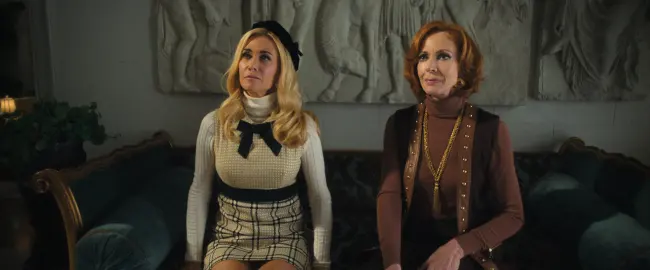
In the colorful, high-society world of Palm Royale, a quiet moment of reflection can transform into a life-or-death struggle in the blink of an eye. At the climax of Season 2, Episode 9, the tension finally boils over for Evelyn Rollins (Allison Janney). What begins as a somber, solitary moment for the socialite quickly spirals into a violent attempted murder when alligator wrangler Jed (Ryan Dorsey) breaks in to strangle her — only for Maxine (Kristen Wiig) to intervene just in the nick of time.
“I think ‘chaotic’ is a great way to describe Palm Royale,” says production designer Jon Carlos, noting that when a tonal shift occurs so rapidly, the environment must be ready for anything. “We have to create flexibility in a world where you don’t know where the story is necessarily going to go.”

For set decorator Ellen Reede, that meant planting subtle “foreboding” clues within Evelyn’s private sanctuary. “We like to add elements that nod toward things that may occur,” Reede explains. “There are lots of sharp objects and different types of bird cages. Those elements really speak to the story itself.”
The auditory shift is just as dramatic. Composer Jeff Toyne notes that the sequence starts quietly with Maxine looking at portraits of the women who came before her, only to end in gunfire when Jed enters and the struggle begins. “This is an example of how rewarding it can be to work on a series where you’ve really fully developed musical themes for all of the characters
“This is a scene with a long arc,” Toyne tells Gold Derby. “As we go, we can easily shift and almost like hanging ornaments on a Christmas tree, all the themes for the characters are available and we can reference them either by their sound or by their melody or their harmony and we can use their themes to set up expectations, red herrings.”
To pull off this “dance” between the actors and the camera, Carlos credits creator Abe Sylvia for his rhythmic approach to directing. “He loves to dance. Everything from his dialogue to his movement through a space with a camera and actors is going to be a dance. We had to create spaces where you could bend light in different ways as the characters move through them.”
The physical environment also serves as a metaphor for Evelyn’s state of mind. Carlos and Reede designed her space to feel like a birdcage. “In Season 1, it was a place that could protect you; it was a shelter and the windows had obscuring glass in them so that nobody could look in on you when you didn’t want them to,” Carlos says. “But in this final struggle, you see it’s actually a cage. She’s stuck in there. There is a duality to how the environment plays with the character evolution.”
Of course, “chaotic” scenes come with a literal price tag. Because the sets were filled with custom-upholstered pieces and genuine 19th-century antiquities, the crew had to prepare for the physical toll of a fight scene.
“We select things that are up to the level of the characters,” Carlos admits. “So when you receive a script where they start a struggle and throw each other over an 1890s headboard, you start to freak. We actually had to rebuild a lot of them for struggle sequences like that.”
Despite the destruction, the team finds joy in the tiniest details like the “happy box” of fringe Reede kept on hand. “I fringed everything in sight, including a ceiling,” Reede laughs. “I think I put three levels of trim on the ceiling in the trophy room.”
This article and video were presented by Apple TV.
