
In Tokyo Story, perhaps Yasujirō Ozu’s most famous movie, an elderly Japanese couple brave the bustle of the hectic capital to visit their adult children. Writer-director Kōji Fukada’s latest feature, his first in Competition at Cannes, is a meticulously detailed reversal that flips that premise in an intriguing way. Unusually for a film about a small town — inasmuch as Nagi can even be described as a town — Nagi Notes is ultimately a story about personal expression and liberation, about learning to find your own space and owning it rather than running off to the big city only to find yourself lost in the crowd.
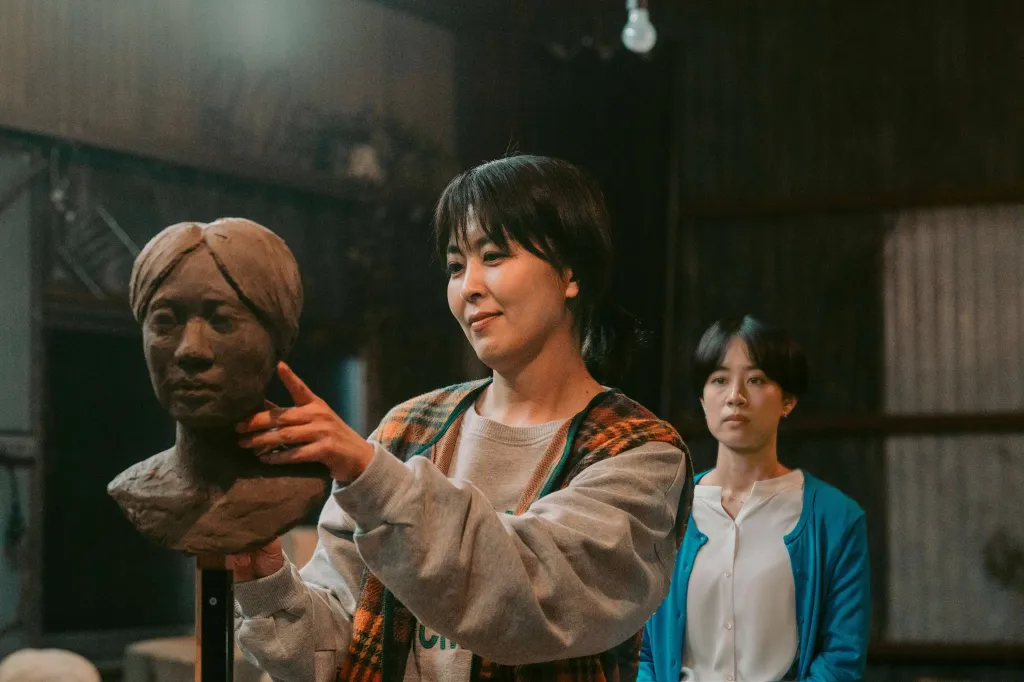
The story begins with Yuri (Shizuka Ishibashi), a sophisticated city architect, stepping off a bus and immediately attracting the attention of a curious young country boy, Keita (Kiyora Fujiwara). Keita escorts Yuri along the short distance to the home of Yoriko (Takako Matsu), Yuri’s former sister-in-law. In contrast to Yuri, Yoriko lives a very modest existence, maintaining a semi-functional dairy farm while pursuing a career as a talented sculptor of life studies. While the two women are catching up, Yoriko asks Yuri if she would like to pose for her — “I like to know the models I sculpt,” she reasons.
Yoriko accepts and stays for a few days extra, immersing herself in Nagi’s hermetically sealed world. We grow used to the dull sounds of gunfire coming from the local Self-Defense Force camp, and the charmingly earnest daily radio reports that keep residents up to date with the weather and that play the same instrumental piece of music whenever somebody local dies. If it weren’t for the calendar, time would simply lose all meaning; indeed, when the TV set lights up with news of a war in Ukraine, it feels like a bulletin from the moon.
But Nagi isn’t quite what it seems on the surface — the town is also home to the wildly contemporary and seemingly incongruous Nagi Museum of Contemporary Art, which the locals and sightseers appreciate in equal measure. Meanwhile, during her stay, Yuri becomes close to two local boys, Keita (Kiyora Fujiwara) and Haruki (Waku Kawaguchi). Keita is a budding artist, who talks of Edward Hopper in hushed tones; Haruki is his best friend, a military kid, recently enrolled at Keita’s school, whose father reads the radio reports.
Yuri’s extended visit proves to be an eye-opening experience, not only because Yoriko opens up about her brief dalliance with big-city life (and the doomed love affair that drove her home) but also because the two boys drop a bombshell that takes the deceptive, so-far sleepy narrative into a wholly unexpected direction. Yuri, perhaps serving as an avatar for the director, takes all of this in her stride, and her understanding is the soul of the movie: This isn’t just a glib morality tale harking back to the good old days, with profound life lessons learned after spending half an hour in the countryside, it’s a more nuanced reflection on what a simple life actually means — says Yoriko, “I might be alone, but I’m not isolated.”
Indeed, Yoriko comes to represent the heart and soul of Fukada’s film. The director clearly feels a kinship with her, and his camera dwells admiringly on her extraordinarily complex process of sculpting, starting with hand-moulded clumps of clay. Like a moviemaker, Yoriko turns people into art, and vice-versa; at the same time, she is also acutely aware there are more practical, earthly matters that need to be wrangled, like the stray cow that goes missing in a thunder storm.
Since no genre really exists to accommodate it, Nagi Notes could fittingly be described as scenic cinema; slow for sure but revealing in the same way a slow train can really open up the passing landscape. LGTB+-positive in a most unexpected and human way, it’s a modest film that charms by stealth and understatement, and, despite the slenderness of its premise, plants seeds of thought that continue to sprout long after it reaches its final destination.
Title: Nagi Notes
Festival: Cannes (Competition)
Director/Screenwriter: Kōji Fukada
Cast: Takako Matsu, Shizuka Ishibashi, Ken’ichi Matsuyama, Waku Kawaguchi, Kiyora Fujiwara, Sawako Fujima
Sales: MK2 Films
Running time: 1 hr 50 mins
