
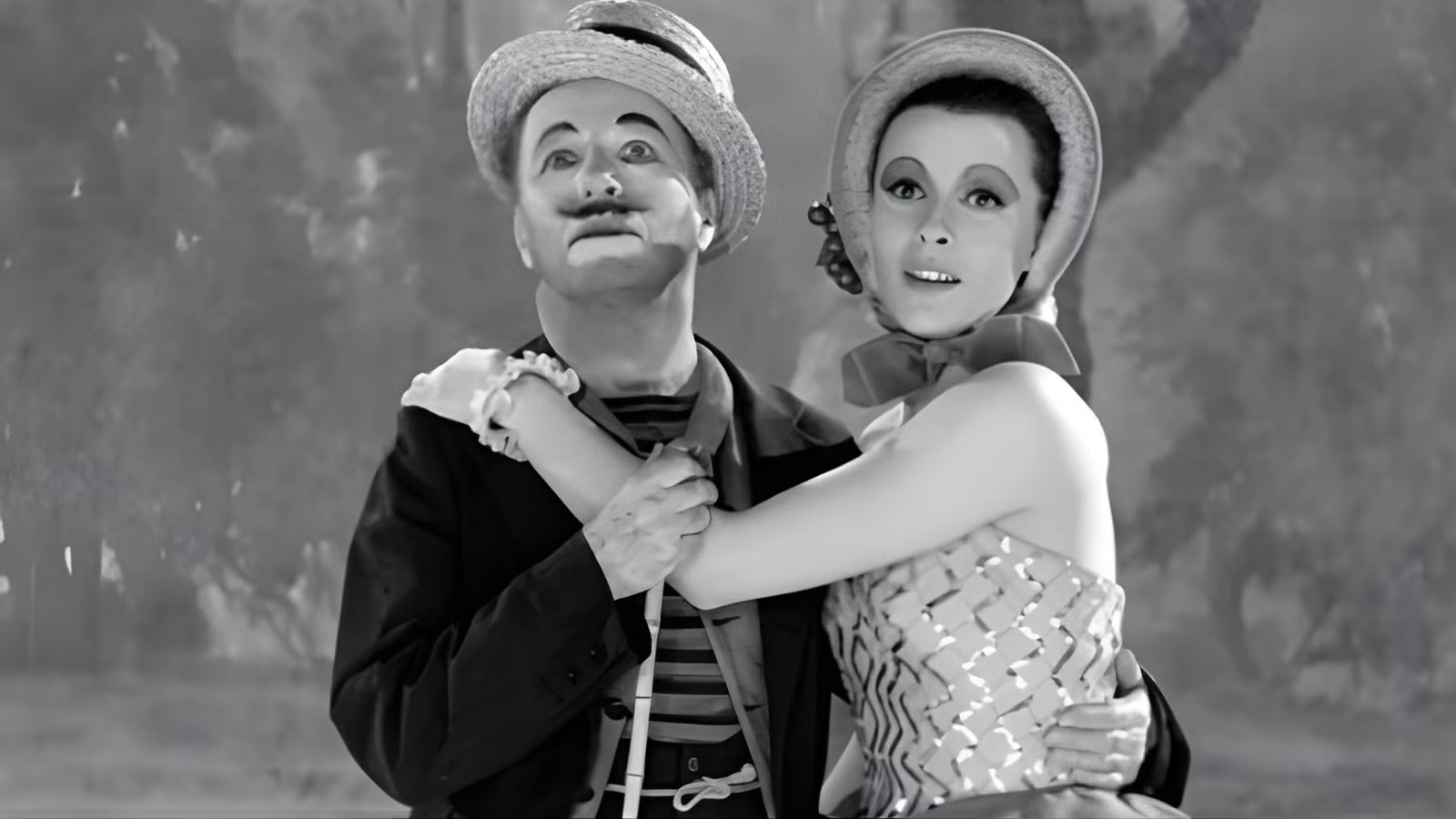
It’s not unheard of for an Oscar to be awarded posthumously. Heath Ledger, for one, received his for his performance as the Joker in The Dark Knight, thirteen months after his untimely death. Art director William A. Horning actually received two posthumous Best Art Direction Oscars: one for 1958’s Gigi, and another for 1959’s Ben-Hur, beating out his own nomination for North by Northwest in the same category that year. But to win one 18 years post-death is one for the record books, and such is the case for Larry Russell, who won an Oscar for Best Score in 1973 for Limelight, released in 1952… two years before Russell’s death. And contrary to what you might believe, the math actually does work out.
‘Limelight’ Uses Music Sparingly — and That’s Why It Hits So Hard
Limelight takes place in London in 1914, where Calvero (Charlie Chaplin), a washed-up drunkard who was, at one time, a famed stage clown, saves Thereza “Terry” Ambrose (Claire Bloom), a young dancer whose severe depression has rendered her temporarily paralytic, from taking her own life. He takes it upon himself to nurse Terry back to health, in every sense of the word, and as she regains her self-esteem, so too does Calvero. And when she’s ready to return to her dancing career, Calvero is inspired to make a comeback of his own: Terry’s is successful, but Calvero’s is not. For Terry to begin a life with someone better suited for her, Calvero leaves home and becomes a street entertainer. Some time later, Terry finds him and persuades Calvero to return to the stage for a benefit concert, a triumphant comeback that changes their lives forever.
Much of the film is sparingly scored, excluding the moments Calvero performs songs on stage. But when music is used, it accentuates the emotions of the moments in which it appears. Not overpowering the scene, but rather guiding the viewer to where they need to be to truly appreciate what’s happening. When Calvero extols the joys of chasing life’s wonders, the underlying piano lilts along. When Terry walks again for the first time, the strings speak to the miracle of the moment. And when Calvero walks out of the home with no explanation, the melancholy felt by both Calvero and Terry is accompanied by an appropriately sorrowful melody. Limelight‘s Oscar win isn’t for the music itself, but rather for how expertly it fits within the context of the film.
The Bizarre Release Rule That Delayed ‘Limelight’s’ Oscar Win
But the question isn’t why Limelight won the Oscar for Best Original Score, but rather how a film released in 1952 won an Oscar in 1973, resulting in the strange math that awarded Larry Russell 18 years after he died for a film released two years before it. The story dates back to the mid 1940s, with Chaplin condemned for being too political in The Great Dictator and for promoting an anti-capitalist message in Monsieur Verdoux, heavily scrutinized by the FBI for alleged Communist sympathies, and personally attacked by J. Edgar Hoover himself over a paternity scandal. Shortly after attending the premiere of Limelight in London, Chaplin’s U.S. permit was revoked, with warnings that he would be heavily questioned over his political leanings if he wanted to come back. He didn’t, moving to Switzerland for the balance of his life.
This Charlie Chaplin Classic Had Its Four Oscar Nominations Rescinded for a Strange Reason
Chaplin was nominated at the very first Academy Awards…until he wasn’t.
As a result of the allegations, the film only received an American release in 1952 in New York City, with theaters nationwide not willing to show the film. In order to qualify for the Oscars, per Collider, a film must be shown in six different counties in America, including New York and Los Angeles. That didn’t happen until 1972, when Limelight was rereleased. Having then checked off the requirements, Limelight was now eligible, and sure enough, Larry Russell – along with collaborators Raymond Rasch and Charlie Chaplin – was nominated, and the rest, as they say, is history.
Russell wasn’t the only one unable to accept the award live: Rasch died in 1964, missing the Oscar by only 9 years. Chaplin was still alive at the time – he wouldn’t pass away until December 1977 – but he did not return to accept the Oscar, despite it being the only competitive Oscar win of his storied career. He did, however, return to Hollywood for an Honorary Oscar for Lifetime Achievement in 1972, garnering a stunning 12-minute standing ovation and earning an apology from the Academy for their poor treatment of the icon in the past. However, the Academy has not issued an apology to date to the families of Russell or Rasch, innocents made guilty by association, who were unable to accept the Oscar they were destined to win when they were alive to appreciate it.
