
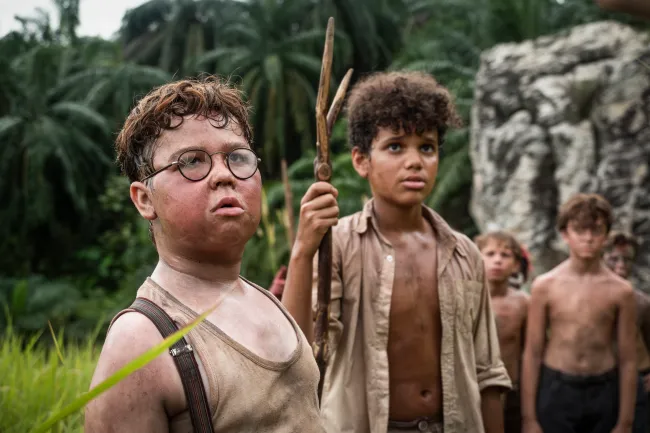
It has taken more than 70 years, but William Golding‘s Lord of the Flies finally gets the prestige TV treatment. A staple of high school English curriculums since its publication in 1954, the story of a group of stranded schoolboys who descend into savagery on a grown-up free deserted island was previously turned into a very good 1963 film by Peter Brook, and a very silly 1990 movie by Harry Hook.
Now, Emmy-winning Adolescence writer Jack Thorne has turned it into a four-episode limited series that arrives on these shores on Netflix following its BBC One premiere in February. Each episode unfolds from the perspective of the core four boys on the island and while it mostly sticks to Golding’s text, close readers will notice some tweaks to the narrative that may — or may not — go over well with purists.

Here’s a sampling of the reviews for the new Lord of the Flies series, which currently has a 94 percent rating on Rotten Tomatoes and an 83 score on Metacritic.
The good
Writing in USA Today, Kelly Lawler calls the show a “must-watch” writing: “Led by an astoundingly talented cast of young actors and brought to life with painterly brushstrokes of vivid color and horrifying imagery, Flies is four episodes of captivating, edge-of-your-seat horror.”
“Every second of Flies is a meticulously thought-out moment of wonder and horror in equal measure. The stunning shots of the island scenery, wrought in deep gem-tones and harsh bright light, contrast with the dark, gray and inscrutable palette of every other ‘serious’ show on TV right now,” Lawler continues. “Director Marc Munden does not want you to miss a single thing that happens onscreen. The setting is a place of deep, almost painful beauty that will bear witness to the unspeakable horrors of humanity, writ large by a group of once-innocent boys who are stand-ins for the depravity of the rest of us.”
Over in The Hollywood Reporter, Daniel Feinberg concurs, noting: “The four-hour series’ greatest achievement is that, for all the inevitable comparisons one might be tempted to make, this Lord of the Flies is wholly its own thing, as audacious and yet devoted to its source material as any TV adaptation in recent memory. Though Lord of the Flies surely suffers from some of the bloat endemic to streaming, even its excesses come in the name of emotional potency. The series is determined to make sure that its most devastating moments hit hard, and if that requires extending those pivotal scenes beyond what was strictly necessary, nobody seems worried.”
And over on his Substack, What’s Alan Watching, veteran TV critic Alan Sepinwall raves: “That Thorne helped craft such an outstanding variation on the classic story would seem to make redundant the idea of him doing a literal adaptation of Golding’s book. But his four-part take on Lord of the Flies is excellent in its own right. It understands why the story has resonated for over 70 years, and become a middle school English class perennial — and the ways in which it feels especially, unfortunately, timely at the moment.”
The meh
The Wrap‘s Gregory Lawrence swats away the positive takes on Lord of the Flies, arguing: “Do we need a four-episode miniseries adaptation of “Lord of the Flies”? Is there anything left to explore and uncover? The answer, at least according to this critic: Not particularly!
“Lord of the Flies starts as a grounded piece of survivalism, but as the facade of polite society erodes, it gets more heightened, violent, and even surreal,” Lawrence continues. “Munden lenses the show at this surreal level from moment one, so when the text actually demands surrealism, we’re already burnt out by the smorgasbord of visual tricks thrown at us. It feels less ‘intentionally composed shot plan’ and more ‘What if a skateboard video was also a Nine Inch Nails music video?’ If everything’s bacon, nothing’s bacon, know what I mean?”
Writing in The Guardian back in February, Lucy Mangan is also dubious that this version adds anything new to the discourse. “Every episode feels simultaneously bloated and thin, a feeling only reinforced by denaturing the otherwise saturated palette during the scenes of violence – primitive, you see? It feels like a gimmick trying to hide the absence of real emotion. When the words do come, they are not great. The script is unevocative… and frequently unconvincing.”
And IndieWire’s Ben Travers is another fence-sitter, noting: “Largely true to the novel, the first TV adaptation aims for similar endurance, like it was made for teachers to screen on a lazy Friday afternoon after a week spent discussing the book. Its characters consist of identifiable archetypes. Its setting is largely stripped of contemporary or antiquated trappings. Its story is basic and broad, easily absorbed on its own yet packed with lessons about life. …It’s a limited series that feels limited.”
