
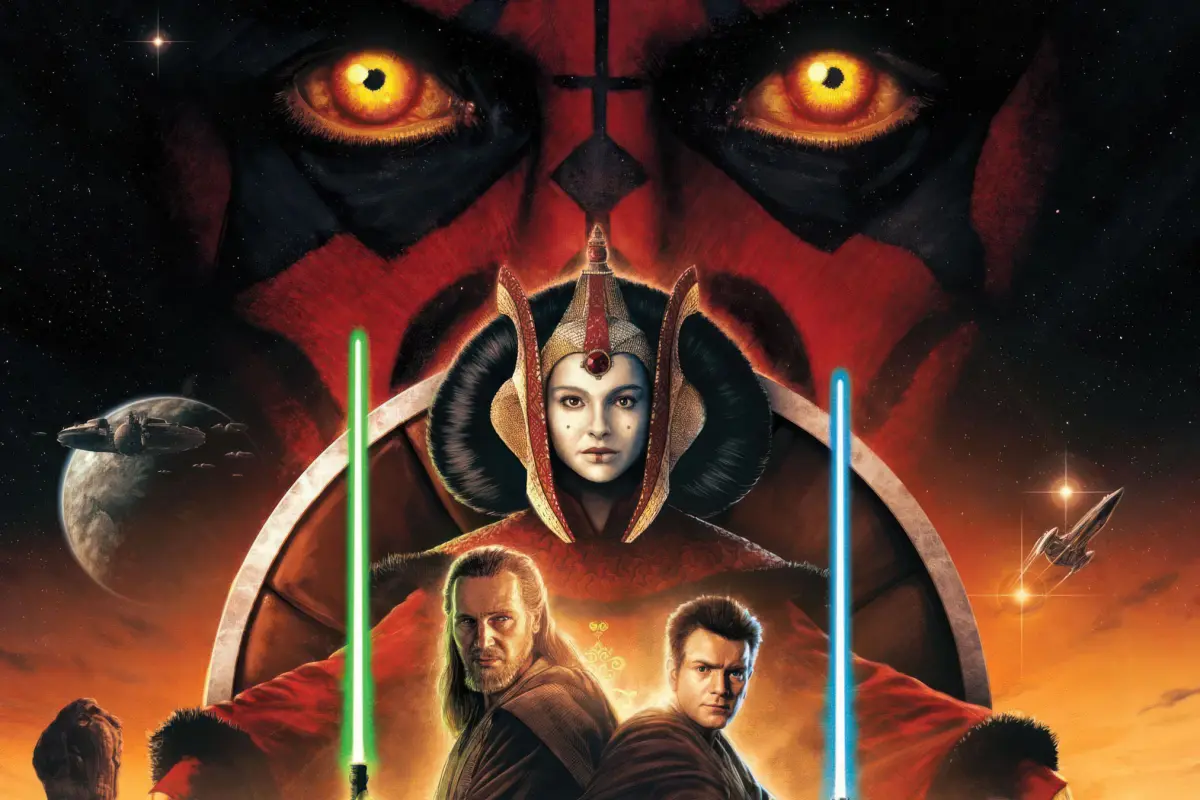
The most resilient of IP-related holidays is upon us, and for the first time in almost a decade, May the 4th (be with you) is coinciding with the release of a new movie: The Mandalorian & Grogu, opening in just a couple of weeks. Naturally, with anticipation building, plenty of fans are firing up their Disney+ accounts to stream other Star Wars stuff in preparation, or out of obedience to the corporate mandate of May the Fourth, in case they want to do something more budget-conscious than spend a ton of money on Star Wars merch. What some will find more surprising is which particular Star Wars movie climbed the highest on the charts in the run-up to May the Fourth: Star Wars: Episode I – The Phantom Menace.
Then again, the originalist idea that there’s the original Star Wars trilogy and then there’s everything else may have long since become outdated. Obviously the original films are impossible to equal in their ways: Specifically, in their freshness, influence, impact, and all that stuff. But for multiple generations who have now grown up with Star Wars as more of a fact of life than a before-and-after cultural event, Phantom Menace feels as much like the beginning as anything else (although in this fan’s opinion, you should probably still just watch them in release order, not chronologically, all other things being equal). It’s also a particularly kid-friendly way into the series, with a young hero – Anakin Skywalker as a bright-eyed and pure-hearted nine-year-old – and a ton of funny alien weirdos on the side.
It wasn’t so uncomplicated back when Phantom Menace was the May movie du jour as the most anticipated movie of 1999, before “May the Fourth” was even really a widespread thing. At the same time, it was less visibly complicated, because the internet was far less ubiquitous in our lives, providing less of a cacophony of opinion. Now, there are so many professional take-havers that it’s hard to even get a consensus on whether there was a consensus about The Phantom Menace when it came out back in ’99.

As someone who was there (as in going to the movies and on the internet, not there on Tatooine or Coruscant), I can say there were contradictions at pretty much every turn, thwarting the desire for a broadly applicable truism. Many of the early geek-type reactions offered the muted praise that the new trilogy-starter was better than Return of the Jedi, but not as good as Star Wars or The Empire Strikes Back. This would eventually be come to see as ridiculously generous, rather than measured and realistic. The actual critics were mixed, with a Tomatometer score of around 60% – in other words, a slight positive skew that today would be considered nearly disastrous, based on the number of easy passes handed out to franchise movies. (By 2026, enough retrospective reviews have been added to pull the number down into the 50s, but it was hovering around 60 for years.) Then again, Empire and Jedi didn’t get sterling reviews in their initial releases, either.
When Phantom Menace was actually made available to the public, the box office opening was very big, but, in part because of Lucasfilm’s decision to exercise some quality control over the auditoriums it would play in that kept it from breaking any widest-release records, not unprecedented. It made a little over $100 million in its extended first weekend. (It opened on a Wednesday, not a Friday.) But the movie did receive an A- CinemaScore from a polling of opening-night audiences, held up extremely well over the following Memorial Day weekend, and didn’t drop more than 40% on a single weekend until after Labor Day, when it finally started shedding screens in a big way. Granted, movies were less frontloaded in 1999. But plenty of movies that summer dropped over 40%, among them the Austin Powers sequel, Adam Sandler’s Big Daddy, Stanley Kubrick’s Eyes Wide Shut, and the Julia Roberts vehicle Runaway Bride.
None of this proves that people actually universally loved Phantom Menace, not least because few if any movies are actually universally beloved. It does suggest, however, that it played more like a family movie than a fanboy-only blockbuster – indicating that the kids were there for Young Anakin, Jar-Jar, Padme, and Obi-Wan, even if some of the olds were grumbling about why the movie wasn’t non-stop Darth Maul. That planted the seeds for a whole other generation of Star Wars fans who saw the prequel trilogy as theirs.

Moreover, Phantom Menace coming out when it did probably created a backstop against some of the more negative reactions, because they weren’t really able to flood the zone in the same way. Yes, it was eventually pilloried as a generational disappointment; there are episodes of Spaced and The Simpsons taking this as part of their premise. But contrary to depictions of the time, where audiences trudge out of the movie in shellshocked disbelief, its rep as a disappointing punchline grew more gradually than the lightning-fast turnaround we’ve grown accustomed to, where movies are discussed to death before they even come out in theaters. Part of that slower rate of growth was likely that in 1999, a tweenage kid that might have really loved the movie would also not necessarily have had any online life at all; a nascent one, if they did; and one far less flooded with cultural-commentary videos than the post-YouTube years.
Indeed, it was YouTube that helped flatten out the movie’s reputation with the notorious Red Letter Media videos critiquing the prequel trilogy, the cultural-criticism equivalent of watching a twerp like Ben Shapiro “DESTROY!” woke college students. Any of the post-Disney Star Wars movies and shows, by contrast, have come out in a completely different environment, where scrutiny is immediate, constant, and often monetized. Phantom Menace has also benefited from anti-corporate attitudes, holding that while the movie may be strange, with awkward dialogue and a complicated narrative and thematic set-up involving trade blockades and the symbiosis of different species on the same planet, it is inimitably George Lucas in a way that more committee-made blockbusters (which today means almost all of them) are not.
When Disney first bought Lucasfilm in 2012, they seemed nervous about reminding anyone too much of the prequels; now, they call back to a lot of prequel-era characters as a way of proving the franchise still has some Lucas-like energy. Which brings to mind another reason people might be in the mood for Phantom Menace these days: The animated series Maul: Shadow Lord has been well-watched on Disney+ and Phantom Menace is the only movie that really features the Darth Maul character (in large part because he seems to meet a sticky end in it).
Of course, the Lucas touch is also why the Phantom Menace got some pretty furious reactions in the first place. But over time, that has lent it a different sort of purity than the agreed-upon holiness of the first actual Star Wars movie from 1977. As big as Phantom Menace and Force Awakens got when bringing back the series in 1999 and 2015, respectively, neither could actually match the phenomenon of the first movie. Star Wars is a series that’s always been biggest at the beginnings of things (that’s part of why J.J. Abrams made such a great match to help revive it, even if he didn’t know how to cap a trilogy). For a certain time and place, Phantom Menace was that beginning, and even 27 years later, for some it’s as good a place to start over again as any. Star Wars periodically finds itself back at what feels like square one, and usually rallies back. But Phantom Menace may have been the last time that it was allowed to do so at something resembling a pre-internet pace.
Jesse Hassenger (@rockmarooned) is a writer living in Brooklyn. He’s a regular contributor to The A.V. Club, Polygon, and The Week, among others. He podcasts at www.sportsalcohol.com, too.
Stream Star Wars: Episode One — The Phantom Menace on Disney+
