
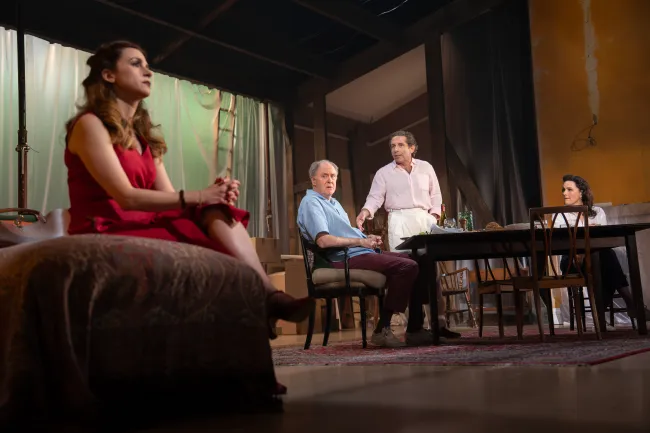
During his lifetime, Roald Dahl wrote some of the world’s most famous children’s books about chocolate factories, giant peaches, and big, friendly giants. But the author himself was a complicated person, as outlined in the Tony-contending play, Giant. Set over the course of one pivotal day in 1983, the drama focuses on the fallout that accompanied the publication of a Dahl-penned book review that contained language that many considered antisemitic.
Written by Mark Rosenblatt and directed by Nicholas Hytner, Giant stars John Lithgow as Dahl who stubbornly stands by his writing. The two sides of the debate over the review — and what it means for the author’s legacy — are embodied by Aya Cash and Elliot Levy as the show’s two Jewish characters. Cash plays Jessie Stone, a representative of Dahl’s American publishing company, while Levey plays Tom Maschler, the author’s longtime friend, agent, and British publisher.

“It feels like an invitation talk about things that people are scared to talk about,” Cash tells Gold Derby about the show, which is expected to earn multiple Tony nominations for both the cast and the production. She and Levey spoke about stepping into their roles and how the characters relate to their Jewish heritage.

Gold Derby: What conversations did you both have about how your characters embraced — or didn’t embrace — their Jewish identities?
Elliot Levey: I’m slowly learning that Mark’s talking about the difference between the American Jewish experience and the Anglo-Jewish experience. And it really hit me here [on Broadway]; there is a fundamental difference between your experience and my experience. Tom Maschler represents the child of immigrants who very quickly had to sublimate their Jewish identity and become more English than the English. There’s something slightly alien about him; here you would loosely say he was a self-hating Jew, but at home it’s more complicated than that.
Now that I’m in New York, I see in Jessie’s face the horror at his cowardice — or what she perceives to be cowardice — and his inability to just have the balls and to stand up as a Jew. But he doesn’t see it that way. It’s business first, and the reality in the play is that he wins. By hook or by crook, he gets Roald to do what he wanted him to do.
Aya Cash: We never talked about much of anything doing this play. We don’t even talk about our politics or our ideas about what the play is saying. And that is such an interesting way to do a play like this because it allows for us all to see what we see, just like the audience gets to see what it sees in the play. There’s no hard line of, “This is exactly what it means and you have to do it this way so the audience gets this one interpretation.” Nick trusts his actors to show up and do all that work for themselves.
Levey: On a personal level, one of the great joys of doing this show is that it’s a guaranteed four hours out of my day where I don’t have to discuss, think, or talk about Israel and what it’s like to be Jewish. That may sound glib, but I mean it. I spend most of my time as an Anglo-Jew in a country where there is firebombing of synagogues. The synagogue where my son had his bar mitzvah was firebombed, and it didn’t really make the news.
So I spend my days having to live in that world, and it’s quite thrilling to turn up to a theater where all you’re doing on stage is talking about it and yet, weirdly we’re not. Honestly, it’s my respite. The audience is having an intense version of this debate, whereas I’m having two hours of time off. And my God, I’m pleased! I don’t want to come off the stage and carry on the debate with my comrades.
Cash: There’s also so much love within all of us already, which the trick for dealing with different political bents. When you love someone you have to hold all of them, and not just the idea of what they believe.
Levey: In reality, Roald and Tom were best friends, so in the show I’m having an informal business meeting with him that we’re pretending is a random lunch gathering in Roald’s house. Whereas Jessie is having a strictly business meeting, which unravels because her passion and her outrage is triggered. On a human level, you have two people trying to massage an ego with one person being more daring and the other being more careful because of the consequences. And love has got something to do with it; Tom loved Roald.

Jessie unleashes an epic takedown of Dahl at the end of Act 1. Aya, what is it like to deliver those lines? Does she feel love for Roald, too?
Cash: There are moments of connection with Roald over his books and over our children, and those are the parts of him that she loves. I mean, I do think she’s a fan. She’s not lying when she says, “I love your books. They still make me feel what I felt as a child.” So she has some hope, even as he is demolishing her throughout Act 1. But it’s a very slim hope and that hope is held in his books.
I get to watch Elliot every night do this beautiful speech about what the books are and how they show life’s cruelty and then take you out the other side. And it’s persuasive enough to her to apologize to him in that moment, even if it’s incredibly challenging. Then Roald goes at her again and then she’s like, “No.” I’m also playing a woman in publishing in 1983, so speaking out in that moment is a huge choice.
I always find the entrance to Act 2 really interesting. I’m sure it looks exactly the same to the audience, but in my mind I’m thinking, “Where is she? Why does she come back?” Every night I’m trying to figure out what she’s done in those few minutes [between acts]. She’s completely let out the dragon — how does she come back and try to start over?
It’s one of many examples in the play where the characters must constantly calibrate how much they are able to say. Jessie chides Tom for “staying silent” about his Jewish heritage, but what kinds of open conversations would have even been possible for him?
Levey: When we first started the show two and a half years ago, I spent more of my time in conversation with people knowing that the world was in flux. It was confusing and non-Jewish people in England were confused and open to talking through the play as an opportunity to talk about what I, as a liberal Jew, think about Israel and all the rest of it.
But now that doesn’t happen so much. In London, minds are made up… just as Roald’s mind is closed. And Tom knows that. So when he says to Jessie, “It’s not our job to educate him, it’s our job to save him for business,” I’m now understanding that’s less cowardly than it seemed two and a half years ago. The idea that we can go through life changing people’s minds through old-fashioned reason and argument and rhetoric at the moment when it comes to this subject — I think that’s sort of over for many people.
That will change; the reality of the world will change, this war will change, and who knows what will happen when the dust settles. But that speech is my long-winded way of saying, “I get it.” I look at Jessie Stone and she’s a young woman who is ambitious, naive, ferocious and clever, and she’s not prepared to throw in the towel. Whereas Tom is old and ugly and thinks, “This is not a fight worth having.” And I get it now.
Cash: I have found that this play has invited a lot of conversation, and it’s been really great to talk to people in my life who have maybe been too afraid to have those conversations. And the conversation keeps changing because of what happens in the news. Every night I hear lines differently based on what’s happening in the news. The play is set in 1983, and it feels like it’s repeating our current moment. It’s an incredible piece of writing — and an incredible reminder of history.
