
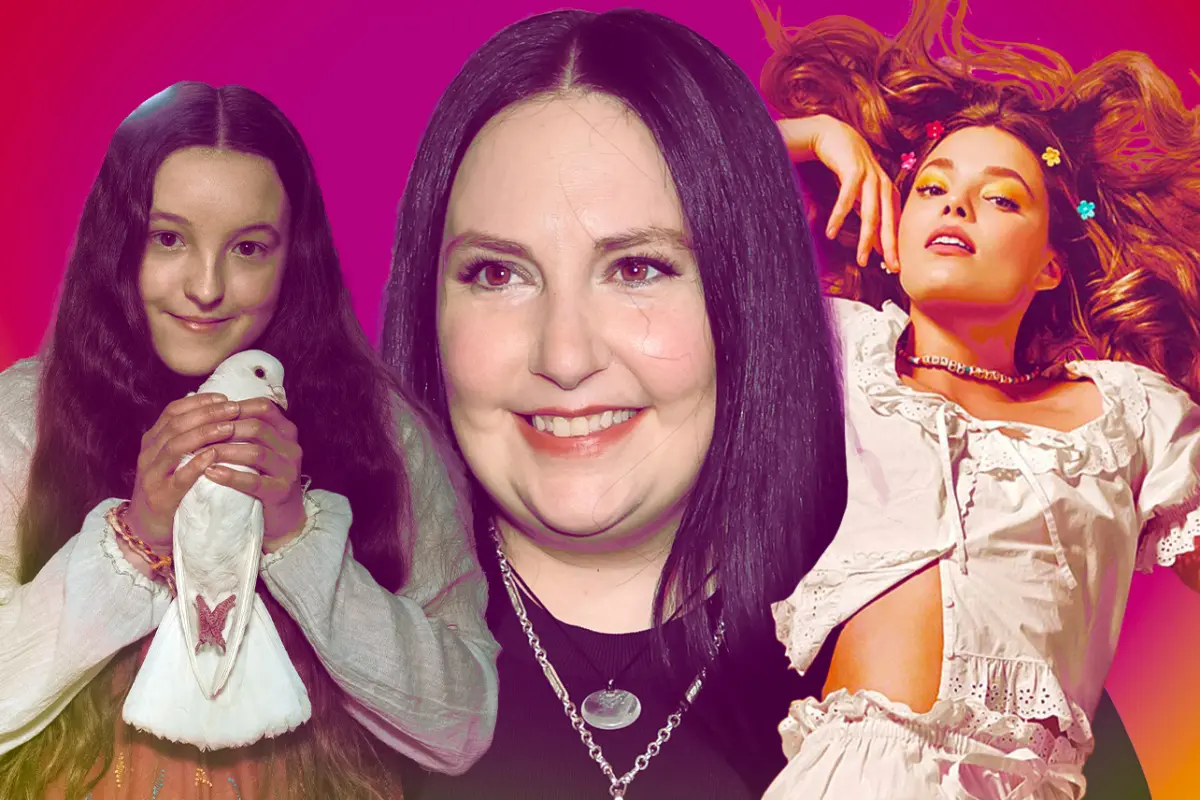
Everyone is talking about Lena Dunham again. Though her recent Netflix series Too Much is over and her Natalie Portman-starring Netflix movie Good Sex likely won’t be out until fall, Dunham has been back in the news with the release of her memoir Famesick, which devotes some pages to the making of her now-classic TV series Girls, her relationship with musician and producer Jack Antonoff, and her ongoing battle with chronic illness. There are details – if Dunham wasn’t so talented and evocative a writer, it might count as the gossip it’s been treated as – about Adam Driver; about her former creative partner Jenni Konner; about, randomly, the horror filmmaker Ti West; about unnamed Hollywood harassers. But the bulk of the book is about events prior to the early 2020s, which means it only briefly mentions Dunham’s most fully realized post-Girls movie projects: Sharp Stick and Catherine Called Birdy, two very different coming-of-age films that she wrote and directed.
In fact, chronologically, her pair of 2022 movies almost serve as the next chapter of the stories she tells in Famesick, despite the lack of direct autobiography. Given the seemingly more autobiographical yet still fictional Too Much, a series that never quite found its footing as an offbeat rom-com, Dunham’s 2022 double feature serves as a reminder of her talent for fiction filmmaking.
Catherine Called Birdy is the project that was made and released before Sharp Stick, but longer in the works; it’s based on a 1994 YA novel that Dunham loved in her youth, and Famesick makes it sound as if it was in the preparation stages for several years before it was shot in spring 2021. (Presumably there were some pandemic-related delays there.) Somewhat uncharacteristic of her mostly R-rated and/or TV-MA material, Catherine Called Birdy is practically family-friendly, following 14-year-old Birdy (Bella Ramsey, later of The Last of Us) through the tumult of growing up in 13th-century England. She’s wryly positioned as a Judy Blume-style heroine, by turns smart, plucky, overexcitable, and melodramatic, Only instead of middle-school social problems, she’s faced with an insolvent father (Andrew Scott) who’s been told he must marry off his only daughter. That said, some things remain universal across the centuries, like the unwanted arrival of Birdy’s “monthly tidings.”

The film was well-reviewed upon its fall 2022 release (briefly in theaters, then on Prime Video, where it remains), yet doesn’t seem to be mentioned frequently among Dunham’s best work. Maybe it seems like a for-hire job, adapting someone else’s book, especially because she mentions an early writing-directing gig for a different YA adaptation that she dropped out of, not sensing she had the time or the interest, as Girls was taking off. (She earns the volcanic ire of producer Scott Rudin in the process.) But Dunham’s attempt at mainstream entertainment is heartfelt and sincere, even as the heroine snips and snarks her way through (and toward) a more independent life, to a soundtrack of anachronistic pop songs.
Sharp Stick, on the other hand, is a weirder and wilder coming-of-age story, about a character who is much younger and, somehow, possibly less worldly than Birdy. Sarah Jo (Kristine Froseth) intersects with Dunham’s real life in that both of them have had a hysterectomy at an early age – Sarah Jo much earlier than Dunham, which in this fable-ish telling has arrested her sexual development at 17. Well, 17 is when the operation occurred; the development seems to have stalled somewhat earlier, closer to a naïve 13-year-old. But Kristine is indeed a full adult, just a sheltered one with some bizarre glimpses into the more advanced sexual lives of her mother (Jennifer Jason Leigh) and adopted sister (Taylour Paige). She plays unexpected catch-up when working with the special-needs child of a feckless, hot dad (Jon Bernthal; Dunham plays his wife). Even after the relationship goes south, she endeavors to compose and work her way through a sexual bucket list.

Unlike the more clearly announced Catherine Called Birdy, Sharp Stick was shot quickly and quietly, its existence more or less announced with the news of its looming Sundance 2022 premiere. (The film eventually opened commercially, at least a few places, the following August.) It has some of the raw materials you might see in a Girls episode, only distended and loopier. Dunham’s Hannah Horvath, for all of her narcissism, was a pretty recognizable and relatable type; Sarah Jo is far trickier to pin down, to the point where the movie faced some early controversy over whether or not the character was intended as neurodivergent.
She’s certainly a heightened character, played charmingly by Froseth, and far more so than the scattered Too Much, Sharp Stick plays a bit like Dunham’s reinterpretation of the romantic comedy for a time when young adults can just easily be vastly sheltered to interpersonal realities or oversaturated with sexual images through websites like Pornhub. It’s the movie that comes closest to the immediacy and audacity of Dunham’s first commercial feature, Tiny Furniture, as well as her first TV show, yet it’s not a rehash of either. Like Catherine Called Birdy, it has Dunham looking at her lead character from the vantage of an older person, and in this case it results in a potent pandemic-era text: Those conditions only exacerbated the gulf between absorbing information and forging genuine human connection. (Clever, too, that Dunham casts herself in an entirely different sort of role as the pregnant wife.) Though its indie berth (and the subject matter) caused it to be treated as an oddity – presumably her Netflix movie with Natalie Portman will be slicker in any number of ways, despite what sounds like a similar preoccupation with sex – Sharp Stick was the film that fully convinced me there was plenty of creative life for Dunham after Judd Apatow and Jenni Konner, her more experienced Girls collaborators.
Reading Famesick, it becomes easy enough to map both Birdy and Sarah Jo onto versions of the Lena Dunham she depicts via memoir. In some ways, both characters read as more hopeful and winning than the complexities of the real Dunham – not through self-aggrandizing whitewashing, but in the romantic way writers have often reoriented stories toward their hopes for themselves. The two films aren’t just a worthwhile chronological follow-up to Famesick; they’re also even more interesting knowing what realities and fantasies they might reflect about their maker’s inner life.
Jesse Hassenger (@rockmarooned) is a writer living in Brooklyn. He’s a regular contributor to The A.V. Club, Polygon, and The Week, among others. He podcasts at www.sportsalcohol.com, too.
Stream Catherine Called Birdy on Prime Video
