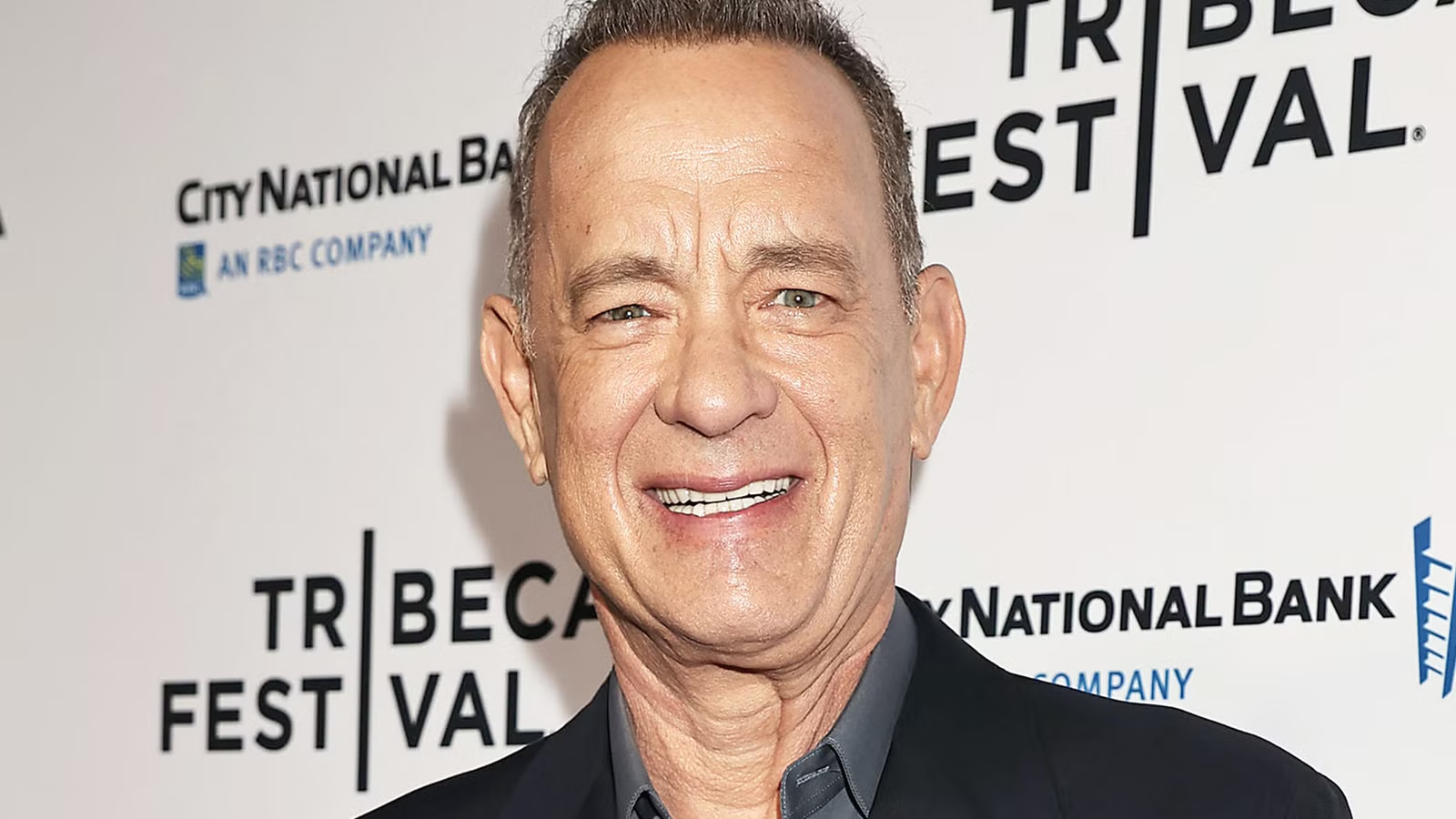
There was a point where Greyhound felt like one of those pandemic-era releases that might quietly fade with time, remembered mostly for the circumstances of its debut. That clearly hasn’t happened. Tom Hanks’ compact World War II thriller has found another wave of attention on Apple TV, where it is once again among the platform’s biggest movies. With a sequel in the works, the timing of that resurgence feels pretty ideal.
The film stars Tom Hanks as Commander Ernest Krause, alongside Stephen Graham, Rob Morgan, Elisabeth Shue, Karl Glusman, Tom Brittney, Manuel Garcia-Rulfo, and Lee Norris. Written by Hanks and directed by Aaron Schneider, the film follows a U.S. Navy commander leading an Allied convoy across the Atlantic while being stalked by German U-boats. It’s a stripped-down, high-tension war movie, and that focused approach is a huge part of why it works.
Collider Exclusive · Oscar Best Picture Quiz Which Oscar Best Picture Is Your Perfect Movie? Parasite · Everything Everywhere · Oppenheimer · Birdman · No Country
Five Oscar Best Picture winners. Five completely different visions of what cinema can be — and what it can do to you. One of them is the film that was made for the way your mind works. Ten questions will figure out which one.
🪜Parasite
🌀Everything Everywhere
☢️Oppenheimer
🐦Birdman
🪙No Country for Old Men
01
What kind of film experience do you actually want? The best movies don’t just entertain — they leave something behind.
02
Which idea grabs you most in a film? Great films are driven by a central obsession. What’s yours?
03
How do you like your story told? Form is content. The way a story is shaped changes what it means.
04
What makes a truly great antagonist? The opposition defines the protagonist. What kind of opposition fascinates you?
05
What do you want from a film’s ending? The final note is the one that lingers. What do you want it to sound like?
06
Which setting pulls you in most? Where a film takes place shapes everything — mood, stakes, what’s even possible.
07
What cinematic craft impresses you most? Every great film has a signature — a technical or artistic element that makes it unmistakable.
08
What kind of main character do you root for? The protagonist is the lens. Who you choose to follow says something about you.
09
How do you feel about a film that takes its time? Pace is a choice. Some films sprint; others let tension accumulate slowly, deliberately.
10
What do you want to feel walking out of the cinema? The best films leave a mark. What kind of mark do you want?
The Academy Has Decided Your Perfect Film Is…
Your answers have pointed to one Oscar Best Picture winner above all others. This is the film that was made for the way your mind works.
Parasite
You are drawn to films that operate on multiple levels simultaneously — that begin in one genre and quietly, brilliantly migrate into another. Bong Joon-ho’s Parasite is a film about class, desire, and the architecture of inequality that manages to be darkly funny, deeply suspenseful, and genuinely shocking across a single extraordinary running time. Your instinct is for cinema that hides its true intentions until the moment it’s ready to reveal them. Parasite is exactly that — a film that rewards close attention and punishes assumptions, right up to its devastating final image.
Everything Everywhere All at Once
You want it all — and this film gives you all of it. The Daniels’ Everything Everywhere All at Once is one of the most maximalist films ever made: action comedy, multiverse sci-fi, family drama, existential crisis, and a genuinely earned emotional core that sneaks up on you amid the chaos. You are someone who responds to ambition, who doesn’t want cinema to choose between being entertaining and being meaningful. This film refuses that choice entirely. It is overwhelming by design, and its overwhelming nature is precisely the point — because the feeling of being crushed by infinite possibility is exactly what it’s about.
Oppenheimer
You are drawn to cinema on a grand scale — films that understand history not as a backdrop but as a force, and that place their characters inside that force and watch what happens. Christopher Nolan’s Oppenheimer is a film about the terrifying gap between what we can do and what we should do, told with the full weight of one of the most consequential moments in human history behind it. You want your films to feel important without feeling self-important — to earn their ambition through sheer craft and the gravity of their subject. Oppenheimer does exactly that. It is enormous, complicated, and refuses easy comfort.
Birdman
You are drawn to films that foreground their own construction — that make the how of the filmmaking part of the what it’s about. Alejandro González Iñárritu’s Birdman, shot to appear as a single continuous take, is cinema examining itself through the cracked mirror of a fading actor’s ego. You respond to formal daring, to the feeling that a film is doing something that probably shouldn’t be possible. Michael Keaton’s performance and Emmanuel Lubezki’s restless camera create something genuinely unlike anything else — a film that is simultaneously about creativity, relevance, self-destruction, and the impossibility of ever truly knowing if your work means anything at all.
No Country for Old Men
You are drawn to cinema that trusts silence, that refuses to explain itself, and that treats dread as a form of meaning. The Coen Brothers’ No Country for Old Men is a film about the arrival of a new kind of evil — implacable, arbitrary, and utterly indifferent to the moral frameworks we use to make sense of the world. It is one of the most formally controlled films ever made, and its controlled restraint is what makes it so terrifying. You want your films to haunt you, not comfort you. You are not interested in resolution if resolution would be dishonest. No Country for Old Men is honest in a way that most cinema never dares to be.
Is ‘Greyhound’ Worth Watching?
Collider’s review stated that Greyhound is a straightforward story but it does what it says on the tin. Instead of building a big story around its crew, it drops viewers straight into a World War II naval mission and keeps the entire thing focused on the threat, with the result being a tight, tense thriller that feels focused from start to finish. Director Aaron Schneider keeps the battles clear, urgent, and easy to follow, even when the naval language gets dense. The movie does a great job of making the combat feel immediate and real. It pulls you into the middle of the fight and keeps you there.
“Some viewers may want more meat on the bones of Greyhound. They may care about the personal lives of the crewmembers and need that entry point to be invested in their story. I get that, but for me, Greyhound is a thrilling and captivating ride that brings a fresh perspective to a World War II story that feels like it could use some more attention. Schneider and Hanks wanted to put the viewer in the middle of the action, and they accomplished exactly that with their straightforward, unvarnished military drama.”