
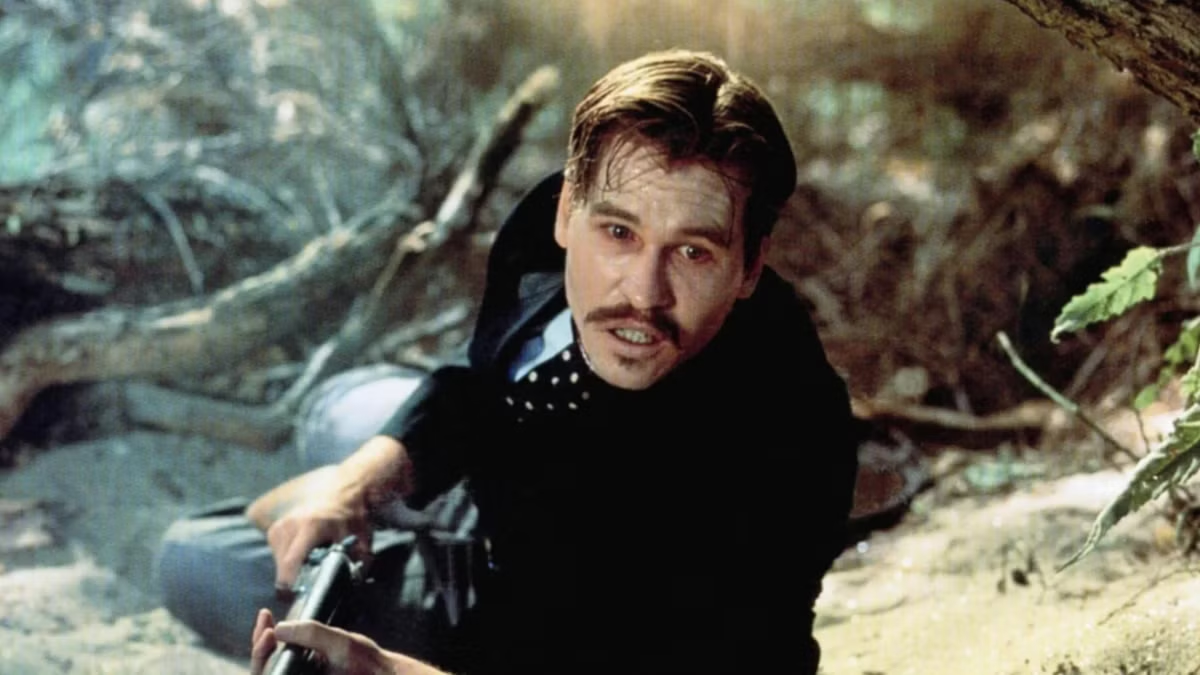
There are few on-screen performances throughout the Western genre that can truly rival what Val Kilmer was able to achieve as Doc Holliday in Tombstone. The popular action Western rode high off the coattails of Academy Award-winning romps like Dances with Wolves and Unforgiven, garnering a massive cult following that has grown into a worldwide sensation. Just about everyone (even those who don’t love Westerns) loves Tombstone, and Kilmer’s remarkable performance is one of the many reasons why. Interestingly enough, the actor ultimately decided to take the part upon reflecting on the advice that Hollywood legend Marlon Brando gave him years earlier.
Marlon Brando Told Val Kilmer That Everyone Needs To Make a Western
Marlon Brando probably isn’t the first person who comes to mind when you think of the Western genre. Although he made several in his lifetime, including his directorial debut One-Eyed Jacks and gritty pictures like The Missouri Breaks, he never quite took off as a genre star. However, Brando held the Western in high regard, with a reverence for the genre that he would pass on to his friend Val Kilmer in his declining years. In Kilmer’s aptly-named memoir, I’m Your Huckleberry, the Tombstone star begins his chapter “Doc Holidays” by noting that it was Brando who once told him that every actor had to make a Western at some point in his career, a remark that took him by surprise. “You know damn well why,” Brando replied when Kilmer inquired further. As the actor-turned-author went on to elaborate, he believed that “Americans have to deal with the West and its glorious, sordid, and sadistic past,” noting that the tension within the drama — which is based on a brutal and often unforgiving time yet reflected on with almost romantic interest — is riveting to American audiences. It is this complicated relationship between the truth of the American past and the mythic Wild West that Kilmer found an interest in Doc Holliday.
Robert Mitchum’s Role in ‘Tombstone’ Is So Underrated and Low-Key, You Probably Missed It
Mitchum’s role was an intentional throwback to the classic era of Westerns.
“The archetype of the gunslinger, played with a naturalism that only Brando could invoke, is ever present,” Kilmer waxed poetically about the genre’s place in the modern world. “I could never give up the chance to play such a character. That’s why when I had the chance to play Doc Holliday, I grabbed it.” For Kilmer, playing such a fabulous part in an already fabulously written Western felt like an obvious “yes.” Brando’s insistence that any serious actor must engage with the Western at some point in his or her career had seeped into Kilmer’s way of thinking.
Though the Tombstone star chalked Brando’s comments up to a brand of “Americanism” he thought the Hollywood star was promoting, his reflections on the genre as a means of American self-examination leads to an interesting interpretation of his take on the mythic Doc Holliday. Indeed, it’s easy to see how Kilmer evokes an almost Brando-like quality in his performance in Tombstone. The way he commands the screen demands the attention of the viewer, even while in the company of plenty of interesting characters and already recognizable stars. Perhaps Kilmer meant his work as Holliday to be a tribute of sorts to the classic Hollywood star, given his insistence that the Western ought to be a rite of passage for American actors.
‘Tombstone’ Is Considered Val Kilmer’s Most Impressive On-Screen Achievement for a Reason
Of course, “phenomenal” doesn’t even begin to describe what Kilmer achieved on the big screen as Doc Holliday. Not only did he effortlessly steal the show from Kurt Russell, of all people, but he delivered a performance (among a heap of impressive performances) that would come to define his career. More than that, some might argue that his part in Tombstone is one of the defining performances in the entire genre. The way he evokes a slow, Southern-ish flair mixed with warring desires to either fight or crack a joke depending on his mood has become the gold standard for any iterations of the character since. Inferior imitators have done their best Kilmer impressions on the screen when attempting to bring Doc Holliday to life, and even those who succeed at truly making the role their own still fall short of what we see here.
For Kilmer, some of the attraction to a Western — be it his role as the title outlaw in Billy the Kid or as Doc Holliday — was that he could say something about the American way of life that would be anchored in history but relevant to the times. The way he speaks about the Western genre in his memoir truly encapsulates what he’s trying to do on the screen in Tombstone, and, interestingly enough, it’s Marlon Brando of all people, who we have to thank for it. Brando may not have been involved in the production of Tombstone — considered by some to be a perfect Western — but without his insistence on the genre’s prominence (and importance) in Hollywood, it’s possible that Val Kilmer would have passed on Doc Holliday altogether.
