
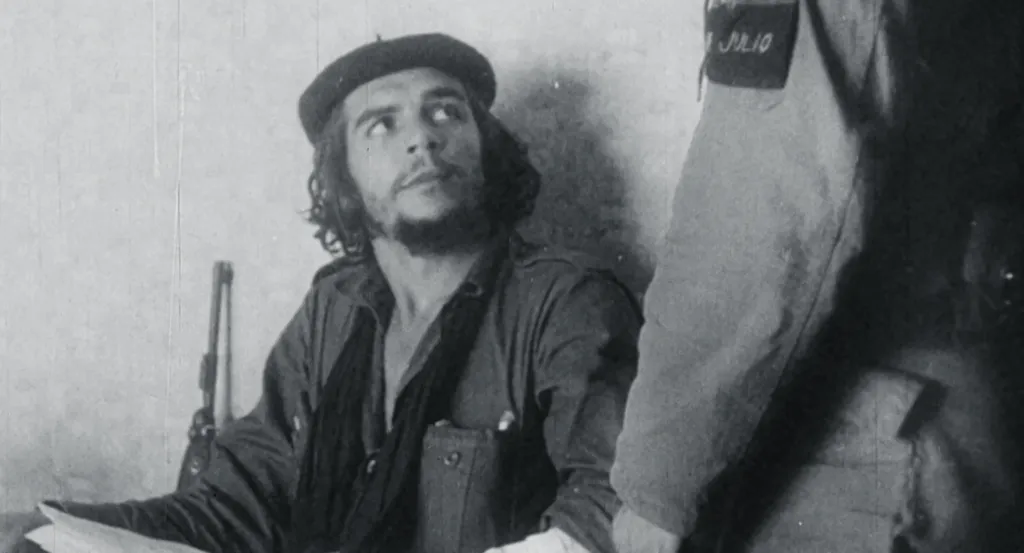
Che Guevara: The Last Companions (Les Survivants du Che) begins with stark images of Guevara’s body laid out on a table. Officials in Bolivia wanted it widely known they had captured and killed – executed, in fact – the famed rebel commander who had helped lead the Cuban Revolution.
His body was thin, almost frail – evidence of the extreme duress Che endured as he tried to foment revolution in Bolivia, advancing through jungle and mountainous terrain. He wasn’t alone – around him were loyal guerrillas who lived and fought as he did. Che Guevara: The Last Companions, directed by Christophe Dimitri Réveille, examines what took place in Bolivia with Che and his fighters, and how those who escaped initial capture tried to make it out of Bolivia alive.
Remarkably, decades after the events in Bolivia, the filmmaker was able to make contact with Che’s surviving fighters in Cuba and France. He describes his film as a “work of memory. As if I had become the custodian of these ‘testamentary’ testimonies, and they should not be buried in the silence of oblivion… It is by crossing the journeys of each person involved that I was able to revisit, as faithfully as possible, this decisive moment in the second half of the twentieth century.”
Benigno in ‘Che Guevara: The Last Companions’
Pentacle Productions
The first Che comrade Réveille met was Benigno, whom he tracked down in Paris in the 2000s. They collaborated on the guerrilla’s memoir, Benigno: Che’s Last Companion, and later a graphic novel, Benigno: Memoirs of One of Che’s Guerrillas. Réveille would go on to meet Urbano and Pombo, also key to Che’s ill-fated campaign in Bolivia.
“I was impressed because when you meet one of them already, it’s unbelievable, but when you meet all of them at the end, you’re like, ‘Okay, this is amazing,’” Réveille tells Deadline. “Because they are all personal stories. Each character can be a movie by himself.”
He adds, “It took time to go back there to find the right contact, to find the right person, to get in touch with them. That’s why [the documentary] took 22 years.”

Bolivian officials display the body of Ernesto “Che” Guevara on October 10, 1967 in Vallegrande, Bolivia.
MARC HUTTEN/AFP via Getty Images
It’s easy, in retrospect, to consider Guevara’s escapade in Bolivia an act of folly. After the 1959 overthrow of the Batista regime in Cuba, he tried to bring revolution to Congo before heading to South America. But it’s important to remember that the Cuban Revolution itself was a far-fetched idea, given that Batista was allied with United States, the superpower only a few miles’ distance across the Straits of Florida.
“It works the first time,” Réveille notes of the Cuban Revolution. “They thought it will happen in Congo and then in Bolivia. But they thought about history and I think they forget about geography.”
Animation in ‘Che Guevara: The Last Companions’
Pentacle Productions
In the absence of archive footage of Che, Benigno, Pombo, and Urbano and comrades in the jungles of Bolivia in the 1960s, the director turned to animation to illustrate the story.
“I wanted to put the audience in their shoes. So, I was like, ‘I have to use something.’ I impose the idea [of animation]” Réveille explains, confessing that he had doubts it would work. “Suddenly, I was scared after a test and my producer luckily says, ‘Christophe, trust yourself. It works. Really, we are not involved like you. We are third eyes on your movie. It’s going to get expensive for us. We’re going to find the money, trust yourself. We find the money, go ahead, keep going with that idea.’”
Régis Debray (left) and director Christophe Dimitri Réveille at the photocall for ‘Che Guevara: The Last Companions (Les Survivants Du Che)’ at the 79th Cannes Film Festival on May 20, 2026.
Victor LOCHON/Gamma-Rapho via Getty Images
Che Guevara: The Last Companions is not a one-sided telling of the story or an attempt to further mythologize Che. Réveille also tracked down key figures who opposed Guevara’s revolutionary activities in Bolivia, including Gary Prado, a Bolivian military officer who led the company of Rangers that captured Che in 1967, and Félix Rodriguez, who had fled the Cuban Revolution as a teenager and was later recruited to work for the CIA. Rodriguez was present at the building in La Higuera where Che was held and where Guevara was executed on the orders of the Bolivian government. Réveille also interviewed Régis Debray, an author and leftist intellectual who supported Che.
“At the end, I tried to let everyone say his truth,” Réveille says. “We don’t judge.”
In an interview included in press notes for the documentary, the director expands on his vision of providing a balanced view of history.
“When I first went to Bolivia, I was the first one to think, ‘Gary Prado is a bastard!’ But actually, he isn’t,” he said. “As [Prado] says in the film, ‘Our job as soldiers was to defend our country.’ I’m not saying he was right, but you can understand where he was coming from. I had already met Benigno, which helped me quickly track down the military men, the CIA agent [Rodriguez], the guy from the Bolivian Communist Party (El Negro). They all said, ‘This kid [Réveille] is asking interesting questions, we should meet him.’ And that’s how I managed to collect all these testimonies.”
Che Guevara: The Last Companions is an official selection of the Cannes Film Festival, premiering in the Special Screenings section. It comes at a time when the Cuban Revolution led by Fidel Castro, Che Guevara and associates faces possibly the greatest threat to its continued survival. Earlier this year, the Trump administration removed one of the last pillars of support for Cuba by ousting Venezuela’s leftist leader, Nicolás Maduro. Without access to Venezuela’s oil, the island nation cannot power its electric grid.
What’s more, earlier this week the Trump Justice Department indicted Raúl Castro, Fidel’s 94-year-old brother and a former president of Cuba himself, on murder charges, in connection with Cuba’s downing of civilian aircraft in 1996 that were carrying Cuban exiles.
Director Christophe Dimitri Réveille
Pentacle Productions
Réveille says given the circumstances in Cuba, he feels ambivalent about unveiling his documentary at the world’s most glamorous film festival.
“The Cuban people, they are suffering and me, I’m in Cannes enjoying with my movie. It’s a kind of schizophrenic situation because I feel guilty,” he admits.
Many of the people he interviewed, including Benigno, have since passed on. “I did this movie for them to tell their story,” he says. “I’m sad that like 90 percent of them, they will never see the movie.”
