
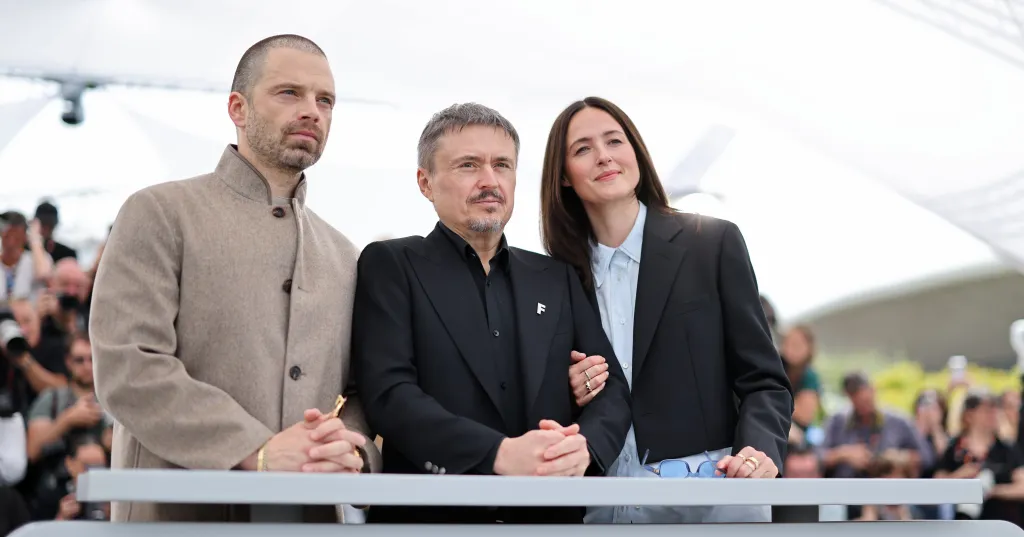
During a break from shooting The Batman: Part II in the U.K, Sebastian Stan sat down with Deadline at Cannes to chat about his latest film Fjord, which premiered at the festival last week in Competition and received an extraordinary 12-minute standing ovation.
Speaking alongside co-star Renate Reinsve and 2007 Palme d’Or-winning writer-director Cristian Mungiu, Stan mused on his decision to take on risky roles — in 2024 he played Trump in The Apprentice, and now, in Fjord he is a deeply religious man who admits to occasionally slapping his children.
“I just love that the movie wasn’t necessarily telling you exactly what to think or how to feel, but really just presenting you the situation and making you think,” he said. “I think for people that go see the movie at the end when they walk out of it, they’re going to have a moment with themselves where they’re actually reflecting about what came up for them when they were watching the movie and that’s what’s really more important.”
Sebastian Stan in ‘Fjord’
NEON
In the film, based on the experiences of a real-life Romanian family, Stan and Reinsve play Mihai and Lisbet Gheorghiu — immigrant parents of five children who move from Romania to Lisbet’s small Norwegian hometown. When a neighboring family spots bruises on the couple’s daughter, the Gheorghui family are torn apart by a child services investigation.
Mungiu said he was very grateful to Stan for choosing the role — his first in his native Romanian language — in a film that’s far removed from the sort of mainstream experience Stan might typically be expected to choose. “They were very generous with me, especially Sebastian,” Mungiu said. “He comes from mainstream cinema, where taking risks is not precisely the regular sport — you’d just prefer to be on the safe side.”

Renate Reinsve and Sebastian Stan with their on-screen family in Cristian Mungiu’s ‘Fjord’.
NEON
Stan added of immersing himself in risky roles: “As actors, obviously we have to leave that all behind and then just follow the script and concentrate on the story and the scene and what needs to be done. And I think that’s what we did. I think it really depends a lot on the leadership and the director. And we were very lucky because we were in this beautifully isolating environment between these mountains every morning.”
Mungiu also paid homage to Reinsve’s absolute dedication to the role of Lisbet: “This is so different from what she did before, but she was also very generous in trying to understand. And I believe that there is something in her that corresponds to the character, and she was very generous to look inside… So I just wanted to mark this a small moment of gratitude.”
I was happy also with the first reaction of the press, but of course we need to wait some 10 years, 20 years, to see if we made a good film or not, because that’s the only thing that qualifies a good piece of cinema.
Cristian Mungiu
The film explores prejudice against immigrants — something that struck a chord with all involved. “A big theme in the movie is really trying to understand someone who comes from somewhere else and something else and a different culture,” Reinsve said. Playing Lisbet was, she continued, “really led by her values and the fact that they’re so different than mine, and exploring that because she lives a totally different [life], the opposite life of me. Her religion, her values really dictate her life. And I think she’s so humble to the life she lives.”
Addressing the film’s Cannes standing ovation and reviews thus far, Mungiu said, “I’m very happy for this reception. At the same time, I’ve been so many times in Cannes. I know that what matters more is for the film to have a long life, and this life has only started with the premiere. It’s good to have such a start. I was very happy, first of all, to see how people reacted during the film. People weren’t really moving too much on their chairs even if this is a long film, and I was very happy as soon as I got out of the cinema to see that the film was already provoking people to have very different ideas about what they’ve seen. And whenever you’re trying to do something which is polemic, and you speak about a society which is polarized, it’s good if you are hearing conflicting opinions once you get out.”
He added, “I was happy also with the first reaction of the press, but of course we need to wait some 10 years, 20 years, to see if we made a good film or not, because that’s the only thing that qualifies a good piece of cinema.”
To see the full conversation, click on the video above.
The Deadline Studio at Cannes is sponsored by SCAD.
