
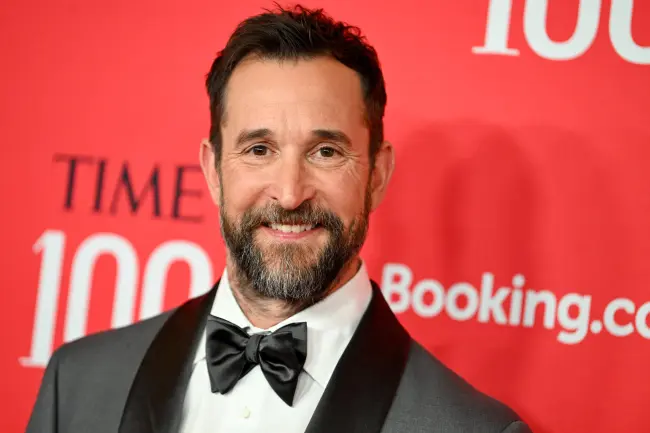
Let’s get the tough question out of the way: Yes, Dr. Robby (Noah Wyle) is going to be OK.
Not that there was really any risk of the show’s Emmy-winning star not coming back for the third season, but things were definitely looking prettttty dark for Dr. Robby in the later episodes of Season 2. But after unloading on nearly everyone on staff, a heart-to-heart to Abbott (Shawn Hatosy) seemed to anchor him — not to mention some swaddle time with Baby Jane Doe.
“We start Season 1 with a guy that doesn’t even know that he has a problem,” Wyle tells Gold Derby in our video interview (watch above). “Season 2, there’s no denying that he has a problem, he needs help. Season 3 is the beginning of that process to bring him to being hopefully a full fledged, three dimensional individual who’s capable of love and balance and all of those things that he’s struggling with.”

Here, Wyle talks to Gold Derby about his work in front of and behind the camera on The Pitt, from the writers’ room (“the college I always wanted to get into”) to directing (“Bill Russell in the Boston Celtics”) to being number one on the call sheet (“occasional purveyor of snacks and drinks”). He also opens up about those cast changes — “It was really hard,” he admits — and what lessons they’ve learned that they’ll bring to the upcoming third season.
Gold Derby: Given the success of Season 1, what did you want to accomplish with Season 2?
Noah Wyle: To avoid the proverbial sophomore slump. First and foremost, to try to at least hit the bar that we had set for ourselves in Season 1. To not succumb to the pressure to do it bigger, funnier, faster, bloodier. But just try to do it again with the same degree of honesty and thoughtfulness that we did the first time. [Executive producer] John [Wells] was wonderful about laying down that mandate about this isn’t about trying to outdazzle them and do what we did last year better. We just need to do what we did last year. So, just stay true to the characters and put as much of ourselves in there.
What were some of the lessons that you learned from the first season that you wanted to bring to the second season?
The reaction that we got and it was more proof of concept because it was fairly speculative in Season 1. Is the show going to work without music? Is the real-time format going to be what we want it to be? Will people be able to follow a storyline that we touched on in the beginning and don’t come back until the end? When all of that came back overwhelmingly positive, then we thought, “OK, then we can introduce an abandoned baby in the first episode, and we can pay that off with one of our characters at the end of the season. We can start to be strategic in how we plan things to harvest in later episodes, and with the confidence of knowing that people are going to be engaged in a runner that’s about the food that goes in the fridge in the doctors’ lounge.” But the minutiae and the small interactions between characters was just as gratifying as the big, very splashy medical scenes.
You wear many hats on the show — actor, producer, director, writer. How do you balance them all?
I have a large head, apparently. [Laughs.] I’ve been granted access to just about every level of this production, and I’m really gratified to be able to work with the incredible people that work in all these different departments. I am incredibly invested in this particular job. I wanted to be part of the writing staff. Directing has become something that I really enjoy because it’s a total collaboration. I play cheerleader, I play occasional purveyor of snacks and drinks. Mostly I just try to be somebody who leads by example, shows up every day committed and prepared and ready to do anything that I would ask anybody else to do.
So let’s talk about playing Dr. Robby. I’ve talked to all of your co-stars at this point, and they’ve all called your performance this season “brave.” What does that mean to you?
I don’t know. [Laughs.] I guess they’re probably referring to an emotional honesty that we get to in the latter rounds of both Season 1 and Season 2, where the professional mask really does fall away and you’re looking at just raw brokenness, as much as I can muster. You know, we work in a very cloistered environment. We’re in that environment for nine months. This level of trust that we build up among our cast and crew and background and foreground is really considerable. So I don’t particularly see it as brave having to emote or go to certain places in front of people, especially when you have that much trust in the ensemble in the company that you’re involved in. So to me, I feel very supportive and supported.
How does Robby compare to you for you to other roles that you played?
Age-appropriate? [Laughs.] I feel like I’m using a lot of where I’ve been, who I’ve been, and what I want in this role. I’m owning it with a degree of relaxation and intentionality that I don’t know that I’ve brought to my work before. I’m so grateful and humbled at the response that this show is having. The profound effect that this show is having is really gratifying. And I take it to heart that helping to be responsible for some of it is right now being viewed as a net positive. And we all need a net positive right now. So I’m quite happy.
Given that you have so many other roles on the show as a writer, director, and producer, how does that inform your work as an actor?
It helps in terms of being able to be a communicator to the rest of the people, when you’ve been in the writing room and you know the intention only behind not just a line, but a storyline or a scene. I loved the triangulation between those two camps. It’s all collaborative and you want everybody to have the same degree of investment and understanding in the story you’re doing. And then as soon as I hear “rolling,” all of that gets shut off. And years ago, anecdotally, I worked with an actor named Mike Wilson who said that before every take, Edward James Olmos turned his eyes to heaven and muttered something, and then he’d begin his performance. Mike went over to him, and said, “What did you say to yourself there?” And according to Edward James Olmos, Michelangelo, before he began any work of art, any creative endeavor, he would turn his eyes to the heavens and say, “Lord, rid me of myself, so that I may please thee,” which in actor speak is “Get me out of my head so that I can be relaxed and in the moment.” So I do that. I’ve stolen that from Mike Wilson, who stole it from Edward James Olmos, who stole it from Michelangelo. Before every take I say some version of, “Lord, rid me of myself.” And then I just let it go. Whatever happens, happens.
Talk about being in the writers room. What does that mean for you?
To me, that was the college I always wanted to get into, and it’s a tough course to get into. Writers are a particular bunch. That’s the blank page. That’s zero to 60. That is where it all begins. I love being part of that collegial process of throwing things on the wall, trying to figure out how to make it stick, building off things that you have already set into motion and then pulling from your entire life everything you’ve ever learned, everything you’ve ever been interested in, any bit of trivia, suddenly it all becomes applicable and you and your life experience is singular and fits in with a chorus of voices that are also singular. I find that process to be incredibly fascinating.
Where do you get your ideas from?
Right now I’ve got this mandate to myself to keep my ears just open and my antenna out because I find that the right messages for the times are always floating around. Artists have a tendency to have their antenna open, and they catch them. And then your head is a bit of a vessel to bring into the world when they come into the world. So I try to keep my antenna open and you never know. The other day I heard somebody say something I thought was really interesting. And so I started doing a little research on it and that becomes an interesting character for a script. I’m writing episode three right now for Season 3. So it all finds its way in somehow.
And then what about directing? What does it mean to you to be able to direct for the show?
That, to me, is getting to be Bill Russell in the Boston Celtics when he was both a player and coach. It’s being able to use your experience and communication skills to bring a whole lot of different people with a lot of different points of view into a singular focus and marshal everybody downfield in that in one direction. I love that the cast responded as well to me doing it as they did. And I love that I’ll be able to do it again and build on my own confidence of having done it. Going forward, I’d love it to be part of the architecture of each season keeps me engaged, certainly. And I feel like I understand the show very well.
The show feels like a masterclass in directing. How do you even begin to approach it?
Humbly, of course, with great humility. I believe when you write a show, you write in the voice of the showrunner. When you direct the show, you direct in the style of the pilot. So I looked closely at John’s pilot, and John has got a bit of a syllabus on the lenses that he likes to use, and the composition we want to employ. And there is a filmic language to The Pitt that gives you a little bit of a roadmap. But I actually find that writing is the best prep for directing, because as you write, you have to concentrate on where you want to move that energy ball in the room. And directing is just putting that camera wherever that energy is going.
What do you think it is about the show that people have responded to so much?
I think it’s basic humanity. You know, it’s funny. I went to New York a couple of months ago to see George Clooney make his Broadway debut in Good Night, and Good Luck playing Edward R. Murrow. And I said, “I think both of our projects benefited from the election going the way that it did, because if we were living in a Harris America, I’m on a good medical show and you’re doing a vanity project. But right now you’re a patriot going out and speaking really important truths eight times a week to people who need to hear it. And I’m on a show that’s being a lighthouse, reminding people that there’s really smart, compassionate, dedicated people out there picking up our broken pieces every day and they deserve the spotlight again.” So I think we’re benefiting from the times that we’re living in to a degree, but we’re also speaking to them.
I’ve heard you refer to it as competence porn.
Yes. Only because I like to refer to myself as a competence porn star. [Laughs.] It’s not just the wish fulfillment of knowing that people who are out there doing those jobs. It’s smart. It’s also a kind of inner longing to be engaged in work that has equal meaning, that if you happened upon an accident site, if you actually had the skill set to be of use, how incredible would that be? When your plumbing breaks and you know how to fix it, or your car broke — capable, competent skills seem to be rare these days in the work that most of us do. And yet we want our work to have meaning, and we want to know that it has lasting value and that if we disappeared, we would be missed and that we bring something singular to it because of who we are. All of that comes through when you watch The Pitt. It’s a bit of a mirror of, do I have it in my life? I want that in my life. How do I find it?
How do you balance the real-world issues that you want to bring into the show with?
It’s usually starts with the characters, and the arcs that feel most organic to them, and then you try to find the medical cases that would help facilitate those arcs or be obstacles in them reaching those arcs, and then you want a little bit of sociology, what’s happening in the world right now. The people that are in these jobs talk about when they’re at work, what are their pressures, what are their dreams? What are the things that make it difficult? I did a deep dive the other day where I thought, the average low income apartment in Pittsburgh right now is about $900. If you were making $7.25 minimum wage, at the end of the month, you have a discretionary income of about $5.50 to spend per day on anything that isn’t rent. That’s food, other bills, transportation, daycare. Whatever your burden is, you have $5.50 a day to spend on it right now. So in the richest country in the world, the fact that that’s a reality for so many people is egregious. We tell a story about that population.
There have been a lot of headlines about the cast changes. Can you explain the thinking behind them?
It’s hard, it’s really hard. You become like a family when you work this intensely with each other, especially when you start something speculatively and have it hit like this. It binds you together in a friendship and collaborative alignment that’s really powerful, and it’s really hard to say goodbye to…. It is a really awkward period of time on our set because we’re playing with real people, we’re playing with real emotions and investment, and it’s a great place to work and a hard place to leave. And yet, over the course of this show’s lifetime, we’re going to have a lot of changes in front of the camera and behind the camera as part of our narrative and because situations will dictate it and it’s never going to be easy. But I do believe that the longevity of the show and its sustainability is in keeping that rotational narrative going and bringing in new characters, because that is the environment of an emergency department. It is a transitory place and people don’t stay there forever unless they do so at the cost of the room itself. That’s the story we tell.
What do you want to see for Season 3?
Relevance. I want this to not feel like it’s jumped the shark. I want it to feel like we’re still in the momentum of the storytelling we’re doing and still reflective of the environment that we’re portraying. That’s it. It’s really about as the show scales larger globally, keeping our perspective local and remembering that the more specific you make a storyline, the more universal it can be felt. And there’s great power in that. There’s also great safety in that, because it’s not our job to take on the issues of the world. It’s our job to take on the cases that come into our emergency room. And if they reflect the issues the world, then so be it. But they don’t have to.
What would John Carter think of Dr. Robby?
Professional respect, for sure. They’re cut from very different cloth. And yet there’s an aspect to John Carter that I believe always wanted to be more like a Robby. And I think there’s an aspect of Robby that really wishes he could be more like a John Carter.
