
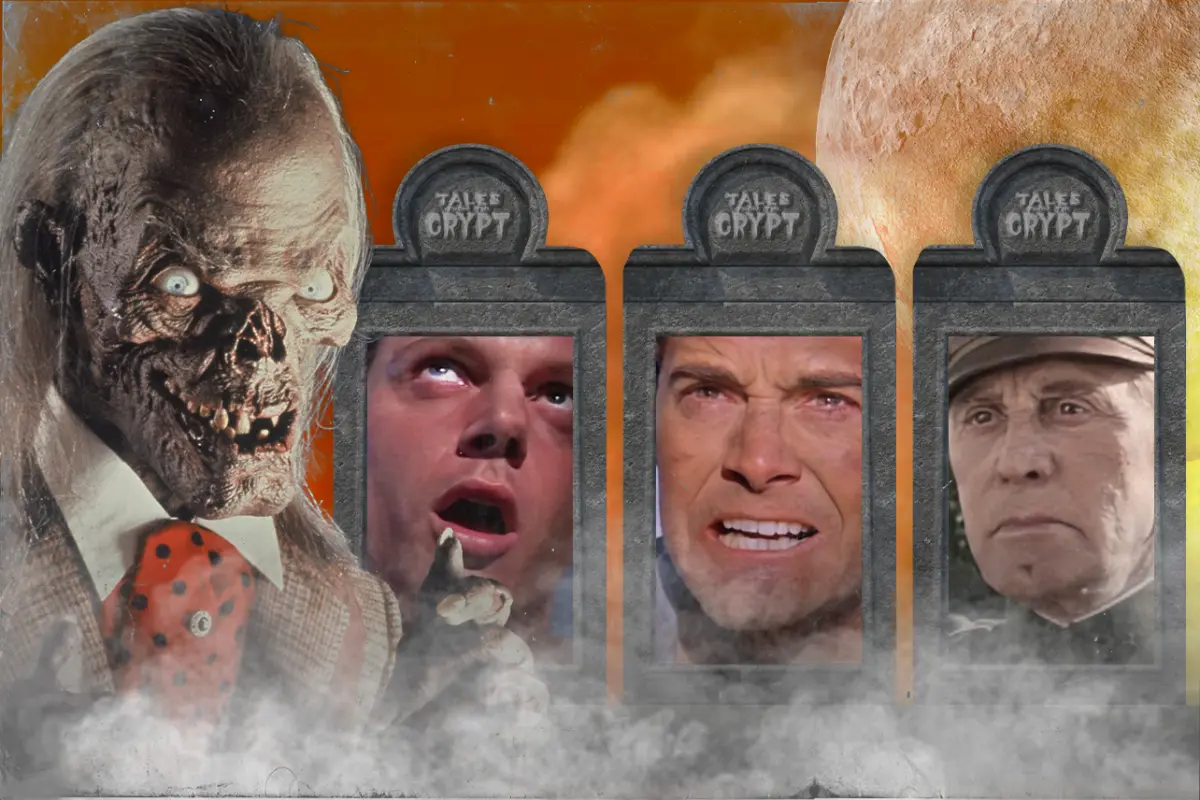
The third season drops with a bang as Tales from the Crypt enters into its “running on all cylinders” phase, where Michael J. Fox directs an episode (“The Trap”, Season 3 Episode 3) with a few zoom-y camera tricks he surely learned from Robert Zemeckis (and with an assist by James “Slacker, McFly” Tolkan, no less). The rest of the season features a bright constellation of stars popping in, like Teri Garr, Tim Roth, Malcolm McDowell, Whoopi Goldberg, Ke Huy Quan, Vincent Schiavelli, John Rhys Davies, Jon Polito, George Wendt, Mariel Hemingway, and David Hemmings. A real murderer’s row of talent, as they say.
Tough to pick just three episodes, so my honorable mentions go to:
Now that I’ve mentioned those very worthy episodes, here are my favorites from this season (in order of broadcast, not necessarily personal preference):
-
“Carrion Death” (Season 3 Episode 2)
Photo: Shudder DIRECTOR: Steven E. de Souza
WRITTEN BY: Steven E. de SouzaKyle MacLachlan is escaped serial murderer Earl Raymond Diggs, high-tailing it to the border when he’s identified by a heroic motorcycle cop (George DelHoyo) really dedicated to his job. Earl engineers a terrible accident and things are looking up, but the cop isn’t done. A nice, frantically-paced and kinetic series of events that reminded me a lot of Robert Harmon and Eric Red’s classic The Hitcher (1986) leads to evil Earl handcuffed to a cadaver. Could he have freed himself by amputating the stiff’s hand? Could he have eviscerated the corpse to retrieve the handcuffs’ key? Sure, but even better is the conception of Earl as a simple-minded goon driven by the whims of his sadistic, bestial impulses who, if he ever stopped to make a plan, might not find himself in his predicament in the first place. Director de Souza told me it’s one of the few of the episodes to be shot on location and he makes excellent use of it. You can feel the dust on your lips. He also reveals being inspired by Erich von Stroheim’s Greed (1924).
MacLachlan delivers in a role unusual for his affable, popular Twin Peaks persona (which, it should be noted, he was shooting at the time): he’s hyper-charged and physical, here, shirtless for most of it while giving us just a glimpse of his “possessed by Bob” mad-dog energy, paid off first in a queasy misadventure with a carelessly-wielded edged weapon, and landing finally in some of the best gore work in the entire seven-season run. One wouldn’t expect any less from legendary F/X wizard Thomas Bellissimo (Saw, The Mask, From Dusk Till Dawn). The real star of the show, though, is a persistent vulture: a kind of Chekhov’s carrion bird that appears in act one in such a way that one’s pretty sure the bird’s gonna go off by the third act. I love the incongruity of that kind of species of vulture in this location — a classic comic book logic of between fact and more interesting to look at, draw the more interesting to look at. When “Carrion Death” pays off, it does so in parts as nauseating as they are glorious. When it’s right, that’s Tales from the Crypt in a nutshell.
watch “carrion death” on shudder
-
“Abra Cadaver” (Season 3 Episode 4)
Photo: Shudder DIRECTOR: Stephen Hopkins
WRITTEN BY: Jim BirgeAn homage — or remake, if you like — of Alfred Hitchcock’s “Breakdown” (s01e07, Alfred Hitchcock Presents, 1955), but instead of a terrible car accident that lands its hero in a waking, locked-in death, this one centers on a brilliant but vengeful would-be surgeon Martin (Beau Bridges) who has a bitter bone to pick with his brother, Carl (Tony Goldwyn). To satisfy that pursuit, Martin concocts a glowing green (naturally) serum that essentially paralyzes its subjects. They’re fully conscious, you see, but appear to be dead, leading to a The Game-like episode in which a series of mean pranks ends in the worst possible way: on the business end of probes, embalming machines and bonesaws. Bridges is especially good as a smart, affable, ultimately mad as a hatter guy driven to doing what he does by what he sees as a missed opportunity to help others. It’s true, he’s a mad scientist via misunderstood martyr.
Bridges is one of the few actors able to carry off “unhinged” in a way that’s in the gonzo spirit of Tales from the Crypt, but remains at all times legibly human. It’s as hard to dislike him as it is easy to dislike Goldwyn. I thought it was interesting how Bridges plays a version of a brother driven by a brother he both loves and envies, as he does in Steve Kloves’ 1989 masterpiece The Fabulous Baker Boys. Similarly, it’s interesting how Goldwyn plays a version of the dude you just can’t trust in Jerry Zucker’s 1990 blockbuster Ghost. They’re effortlessly convincing and now I wonder if the casting was intentional… or lazy? Whatever the intent, the effect is invisible and effortless. They’re great.
Watch a dialogue sequence in the middle that covers much of the same ground as the “back of the taxi cab” actor’s workshop put on by Marlon Brando and Rod Steiger in On the Waterfront (1954). Here, it’s Martin bemoaning how he could have been a great surgeon (a contender!) to Carl who doesn’t know that Martin’s held a grudge and has targeted Carl for comeuppance for years. The last third of “Abra Cadaver” is dedicated to the delicious tension of “will they/won’t they?” as a team of morticians chat before a horribly-aware and totally helpless victim about how they’re going to go about vivisecting the “corpse” on their table. It’s nightmare fuel.
watch “abra cadaver” on shudder
-
“Yellow” (Season 3 Episode 14)
Photo: Shudder DIRECTOR: Robert Zemeckis
WRITTEN BY: Gilbert Adler, A L Katz, and Jim ThomasLt. Martin Kalthrob (Eric Douglas) is a WWI doughboy and a coward. His men hate him. His Captain, Milligan (Dan Aykroyd) suspects Martin’s a liability, too. But everybody’s hands are tied by the good lieutenant’s dad, General Kalthrob (Eric’s real-life dad, Kirk Douglas), who’s gotten Martin a command job through nepotism. One night, Martin’s cowardice leads to the decimation of his battalion while a lone survivor, Sgt. Ripper (Lance Henriksen) drops the hammer in front of the General. Humiliated, the General court martials his own kid, sentencing Martin to death by firing squad. “Yellow,” beautifully metered and directed by Zemeckis (in what’s possibly his best film after Back to the Future), comes to life in a scene between father and son where Martin argues that it’s madness to be labeled a coward for wanting to live and challenges society’s brutal notions of masculinity.
The cult of manhood is what’s on trial in “Yellow” — and the interplay between screen-legend Kirk and a son — who, in real-life, battled the demons of drugs and alcohol until his premature death at the age of 46 — carries with it a heartbreaking extra-textual profundity. Eric, the half-brother of Michael Douglas, aspired to the same kind of stardom as Michael and Kirk but was found lacking. The devastation of disappointing one’s dad is the real horror of “Yellow” which, unusual for the series, relies on neither gore (though there is some wartime injury) nor a major twist even if it has about it throughout the haunted feeling of an Ambrose Bierce story. The ending of “Yellow,” even without a sucker punch, is devastating, all of it anchored by a Kirk Douglas performance that works as a mirror darkly held to his noble Colonel Dax character from Kubrick’s Paths of Glory. Two approaches to the “war is hell” idea and two very different arguments to be made about who decides what the true price comes out to in the game of upholding dehumanizing systems. Dark and principled, “Yellow” is a joy.
watch “yellow” on shudder


Walter Chaw is the Senior Film Critic for filmfreakcentral.net. His book on the films of Walter Hill, with introduction by James Ellroy, is now available for purchase.
