
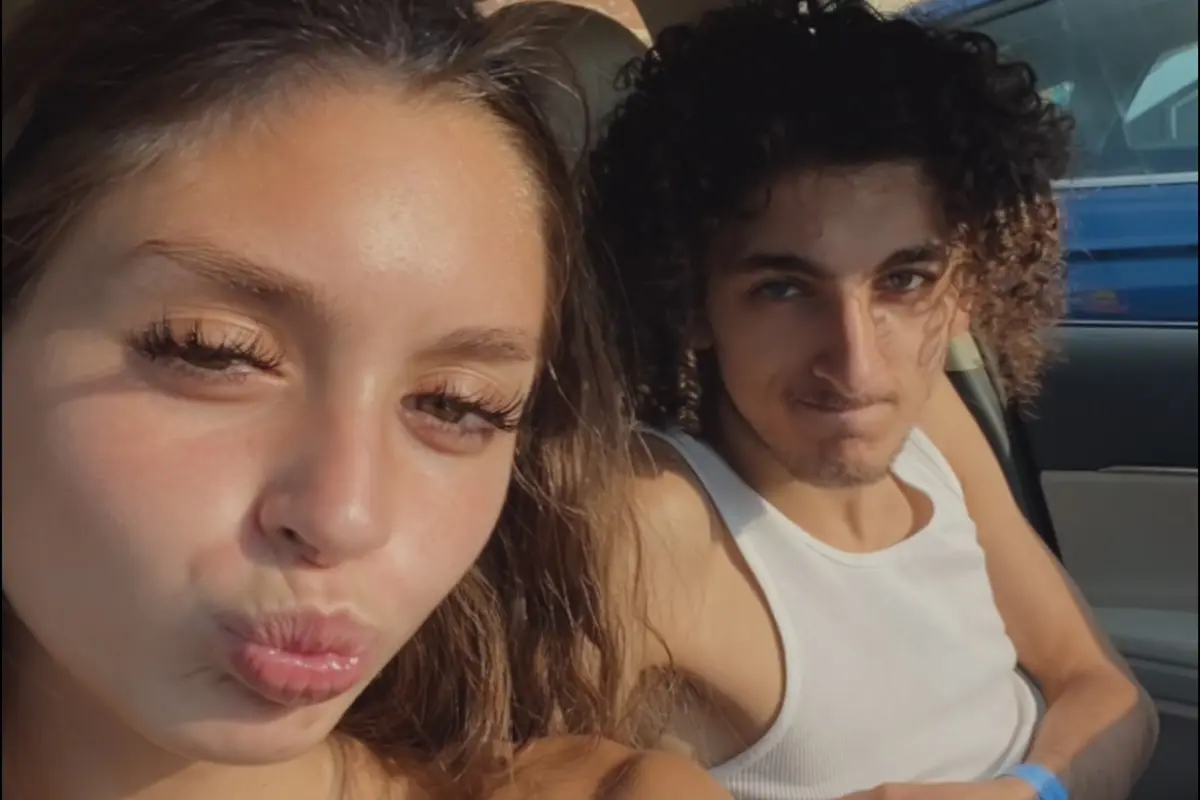
This week on Typically Depressing True Crime Theatre is The Crash, a reiteration of an awful tragedy that fits the Netflix-documentary template perfectly. In 2023, a judge determined that Mackenzie Shirilla crashed her car on purpose, killing Dominic Russo and Davion Flanagan; Mackenzie got two 15-years-to-life sentences, to be served concurrently. So we get a doc, helmed by Gareth Johnson (whose resume includes Shark Week content and a handful of true-crime series like The Puppet Master and The Body Next Door), structured as follows: A who-what-when-where first act. A looking-deeper-at-the-central-“character” second act. And a wow-they-interviewed-her-while-she’s-in-prison third act. No surprises here, then – but Johnson’s work may have enough of a journalistic bent to compensate for the film’s unwillingness to deviate from formula.
THE CRASH: STREAM IT OR SKIP IT?
The Gist: Strongsville, Ohio. At roughly 5:30 a.m. on July 31, 2022, Mackenzie was driving her Toyota with her boyfriend Dominic in the passenger seat and their friend Davion in the back. The film will eventually show us – via police evidence ranging from surveillance cams to black-box data – that she executed a perfectly normal right turn, then proceeded to stomp the gas pedal to the floor, reaching nearly 100 miles per hour. The car veered this way a little, that way a little, was bumped into neutral and back into drive. The brakes were never engaged before the car slammed into a brick building. The Crash opens with police bodycam footage of first responders on the scene. Dominic and Davion were dead when they arrived, and Mackenzie was pulled from the wreckage with significant injuries. As we look at horrific images of the mangled car, we hear one of the officers say, “This is the worst crash I’ve ever seen.” Mackenzie has to this day stuck to the assertion that she remembers nothing, and points at a diagnosed blood pressure disorder as a potential cause for her blackout.
Now, we know already that Mackenzie is in prison, but far be it for a true crime documentary to not question whether she deserves to be there. In this case, there seems to be enough of a crack in the story for a little light to shine through: “Was it an accident?” is the tagline on the poster, and the film spends 92 minutes gathering all the principals and posing the question. It also buries us in endless reams of Mackenzie’s selfie footage. She’s an apparent wannabe model and influencer, duck-lipping into the lens, flipping the bird, doing bong hits and/or posing with her four-year boyfriend Dominic or best friend Rosie Graham (who has more than 200,000 Instagram followers). She was 17 at the time of the crash, and a recent high school graduate. She liked to hang out with friends and party, and her social media feeds document all of it. Typical teenage stuff? Pretty much.
Atypical: In the second act, a slew of commentators – via interviews or footage of police interviews – characterize Mackenzie as cruel and vain, a school bully who’d curse people out and tell them to go kill themselves; cue selfie videos of her doing precisely that. She lived with 21-year-old Dominic, who appeared to be independently wealthy enough to buy her all manner of designer clothing and accessories. Her parents, Steve and Natalie Shirilla, appear in the film, defending her as someone who “never needed to be disciplined” and “mature enough” to move out and live with her boyfriend at 17. This is not the first time Mom and Dad Shirilla will look clueless, silly and utterly incapable of viewing the tragedy their daughter seems to have purposely caused with even the tiniest bit of objectivity. The film continues its Mackenzie-selfie barrage as it works through the details of her and Dominic’s volatile relationship, interviews friends and family of Dominic and Davion, chronicles the prosecutor’s investigation and documents the 2023 trial. And it builds to the big reveal that Mackenzie agreed to be interviewed for the film, her opportunity “to tell my side of the story.” It also sorta reveals that the Shirillas don’t seem to be doing themselves any favors.

What Movies Will It Remind You Of? Well, Unknown Number: The High School Catfish retains its crown for depicting the worst parenting ever. The story itself shares commonalities with a similar-ish case outlined in I Love You, Now Die. And stylistically, the film hews closely to the bodycam/social media/talking heads structure of other Netflix true crimers like American Murder: The Family Next Door.
Performance Worth Watching: Davion’s father, Scott Flanagan, comes off as the most reasonable and sympathetic commentator in the film.
Sex And Skin: None.

Our Take: The Crash feels a tiny smidgen less icky than typical Netflix true crime documentaries, which tend to leave us conflicted in the classical tabloid sense: Is it journalism, exploitation or some weird hybrid of both? I’d say the journalism/exploitation ratio here is about 50/50, and sitting firmly on the op-ed page, considering how Johnson tends to brush away any points to be made in Mackenzie’s defense, uses the second act as a means to paint her as a villain and wraps the film with a soft-focus tribute to Dominic and Davion. (Of course, not all journalism is noble and competently executed.)
The latter point is well-intentioned, especially in a culture that historically seems more fascinated by the motives of a murderer than the suffering of the victims and their families. I don’t know if the doc is better or worse for resisting the urge to indulge psychological speculation as to whether Mackenzie exhibits sociopathic behavior, but it seems weirdly incurious about how she might’ve reached the point where she’d risk her own life to hurt someone else. It doesn’t even bother to ask the question in general, or present an expert on the subject. Johnson’s talking heads are primarily authorities, friends and family, and the film struggles to contextualize the narrative beyond presenting some firm facts from the legal case and prompting us to interpret the avalanche of Mackenzie’s selfies as either normal teenage behavior or something more sinister.
Either way, you’ll get sick of seeing Mackenzie’s heavily orchestrated pouts and poses, because Johnson uses them as a narrative crutch. He also shows little interest in delving deeper into her character – he has a bevy of interviewees sympathetic to her, so why not ask them what her hopes and dreams are, or even the most bog-basic question of any recent high school grad, if she was planning to go to college? The film comes off cynical in its construction, less interested in asking tougher, deeper questions, instead bent on building to a couple of third-act reveals that jerk us around and hope to make our jaws drop, prompting questions as to Mackenzie’s guilt before heavily implying that she’s a shrewd, calculating personality.
Most damningly, The Crash never truly interrogates how or why social media plays such a significant role in Mackenzie’s life, or many teenagers’ lives, for that matter. We’re privy to mountains of her content and scads of internet comments about her, scrolling down our screens with their signature dopamine pings. The documentary seems to shrug at substantive conclusions, content with the scrolling internet commentary it seems designed to generate. It doesn’t seem to function in the best interests of the dead, the living or the story itself.
Our Call: The Crash is a mess. SKIP IT.
John Serba is a freelance film critic from Grand Rapids, Michigan. Werner Herzog hugged him once.
