
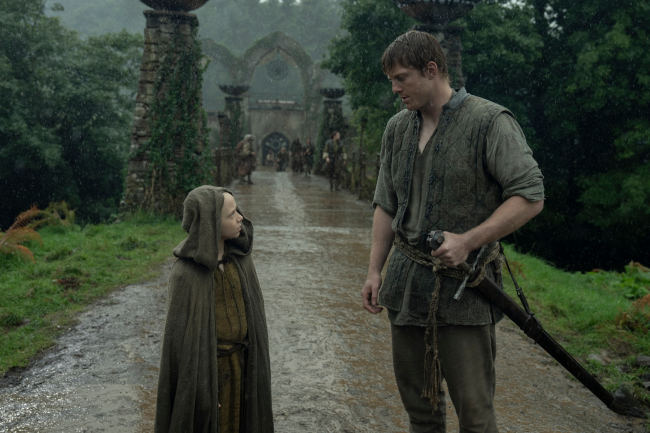
Westeros sounds different in A Knight of the Seven Kingdoms, and that shift began with composer Dan Romer. His score trades scale for intimacy, staying close to the characters and threading a subtle Western sensibility through the world of Dunk and Egg. That direction took shape through early conversations with showrunner Ira Parker, built around a deceptively simple question: how do you create “a score that feels like a Western, that feels like an old cowboy movie, but sounds like it takes place in Westeros.” From there, the process becomes one of fine-tuning, testing the edges of that idea until the balance feels right for the world.

A Knight of the Seven Kingdoms is HBO’s prequel series based on George R.R. Martin’s Dunk and Egg novellas, set a century before the events of Game of Thrones. Created by Parker, the show follows Ser Duncan the Tall (Peter Claffey) and his young squire, Egg (Dexter Sol Ansell), as they move through Westeros, navigating a story that stays closer to the ground and more personal in scale. The Thrones spinoff marks a clear tonal shift within the franchise. Romer, whose work also includes Luca and Beasts of the Southern Wild, builds a score shaped by proximity and restraint, often imagining “four, five, maybe six musicians standing around you and playing,” and letting the music expand only when the story demands it.
That approach carries through every layer of the score. The whistling emerges as something instinctive and character-driven, closely aligned with Dunk’s inner life rather than functioning as a surface-level motif. As the series unfolds, the score shifts with it, from the merging of Dunk and Egg’s musical identities to the introduction of a heightened Targaryen sound that leans into what Romer calls “old-school villainy.” Those choices build toward moments where the music opens out into something grander in scale, including the sequence where his themes sit alongside composer Ramin Djawadi’s iconic Thrones theme, a moment that resonates because it arrives at exactly the right point in Dunk’s journey.

In a conversation with Gold Derby, the Emmy- and Grammy-nominated composer (Station Eleven, Dear Evan Hansen) speaks about finding the balance between experimentation and restraint, shaping a sonic language that feels both familiar and new, and working closely with Parker to build a score that stays rooted in character while still opening the door to something bigger.
Gold Derby: A Game of Thrones prequel with a Western pulse, is a bit of a swing. Guitars, whistling, a more intimate feel, all set against a world originally shaped by Ramin Djawadi’s scale. So, when did you first feel confident that your approach truly belonged in this world?
Dan Romer: It was just something that we had to try, you know? It was an idea that Ira and I were talking about — the basic concept being, “How can we make a score that feels like a Western, that feels like an old cowboy movie, but sounds like it takes place in Westeros?” That sound was really found through a lot of experimentation, seeing how far we could push it in the cowboy direction, how much we could get away with, how little we could get away with. There were moments when we would try certain things and thought that it was way too Western sounding. And then, there were times when it was too standard sounding, too of-the-world sounding, so we need to push it a little further.
When you describe the goal of giving it a Western feel without actually sounding like a Western, what are the specific ingredients you allowed for to achieve that vibe?
I think it’s really important to think about what’s the middle of that Venn diagram. What’s the crossover between Western music and medieval music? We can’t, for example, use electric guitars, because those exist in this sort of cowboy Western world. Or using an actual drum set with a marching snare. We can do that in Westeros. Our thought process was the guitar is this very old instrument that’s gone through so many iterations. I’m not sure exactly what date it was said that “this is now a guitar.” But, you know, there’s so many things in the realm of plucked string instruments. There’s a ton of different ones from different cultures, so we were kind of thinking, let’s put some fake gut strings on this acoustic guitar, on this nylon string guitar, and tune it in a way that makes it sound a little bit older and less put together, and it’ll give us this in-between medieval and Western sound. I think the most obvious standout thing bordering this world is the whistling. Where you hear the whistling, you’re like, well, that very much sounds like Western music. But, humans have been whistling for all time, so it’s not a shocker to me that someone in Westeros might just be whistling their heart out.
Ira has said that the whistling is the music in Dunk’s head; that’s how he imagined it. How did you and Giosuè Greco [a composer and frequent Romer collaborator who provided the whistling] shape the personality of the whistle, so it feels like Dunk’s internal soundtrack?
You know, that’s a good question. Giosuè and I have been working together for such a long time. We’ve scored a bunch of stuff together, we’ve scored a bunch of films together, we’ve worked on a bunch of TV shows together, he’s whistled on everything I’ve ever done that’s had whistling on it. He knows my writing well enough to understand my intentions. So when I’m sitting there writing whistles from the point of view of Dunk, I think it was pretty intuitive as a way to hear it and say, “Oh, OK, I understand this vibe.”
I read a quote somewhere that you wanted the music to be “handheld, brawler, middle-class” music, not “royal” music. In practical terms, apart from instrumentation, does that mean orchestration, intimacy, harmony, rhythm, the mix, or all of the above?
The idea of having handheld instruments to make it feel smaller scale, I feel like is mostly about the number of musicians, but also about the kind of instruments. So, trying to stay away from the gigantic orchestra as our go-to sound. Because in a lot of things that you hear, the orchestra is the standard. But we wanted the standard to be one fiddler, one cello player, one pluck-string instrument, one drum. Just something that felt like you could picture, four, five, maybe six musicians standing around you and playing, and only pull out the orchestra when we really needed that extra push.
You started with separate musical identities for Dunk and Egg, but those lines start to blur as the story evolves. Can you point to a moment where you set to write purely for Dunk, but the narrative forced the music to become more about the relationship or something broader?
I think that the melody at the end of the first episode, with the orchestra playing it as they look into the stars; that moment needed the orchestra because of the grandiosity of the sky. I think of it as Dunk has his melody and Egg has his melody, and as they go on, you’re exactly right, the melodies intertwine and become less specific as they become a tighter-knit duo. It becomes less about whose melody is whose, and more about situations.
The score shifts when the Targaryens enter the frame. It turns darker, more string-led, and more overtly operatic. What led you to give them that more classical language, and how did you keep it emotionally connected to the grounded world you built with Dunk?
Ira and I together thought it was a fun idea to give the Targaryens more of an old-school villainy kind of sound. We felt like the more we turned up the melodrama on it, the more returns we got back from it emotionally. So we really just kind of went for it, and it felt like a really fun idea to introduce that over-the-top villainy kind of sound. When we hear that sound again later with Egg’s reveal, have it with an opera singer singing Egg’s theme, to tie it together. So we say, here’s the Targaryen sound, and then at the Egg reveal, we have Egg’s theme, performed as a piece of Targaryen music.
Was the instrumentation wildly different, or were you just adapting similar instruments, and just adding color and texture?
For Targaryen music, it’s strings, horns and singers. It really became more about the arrangement, the orchestration of the parts, and also ultimately the audio processing and mixing. We were doing certain mixing techniques to try to make it sound like it was a recording from, let’s say the 1950s or ’40s.
The end credits feel like the moment Dunk finally belongs in Westeros. Your theme and the Game of Thrones theme begin to intertwine, and it lands as something genuinely moving. How did you approach bringing those two musical identities together, so it felt earned rather than imposed?
That was so enthralling to do. I never would have thought in my entire life I would get to write a piece of music that has the Game of Thrones riff behind it. As soon as I started writing with that riff, it was like, “Oh my god, I can’t believe I’m doing this. This is amazing.” It’s an honor. But yeah, I think that at that point in the story, Dunk’s really earned it at this point. I think that’s a very smart way of thinking about it. And we’ve earned his melody throughout the show, throughout the first four episodes, we earned his melody, and then I think doing it with the big orchestra at the end of that episode makes sense as he’s stepping into the arena to defend his life.
Were there many conversations about how much to calibrate, and how far to go, how much to pull back when it came to the original Game of Thrones theme?
I think it was just really on a case-by-case basis. Every moment was just about how far we could push it. Or, how little can we do and get away with doing very little. Because there’s a lot of moments, musical moments in this show, that are very withheld. Very soft, very minimalist, juxtaposed with some of the bigger musical moments I’ve done in my entire life. It was really just a conversation as to what was working for us best in those exact moments. Ira’s taste is just amazing, and he’s just so smart about how he does things. I’ve always felt very comfortable, really trusting Ira’s sense of how big things should get, or how small things should get.
When you first came onto the project, what was going through your mind? Did the scale and legacy of Game of Thrones feel daunting, or did you see it more as an opportunity to push yourself in a new direction?
Well, just first hearing that before I talked to anybody from the team, just hearing that I was going to have a conversation with the showrunner of the new Game of Thrones series, I was very excited, and unsure about what they were going to say to me, because no one else had ever made Game of Thrones music. So, going in to talk to Ira about it, immediately he was just like, “I was thinking about you, because this is exactly what we want to do, and I think that you’re the right person to do it.” And, having that vote of confidence and knowing what he wanted to do with the music, I felt just very comfortable and very excited. He didn’t say “we love the Game of Thrones music, we just want more music, just like how the Game of Thrones music has always been.” That would have been a much more daunting task, because that’s been done so incredibly already. But just having it be a totally different idea, was so much more exciting and comforting.
Looking back now, how has this project changed you as an artist, especially compared to the emotional range you explored in previous work?
That’s a really good question. What really helps me grow as an artist is my collaborators, is working with different people, and every person that you work with and see the way they work, it adds something to the way that you work, or take something away from the way that you work. I think that I’m a very different composer now than I was, certainly for Beast of the Southern Wild, my first film. I scored that movie when I was 27 years old. But I feel like I’ve changed a lot since Luca, and Station Eleven in 2021. It’s hard to exactly say how. I feel that as I go on, I trust more and more in less instruments. I trust more and more in the performance of a moment, and less in layering. But then, who knows, I might turn around and just do the most layered thing you’ve ever heard in your life tomorrow. I do think that that’s one thing that I’ve relied on more, and I’ve thought about more and more as I go. To get the sounds from instruments that are in the room, just make the music with what you have, and don’t think about what could be, what will be in the far future. I like to get sounds that are right in front of me very quickly.
