
Most documentaries about guns in America come in loud. They argue. They persuade. They pick a side and push it hard.
Doug Pray’s Louder Than Guns does something far quieter — and, in its own way, more radical.
“I’ve never done an overtly advocacy film,” Pray tells Gold Derby. “I always find it difficult to do polemic-type things. … My problem is I’m too sympathetic with all sides.”
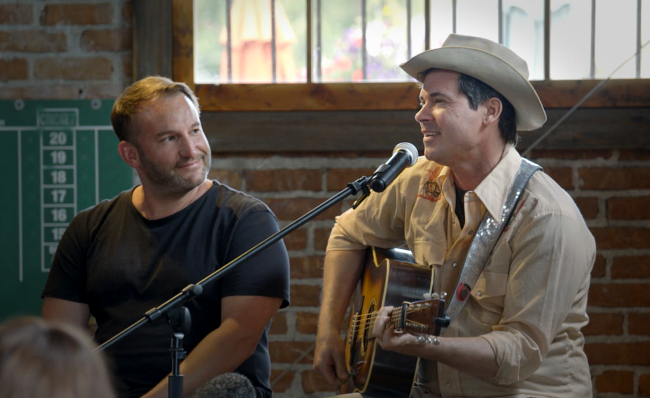
That instinct — to listen instead of argue — is what defines Louder Than Guns, a music-driven documentary featuring and executive produced by musician Ketch Secor and journalist David Greene, former host of NPR’s Morning Edition, that attempts something rare in today’s media landscape: bringing people with deeply opposing views on gun ownership into the same room and asking them to actually talk to each other.

Not debate. Not shout. Talk.
A different kind of gun documentary
The project began with Secor — best known as the frontman of the Grammy-winning band Old Crow Medicine Show and the voice behind the enduring hit “Wagon Wheel” — who, in the wake of the Covenant School shooting in Nashville, started asking a simple question: Why can’t we have this conversation differently?
That question became the foundation of the film, alongside Greene, a longtime journalist known for bridging perspectives through his work in public radio.
“It’s not a liberal film. It’s not a conservative film. It’s not a pro-gun film. It’s not anti-gun,” Pray says. “It’s a film where we want to actually respectfully have dialogue.”
That distinction matters. Pray is acutely aware of the “stigma” that follows many issue-driven documentaries — even the good ones — where audiences expect to be preached to or find themselves surrounded by people who already agree with them.
Instead, Louder Than Guns is built to disarm that instinct.
“It could be a music film,” Pray says of what drew him in. “And it wouldn’t have the kind of stigma that a lot of political films unfortunately do.”
Putting people in the room — and asking them to listen
At the center of the film are a series of community conversations held across the country — in barbershops, churches, restaurants — bringing together gun owners, non-gun owners, and people who have rarely, if ever, spoken openly about the issue.
The goal wasn’t to create fireworks. If anything, it was the opposite.
“Right before the cameras rolled, I’d say, ‘We’re not here for reality TV. We’re not after conflict,’” Pray recalls. “If somebody has a very different viewpoint than you, please hear them out. … The most radical thing you can possibly do in 2026 — listen.”
That framing shaped everything that followed.
The conversations weren’t always easy. At times, they got heated. But they didn’t collapse into the kind of shouting matches that dominate cable news or social media. Instead, something quieter happened.
“I don’t think they thought, ‘Oh, we’re showing America how to talk about guns,’” Pray says. “But in the end, that’s kind of what it felt like we were doing.”

What people actually agree on
One of the film’s most striking takeaways is how much common ground exists once the volume is turned down.
“Everybody wants safer schools. Everybody,” Pray says. “People who don’t have guns usually don’t have them because they want their house to be safe. People who do have guns usually have them because they want their children to be safe. Both sides want safety.”
That shared goal — safety — becomes what Pray calls a kind of “glue” in the film.
It doesn’t erase disagreement. It doesn’t magically resolve policy debates. But it creates space for something that often feels absent in the national conversation: recognition.
“It’s not like everybody was holding hands and singing ‘Kumbaya,’” he adds. “It’s a tough topic. But just seeing people listen and agree is very healthy for this country.”

Why country music is the key
If Louder Than Guns works, it’s largely because of how it enters the conversation. Not through politics — but through music.
At Old Crow Medicine Show concerts, Secor has long noticed something unusual: audiences made up of people from across the political spectrum, all singing the same songs.
“He’ll perform and there’ll be people — gun owners, non-gun owners, red state, blue state — all there loving the music,” Pray says. “And his whole theory is: Why can’t we bring these people together to talk about this really important American issue?”
That idea — that country music can serve as common ground rather than a dividing line — gives the film both its tone and its access. It also helps it avoid the eye-roll factor that often greets celebrity-driven issue docs.
“There was an intention there,” Pray admits. “Ketch’s dream would be that this encourages bigger country stars to feel okay just talking about the subject.” Not endorsing legislation. Not picking sides. Just talking.

A conversation, not a conclusion
For Pray, success isn’t measured in policy outcomes or sweeping cultural shifts — at least not immediately. “It would be hard to quantify,” he says. “But I literally mean it when I say that it helps continue this conversation — this kind of conversation.”
He compares it to the long, incremental shift in attitudes around smoking — not a single breakthrough moment, but decades of small changes that eventually reshaped the culture.
“I don’t think anything’s going to change overnight,” he says. “But it’s a little like a 3% solution. It’s incremental.” The hope is that the film doesn’t just play in theaters, but travels — sparking discussions in communities that rarely engage with each other this way.
Because if Louder Than Guns argues anything, it’s this: The problem isn’t just disagreement. It’s that people have stopped listening. And sometimes, the most radical thing a film can do is simply make space for that again.
Louder Than Guns opens in theaters May 8 in New York City via Abramorama, with a North American rollout to follow.
