James Grayis a filmmaker who has consistently shown an ability to capture human frailty, regardless of the genre that he is working in. Although he made a science fiction epic with Ad Astra, a semi-autobiographical coming-of-age story with Armageddon Time, and a haunting mafia thriller with We Own The Night, Gray has managed to examine complex, relatable characters with every film that he has directed.
The prospect of Gray making an adventure film was somewhat surprising, as he is not exactly a filmmaker that seemed well-suited to making a swashbuckling crowd-pleaser like Raiders of the Lost Ark or The Princess Bride. However, The Lost City of Zis a harrowing epic about a real discovery mission that went awry and deserves to be heralded as one of the best films of the 21st century.
What Is ‘The Lost City of Z’ About?
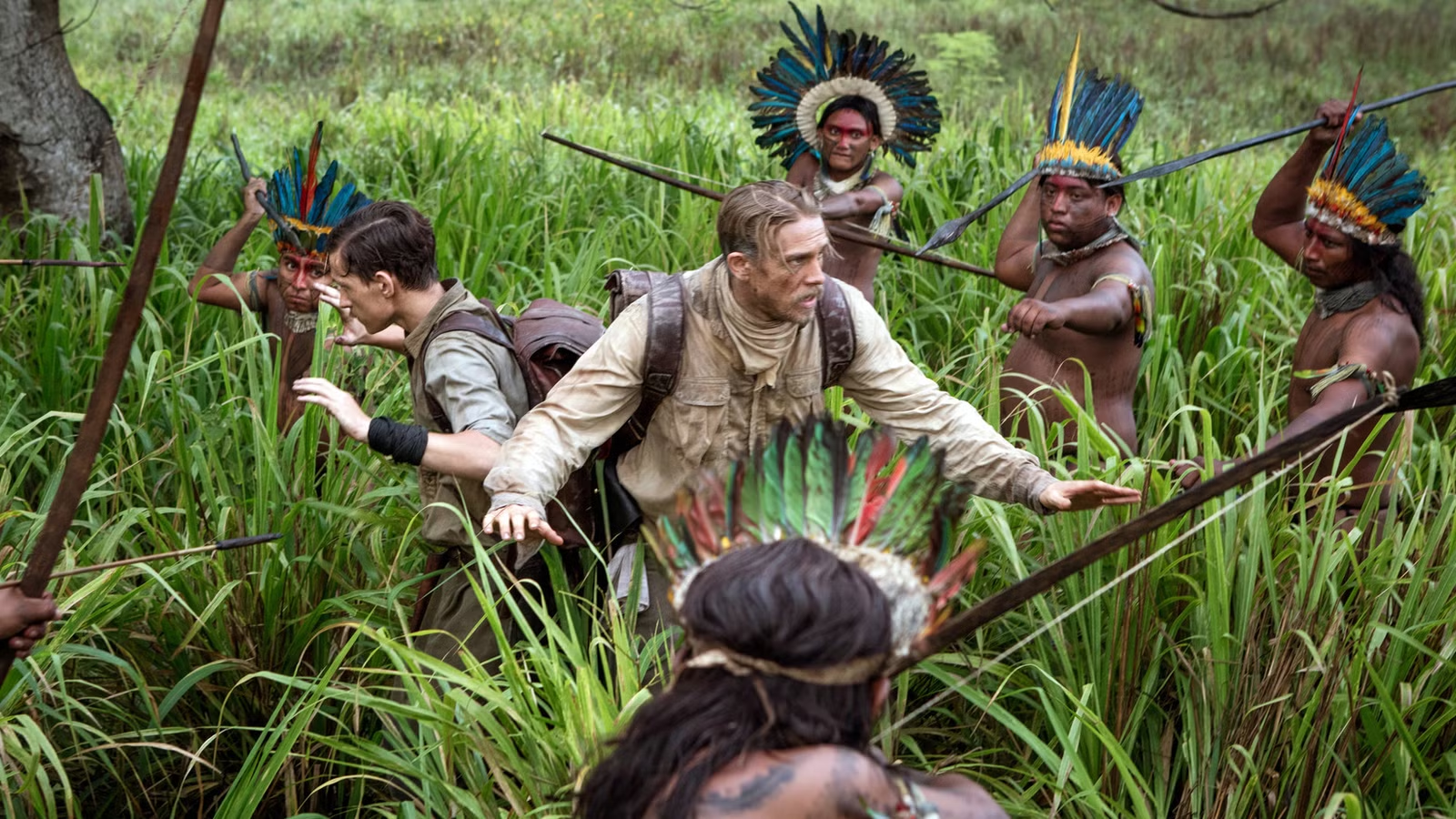
Set at the very beginning of the 20th century, The Lost City of Z explores a real search for a mythic lost city in the Amazon, which was rumored to contain deep knowledge and hidden riches. The British Army major Percy Fawcett (Charlie Hunnam) was initially tasked with surveying the Amazon to examine the ongoing rubber trade but becomes informed about the legend of the mysterious city after he ventures deep into the jungle with Corporal Henry Costin (Robert Pattinson), who quickly becomes one of his closest friends. Fawcett continuously lobbies the British government to grant him additional resources to explore the area, as many of his planned expeditions are thwarted by a lack of funding and improper planning. Despite being told that his obsession had become dangerous to his health, Fawcett continues his search and even brings his young son Percy (Tom Holland) along with him.
The Lost City of Z is modeled after the classic adventure films popular within the Golden Age of Hollywood, as it is odd to see a film with the ambitions of The Treasure of the Sierra Madre or The African Queen that is made today. Although the sweeping cinematography and massive sets feel reminiscent of an older generation of storytelling, Gray adds enough nuance to the details that The Lost City of Z never feels antiquated; there is a lot of graphic violence that shows how dangerous the expedition really was and makeup that indicates how much the characters have changed over time. What’s more impressive about The Lost City of Z is how it bucks conventions in terms of its structure; despite being met with failure at every turn, Fawcett continues to believe in himself, even when his wife Nina (Sienna Miller) comes to doubt his sanity.
Collider Exclusive · Horror Survival Quiz Which Horror Villain Do You Have the Best Chance of Surviving? Jason Voorhees · Michael Myers · Freddy Krueger · Pennywise · Chucky
Five killers. Five completely different ways to die — if you’re not smart enough, fast enough, or self-aware enough to avoid it. Only one of them is the villain your particular set of instincts gives you a fighting chance against. Eight questions will figure out which one.
🏕️Jason
🔪Michael
💤Freddy
🎈Pennywise
🪆Chucky
01
Something feels wrong. You can’t explain it — you just know. What do you do? First instincts are the difference between the survivor and the first act casualty.
02
Where are you most likely to find yourself when things go wrong? Setting is everything in horror. Where you are determines which rules apply.
03
What is your most reliable survival asset? Every survivor has a quality the villain didn’t account for. What’s yours?
04
What kind of fear is hardest for you to fight through? Knowing your weakness is the first step to not dying because of it.
05
You’re with a group when things start going wrong. What’s your role? Horror movies are brutally clear about who survives group situations and who doesn’t.
06
What’s the horror movie mistake you’re most likely to make? Honest self-assessment is a survival skill. Denial is not.
07
What’s your best weapon against something that can’t be stopped by conventional means? Every horror villain has a weakness. The survivors are always the ones who find it.
08
It’s the final scene. You’re the last one standing. How did you make it? The final survivor always has a reason. What’s yours?
Your Survival Odds Have Been Calculated Your Best Chance Is Against…
Your instincts, your strengths, and your particular way of thinking under pressure point to one villain you actually have a fighting chance against. Everyone else — good luck.
Camp Crystal Lake · Friday the 13th
Jason Voorhees
Jason is relentless, but he is also predictable — and that is the gap you would exploit.
He moves in straight lines toward his target. He doesn’t strategise, doesn’t adapt, doesn’t outsmart. He simply pursues.
Your ability to keep moving, use the environment, and resist the panic that freezes most victims gives you a genuine edge.
The Crystal Lake survivors were always the ones who stopped running in circles and started thinking about terrain, water, and distance.
You think like that. Which means Jason, for all his indestructibility, would face someone who simply refused to be where he expected.
Haddonfield, Illinois · Halloween
Michael Myers
Michael watches before he moves. He is patient, methodical, and almost impossible to detect — until it’s too late for anyone who isn’t paying close enough attention.
But you are paying attention. You notice the shape in the window, the car parked slightly wrong, the silence where there should be sound.
Michael’s power lies in the invisibility of ordinary suburbia — the fact that nothing ever looks wrong until it already is.
Your spatial awareness and instinct to map every room, every exit, and every shadow before you need them is precisely the quality Laurie Strode had.
You are not a victim waiting to happen. You are someone who already suspects something is wrong — and acts on it.
Elm Street · A Nightmare on Elm Street
Freddy Krueger
Freddy wins by getting inside your head — using your own fears, your own memories, your own subconscious as weapons against you. That strategy requires a target who can be destabilised.
You are harder to destabilise than most. You’ve faced uncomfortable truths about yourself and you haven’t looked away.
The survivors on Elm Street were always the ones who understood what was happening and chose to face it rather than flee from it.
Freddy’s greatest weakness is that his power evaporates in the presence of someone who refuses to give him the fear he feeds on.
Your psychological resilience — the ability to stay grounded when reality itself becomes unreliable — is exactly the quality that keeps you alive here.
Derry, Maine · It
Pennywise
Pennywise is ancient, shapeshifting, and feeds on terror — but it has one critical vulnerability: it cannot function against someone who genuinely stops being afraid of it.
The Losers Club didn’t survive because they were braver than everyone else. They survived because they faced their fears together, and faced them honestly.
You ask the questions others avoid. You look directly at what frightens you rather than turning away.
That directness — the refusal to let fear fester in the dark — is Pennywise’s worst nightmare.
It chose the wrong target when it chose you. You are exactly the kind of person whose fear tastes like nothing at all.
Chicago · Child’s Play
Chucky
Chucky’s greatest advantage is that nobody takes him seriously until it’s already too late. He exploits the gap between how something looks and what it actually is.
You don’t have that gap. You take threats seriously regardless of how they present — and you never make the mistake of underestimating something because of its size or appearance.
Chucky relies on surprise, on the delay between recognition and response. You close that delay faster than almost anyone.
Your instinct to treat every unfamiliar thing with appropriate scepticism — rather than dismissing it because it seems absurd — is the exact quality that keeps you breathing.
Against Chucky, not laughing is already winning. You are very good at not laughing.
‘The Lost City of Z’ Explores the Horror of Obsession
The Lost City of Z is a brilliant character study that shows how dangerous it can be to center one’s life around a singular mission that may be impossible. Since Fawcett is granted with privilege as the result of his upbringing, he does not seek the city out of any sense of entitlement or search for personal glory; rather, he feels frustrated that no one has been able to discover such an important achievement in civilization and feels obliged to complete something that was never thought to be attainable. Hunnam is able to examine how this narrow-minded viewpoint turns Fawcett into a monster of his own creation; he ultimately is willing to risk both his own life and that of his family in order to finish a suicide mission.
The Lost City of Z is a very psychological film, as it examines how the best of intentions can go awry as the result of unchecked ambition. The dynamic between Fawcett and Costin embodies this, as Pattinson is able to show how the corporal’s unflinching loyalty ends up costing him greatly. Holland also gives a strong dramatic performance that adds some needed emotional weight to the film’s ending. It is a great shame that The Lost City of Z was only released into a select number of theaters by Amazon Studios, as it is a probing, beautiful historical epic that deserved to be seen in the best possible format.