
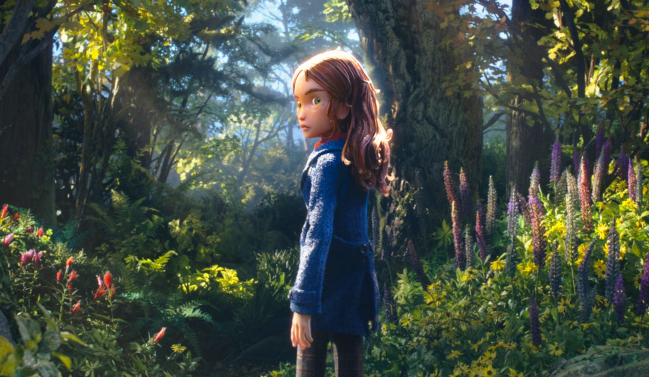
Filmmakers like to talk about how their movies are hand-crafted — and then there’s Wildwood. The stop-motion animated feature has been painstakingly created over the course of nearly two decades, and while it wasn’t quite ready to screen at the Telluride Film Festival, the filmmakers did have a few stunning sneak peek clips on hand to share with the audience ahead of the release, which is set for Oct. 23.
“This is like a time warp, because some of those scenes were shot almost six years ago,” said director Travis Knight, who took the stage alongside cinematographer Caleb Deschanel. “It takes so long to do these things, and so now we’re finally almost at the end of this journey together, and it’s a thrill to be able to share it with people.”

Laika’s stop-motion animated feature, which is based on the novel by Colin Meloy, follows a teenage girl named Prue (voiced by Peyton Elizabeth Lee) and her friend Curtis (Jacob Tremblay) who set off to rescue her baby brother who has been kidnapped and find themselves in an enchanted forest. Like its predecessors at the studio, Wildwood is expected to be a contender for Best Animated Feature.

How did you discover the source material?
Travis Knight: Colin, who is an amazing musician and a great writer, gave me a sneak peek at the book he was writing. He was about 133 pages in … and I absolutely fell in love with it. It was just magic. It felt like it had moss under its fingernails. It breathed the same air as all these great fantasies and fairy tales I loved as a kid, and yet it also had something bracingly contemporary and something deeply emotional under everything. I had to make it. One of the things Colin said to me was, “Well, I just have one request. There’s a three-book series. Can you please make sure the movie doesn’t come out before the books come out?” That was 16 years ago. So mission accomplished.
Caleb, how did you two find each other and become friends and collaborators?
Caleb Deschanel: I’ve always been interested in animation — as a matter of fact, when I was a little kid, I used to draw little animated creatures on flip books and stuff when I was 7 and 8 years old. I’ve always loved it, and I’d never done a stop-motion film, which was another factor. Then Travis and I met, and we talked about it and talked about the story, and I really got drawn into it. When I read the script, I really loved it. I love Kubo and the Two Strings and all the other films he’s done with Laika. And then there were a lot of missing pieces I didn’t know about that I found out when I agreed to do it — how complicated and complex it is, and how much work goes into it.
With most movies, we would do the whole scene, complete all the coverage for it, and finish it in a day or two, however long the scene is. In this movie, you do one little piece at a time, and it’s like this giant mosaic you have to piece together. You’re basically in this giant building that’s been divided up into a hundred-something sets, all designated by color and numbers, and you wander around depending on where the animation is being done, constantly reminding yourself where you are when you go into a scene.
Knight: Stop-motion is filmmaking at the pace of a glacier. It’s these little tiny characters. You have these little puppets shot on real sets with real light and real cameras. They have little metal skeletons inside. An animator goes in there, moves it a little bit, takes a picture, moves it a little bit, takes a picture, and you repeat that process over and over again until either the film is done or society collapses. So that was my pitch to Caleb. I said, “Hey, Caleb, you want to come out to Oregon for a few years and shoot a woman the size of a burrito?” And he said, “Damn right, I do.”
Deschanel: And the other thing that’s really fascinating, which I didn’t know, is that one of the big characters is a rat sometimes sits on the shoulder of Curtis, and a rat on the shoulder of Curtis is only that big, so it’s almost impossible to animate him. There are parts of this movie where you had to blow that character up 500% — have sets and props and everything that are 500% to tie together with the small one — and then, if you have them interacting, you have to build a maquette of Curtis that’s 500% with blue screen, and then you put the rat on that, which is also 500%. It’s permutations and combinations. I thought I was coming in to do algebra, and it’s analytic geometry and calculus.

Laika has been around for 20 or so years. How, if at all, has the technology changed?
Knight: It is different. It’s an evolution. At the core of everything we do, it is art and craft — handcrafted things brought to life by an artist’s hands, and that’s never changed. But when we started Laika — stop motion has always been on the verge of dying. As a stop-motion animator, I remember 30 years ago when CG was on the ascendancy. It was like, “Oh no, we are screwed. CG can do everything we can do, but better and faster and cheaper.”
So my thought was to find out how we could essentially embrace the author of our demise. How can we wrap our arms around the infernal machine and be like a Luddite embracing the loom? This is something that’s trying to kill us — how can we make peace with it? That’s when we started involving technology in what we do. The sum total of the last five movies we’ve done has been building to this movie, and we use all the different tricks we’ve learned over that time and, hopefully, can apply them.
When I said to the team, “All right, we’re making Wildwood,” the universe smiled at me and said, “Fine, but you will suffer beautifully for that choice.” So here we are, six years later. Most animation companies use computers, and we use computers too — we’re not Amish — but it’s in service of the craft. It’s in service of the art, and there’s always a human behind it.
Caleb, you’ve been doing this for so long and are so accomplished in so many different types of films, different looks, different tones. What would you say working on this project has allowed you to do that maybe you’ve never gotten to do before in your career?
Deschanel: In a way, it was reinventing all the things I knew over the years. When I first came to Laika, one of the things I did was go outside and take a lot of photographs of people at different f-stops, so I had a catalog to remind myself of what reality is. I actually took one of the puppets from an old Laika film, went into the woods, and took lots of photographs — with a bunch of people walking by, scratching their heads, wondering what the hell I was doing. Along the way there were a couple of times when, because of the size of the cameras — even though they’re still cameras, they really are the size of a Technicolor blimp camera from the 1930s — when you put them on the size of these sets we had, I couldn’t figure things out. So Brian, our head gaffer, who also lays out all the stages, would build a full-size set with cardboard and our assistant, and we’d walk it through and figure it out, and then say, “Oh, this is how we can do it in the miniature set.” There were lots of things I needed to develop in my mind.
All these landscapes we’re looking at, and moving water — is it all practical? Some of it’s not?
Knight: Some of it’s practical, some of it’s not. We use a variety of techniques. Most of what we do is shot on stage. Everything we do shoots miniatures, but we have miniatures of miniatures sometimes. We do old-school matte paintings, just like they did 60 years ago, and then we do have some CG visual effects, combining all those things together.

In a regular movie, you hear they’ll shoot a scene, complete it, and then when they watch it back, it’s like, “Oh, that didn’t work for some reason. We’ve got to reshoot.” I imagine that’s got to be one plus of what you’re doing — because you’re doing everything so gradually that hopefully you don’t have a situation where something’s done and then you watch it and go, “Oh no, that didn’t work, we’ve got to start over.”
Knight: Animating in stop motion is a high-wire act. You essentially get one shot at every one of these shots, because it’s so difficult to reshoot something. It takes so much time, so you have to get it right the first time, which puts a lot of pressure on the shoulders of the animators. And it’s progressive. Most other forms of animation are iterative — you set keyframes, sometimes the computer will do in-betweens. Here, the animator is working from frame one to frame two to frame three. They have to keep all that choreography in their mind, so it’s like chess. It’s like a whole math thing, but then it also has to feel alive — it can’t just feel mechanical. Animators are hunched over these puppets all day long. They’re like benevolent gods with lower-back pain. But we get this out of it.
Deschanel: You should also know that Travis started out as an animator, and everybody I’ve spoken to in stop-motion animation says he was the best and the fastest. So he comes from that and understands it. Listening to him talk with the animators — I’ll see something in one of the preparatory tests, before they actually shoot the hero animation, and I’ll look at it and go, “Oh my God, that’s great,” and Travis will always have something to say to make it better. He has an incredible eye for how these characters come to life and how they express the emotions you need to get through.
Like basically all of the Laika movies, this one really walks a fascinating line between being for young people and also appealing to so many different ages. What was in your mind as far as who it’s for — mostly, or do you want it to be for everyone? Because there’s some scary stuff in there.
Knight: I do think it’s for everyone. It’s a movie for families — probably not the youngest members of the family, but I do think it’s a family movie. Although, you’ve got to remember, I’m a guy who saw The Exorcist when I was five years old, so my definition might be a little looser than others. With our first film, Coraline, I’ve heard multiple times that we’ve traumatized children. That is never the goal.

But honestly, just in terms of storytelling, I think back to the cinematic experiences I had growing up — those movies that really stuck to my ribs, the ones that took me on a journey in a safe space in a cinema and could make me see things and feel things and connect to things outside my experience, and hopefully connect to something with empathy and emotion. That’s what we try to do in movies. We do not want to speak down to the audience. We do not want to speak down to children. Of course, every parent has to judge whether this is appropriate for their kids. But ultimately, I think the movie is about something very meaningful, something very dear to me, something I think we all experience in some form or another. I find it very moving. When we get to the other side of it, there is intensity, there is heaviness, but more than anything, there is joy and light.
Caleb, now that you’ve gone through almost the entirety of this experience — how did it differ from how you imagined it might be, and would you do it again?
Deschanel: Every day, when we would see dailies after the animators did their work, I was just inspired to keep going, because the work the animators do in creating characters is really incredible. It was coming to life the way we hoped it would. I have to say, I can see these over and over again — I’ve seen every one of the shots individually over time — but I never lose interest in this story. It’s simply about a young girl coming of age and realizing she needs to do things on her own that her parents aren’t going to do for her anymore. She has to make decisions. She makes a stupid decision early on, and that leads to her discovering herself.
Travis, what are your priorities? What are you most excited about and proud of with this movie?
Knight: At the very beginning of this process, it’s very daunting. You begin with absolutely nothing. Every single thing is a choice. Everything is designed and built and manipulated by an artist’s hand. If a character feels sad, that’s not because sadness was lying around in the studio — someone had to sculpt sad, and move sad, and shoot sad, and light sad. It’s the accumulation of all these incredible choices over the years by these amazing artists who put so much love and care into what they do. It’s a very special breed of person — you have to be a little weird to devote yourself to this kind of work. But at the core of it, it really is about care. It’s about devotion.
We live in an era that’s largely frictionless, where systems are designed to make things easy, and where entire worlds can be generated with a click of a mouse, where things can spring to life with nothing but a prompt. With stop motion, it’s something different — that taking your time with something actually matters, that putting effort and care into something actually makes a difference. So when you see the movie, what I love most about it is that it really is a celebration of empathy and humanity, and that’s at the core of everyone who made it.
