
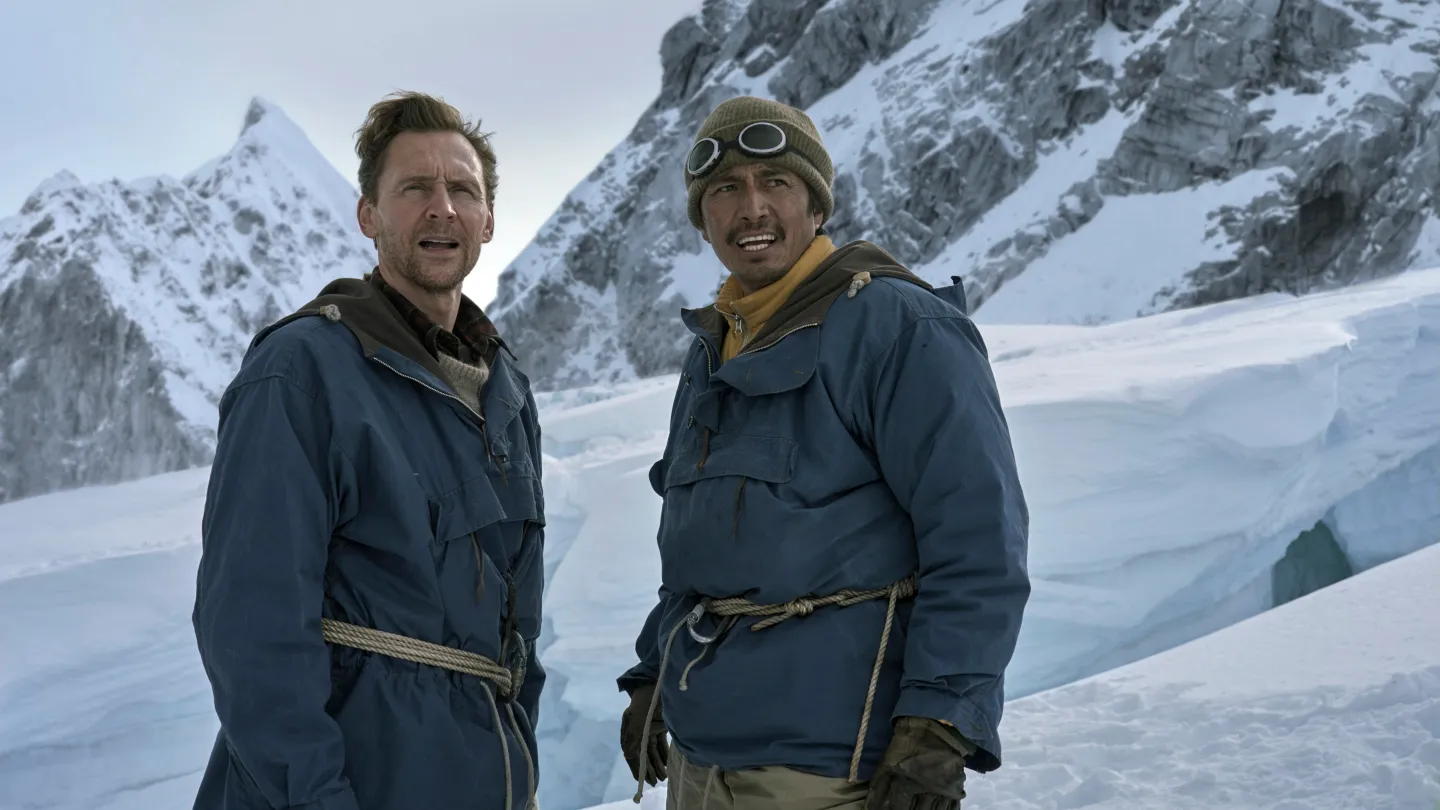
The most moving relationship in Tenzing, Jennifer Peedom’s new narrative feature about the mountaineer, is not the one between Tenzing Norgay (Genden Phuntsok) and Edmund Hillary (Tom Hiddleston), who in 1953 would become the first humans to summit what the British call Mount Everest. It isn’t the hard-won mutual respect between Tenzing and his fellow Sherpa, Pasang (Tenzin Jigmey), nor his fierce love for his wife, Dawa (Thinley Lamo).
It’s the one between Tenzing and the mountain itself, known to him as Chomolungma. Where the Europeans see a battle to be won, and even the other Sherpa see a terrifying sacred force, Tenzing sees a heavenly mother — smiling down on him since childhood, bearing witness to his heartbreaks in adulthood, calling him now to come home.
Tenzing
The Bottom Line
Broadly likable, mostly forgettable.
Venue: Telluride Film Festival
Cast: Genden Phuntsok, Tom Hiddleston, Willem Dafoe, Caitríona Balfe, Tenzin Dalha, Thinley Lhamo, Johnny Flynn, Tenzin Jigmey, Samdrup Dorje Lama
Director: Jennifer Peedom
Screenwriters: Luke Davies, Jennifer Peedom
Rated PG,
2 hours 6 minutes
It’s a subtle but lovely reframing of Norgay and Hillary’s historic climb, from an act of conquest to one of pure, spiritual love. But it’s not quite enough to free Tenzing as a whole from the usual sturdy-but-staid biopic formula. With its good-hearted heroes and pretty (but rarely breathtaking) landscapes, the Apple release is plenty likable, but also plenty forgettable.
The script, by Luke Davies, loosely braids three different timelines. In the 1920s, Tenzing is a little boy (Samdrup Dorje Lama, adorable) in a remote Tibetan village, fascinated by the foreigners (including Johnny Flynn as George Mallory) who’ve come to scale the mountain he thinks of as his.
Some years later, he’s a young man (Tenzin Dalha, gentle and sweet) headed to Darjeeling with his wife (Thinley Lamo, even gentler and sweeter) in hopes of getting a job as a Sherpa guiding European expeditions up Chomolungma. (In a respectful nod to Tenzing’s culture, the peak is almost never referred to as “Everest” in the movie.)
In the last and most central storyline, an all-grown-up Tenzing has been hired as head Sherpa for England’s latest attempt to complete the ascent — the one we know, but Tenzing does not yet, will become the first successful one. The movie follows the team through perilous terrain, grueling physical challenges and interpersonal disagreements and friendships over the course of the nearly two-and-a-half month trek.
Tenzing’s more spiritual perspective as a Sherpa is a welcome change of pace from the typically Eurocentric one represented by characters like expedition leader John Hunt (Willem Dafoe), who refers to the final ascent as “the Siege of Everest.” When Hillary bonds with Tenzing over their mutual admiration of Mallory, referring to the late explorer as “the reason we’re all here,” Tenzing amiably replies, “I was already here.” And when other Sherpas gripe to Tenzing that the Europeans are just playing at being heroes — they’re the ones doing most of the hard and dangerous work of lugging heavy cargo up this impossible mountain — we understand they have a point, even if Tenzing manages to calm their disgruntlement in the moment.
The trek is literally a matter of life or death, the pillowy pristine landscape hiding all manner of potential traps: snowdrifts that give way under one’s feet, impossibly sheer cliffs, air too thin and cold to breathe in without masks and oxygen tanks. It is surprising, then, that Tenzing rarely manages to quicken the pulse, to make you gasp with fear or applaud their daring.
You can chalk up some of this lack of tension to the fact that we already know how this story ends; even when Hillary suddenly finds himself dangling over a seemingly bottomless crevasse or Tenzing briefly passes out from lack of oxygen, it’s not as if there’s any question they’ll dust themselves off and press on.
But the bigger issue is that Tenzing keeps its title character and his closest ally (to say nothing of all the smaller characters around them) at a reverent distance, rendering them in broad strokes rather than fine shading. Phuntsok and Hiddleston are pleasant to watch and share a nice, friendly chemistry, with Tenzing as the relatively more excitable one and Hillary as the quieter one. But I couldn’t tell you what brings them together, other than a vague understanding that they both love climbing and both feel like outsiders within the team.
As an individual, Tenzing’s defining passions are his mountain, his wife and his daughters, seemingly in that order, but the only one of those three passions to get any real complexity is the mountain. His wife is an eternally supportive angel whose sole desire is to see Tenzing happy, their children are much the same, and the relationships between all of them are perfectly happy and perfectly nonspecific. (The only thing we learn about Hillary, randomly, is that he is unmarried but does have a lot of bees back in New Zealand. Sure!)
If there’s anything flawed or complicated or even slightly offbeat about its title character, Tenzing isn’t letting on. If there have ever been any hurdles in his path he’s struggled (or god forbid, failed) to overcome, Tenzing never shows us that either.
This Tenzing only seems to encounter minor blips. He bemoans that the British would never agree to make him a full climbing member of the team (as opposed to a lower-status Sherpa), and then a few scenes later Hunt agrees to do just that with a minimum of fuss. The tension between Tenzing and the other Sherpas, who regard him as an outsider because he’s technically from another tribe, simmers intriguingly under the surface for most of the climb, only to be healed for good with a single friendly conversation.
Tenzing is ostensibly about a man who’s overcome incredible obstacles to achieve something no other human ever had before; indeed, that great feat is the only reason for this movie to exist at all. Instead, accidentally, it tells the story of a man for whom obstacles just seem to fall out of the way at the slightest prodding. Tenzing’s historic ascent begins to look straightforward and inevitable, a matter of preordained fate, rather than one brought about by his choices, his efforts, his courage, his determination.
Maybe that makes the movie easier to swallow — something you can fire up on Apple on a lazy Friday night before bed. But I’d be hard-pressed to say it does its fearless subject justice.
