
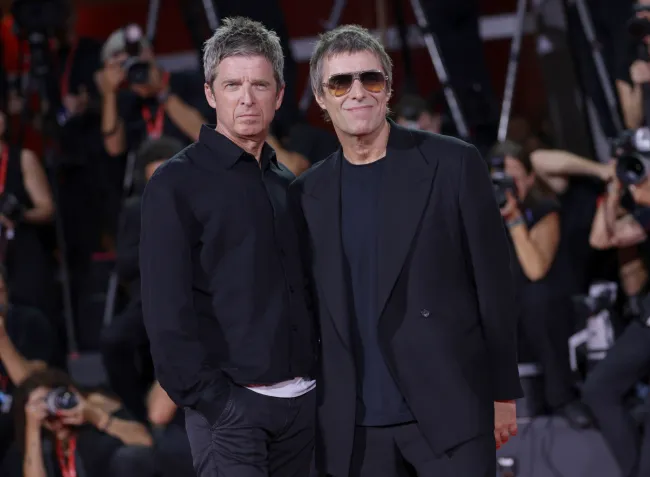
Venice Day 4 started with the Oasis documentary, Don’t Look Back in Anger. The Venn diagram of Italian audiences, festival cinephiles, and Oasis fans clearly doesn’t have much overlap, because the Sala Darsena — the theater where most of the working press and industry screenings happen — was half-full, the least amount of people I’ve ever seen in it.
For the first twenty minutes I wished I’d skipped the documentary, too. And then, like the arcs for Noel and Liam Gallagher in the film, I changed my mind.
Make no mistake, Don’t Look Back in Anger is meant for the fans. If you only know the band’s hits but don’t know much about the history of the Gallagher brothers? As they themselves might say, and do say a lot in the documentary: “F–k off.”

In the first 20 minutes, we find out that after years of confrontations and a diminishing output as a band, Liam and Noel had a fistfight in Paris before a 2009 show and cancelled not only that concert but the rest of their entire world tour. The two brothers then didn’t speak for 15 years.
What brought them back together? Who knows — we aren’t told. Did someone need money? Did their family coax them into it? Was it for tax reasons? Good luck finding that out from the film. But we’re going to watch them reunite… eventually.
The initial rehearsal sessions are painful to sit through, mostly because Liam, the more volatile of the two, doesn’t show up. There’s a number of shots of an unattended microphone. We rather resent him for this. His brother Noel puts the band through their paces. We’re told that he wrote all the songs but that it’s Liam, the lead singer, who is the fire of Oasis. They can’t have a tour without him.
When Liam does show up, he’s petulant and curt. It’s not promising, but the band keeps rehearsing and they do their first concert in Cardiff. The security team leader who debriefs his team about what they might expect says their fans have a “herd mentality” and can be volatile and violent. And then the band goes onstage and Don’t Look Back in Anger never looks back.

The concert footage of the ecstatic crowds as Oasis makes it through their U.K. tour, then traveling around the world with stops in Seoul, Brazil, and America is exhilarating. The band is surprised at the reception, and it seems to change them as well as they see the kids of their one-time fans loving their music as much as their parents did. They see fathers and sons together belting their anthems out together, which brings the brothers to tears.
Somewhere along the road the film elevates; it’s no longer about churlish rock stars who had tantrums. It becomes, amazingly, about forgiveness, the power of music to unite people, and about deciding to be a better person. And as they start playing their most recognized hits, I dare you not to sing along.
After the morning press screening, the Gallaghers were up to their usual tricks. They skipped the press conference, even though they trucked in from Venice across the lagoon to the Lido and the Palazzo del Casino, the massive travertine structure that acts as the engine room of the festival. They went to their pre-conference photoshoot and then got right back on the boat to Venice. Fans of the band would likely be miffed if they’d done anything else.
The brothers reappeared for the big premiere that night in the Sala Grande, raising their hands together in triumph as the crowd reportedly went a bit berserk. There’s a filmmaker or two who would have relished such a reception to their premiere.

Also playing here is Maggie Gyllenhaal’s short film, Flesh Impact. It gives her another role at the festival besides being president over the main jury. Her film is 21 minutes long and it could — even should be — longer. In fact, it needs to be a feature, because Gyllenhaal has written and directed a helluva movie.
Flesh Impact features Ellen Burstyn playing an apparition of the 100-year-old Marilyn Monroe, who appears for a modern-day stage audition for Tennessee Williams’ Orpheus Descending. The grizzled New York director is wryly and charmingly played by Gyllenhaal’s husband, actor Peter Sarsgaard. Burstyn’s Marilyn recounts her young years, laying out anecdotes about her with Lee Strasberg, Billy Wilder (who said the actress had “flesh impact”) and Arthur Miller, and probes the perceived truth about who the icon was.
I don’t know if one the things that Marilyn is told — “Powder on a nose turns a weed into a rose” — is a true saying from the era or one that’s made up by Gyllenhaal, but it’s to her great credit that I don’t care. It’s a bruising, beautiful saying all the same.
Flesh Impact also features flashbacks to Marilyn in her 30s where she’s played by Dakota Johnson, who brings a piquant sadness to her role. It all ends too soon. You want more from Burstyn and her raconteur Marilyn, telling us stories. I’d sit at her feet and listen. Boy, I sure wish Flesh Impact had gone on for another hour.
