
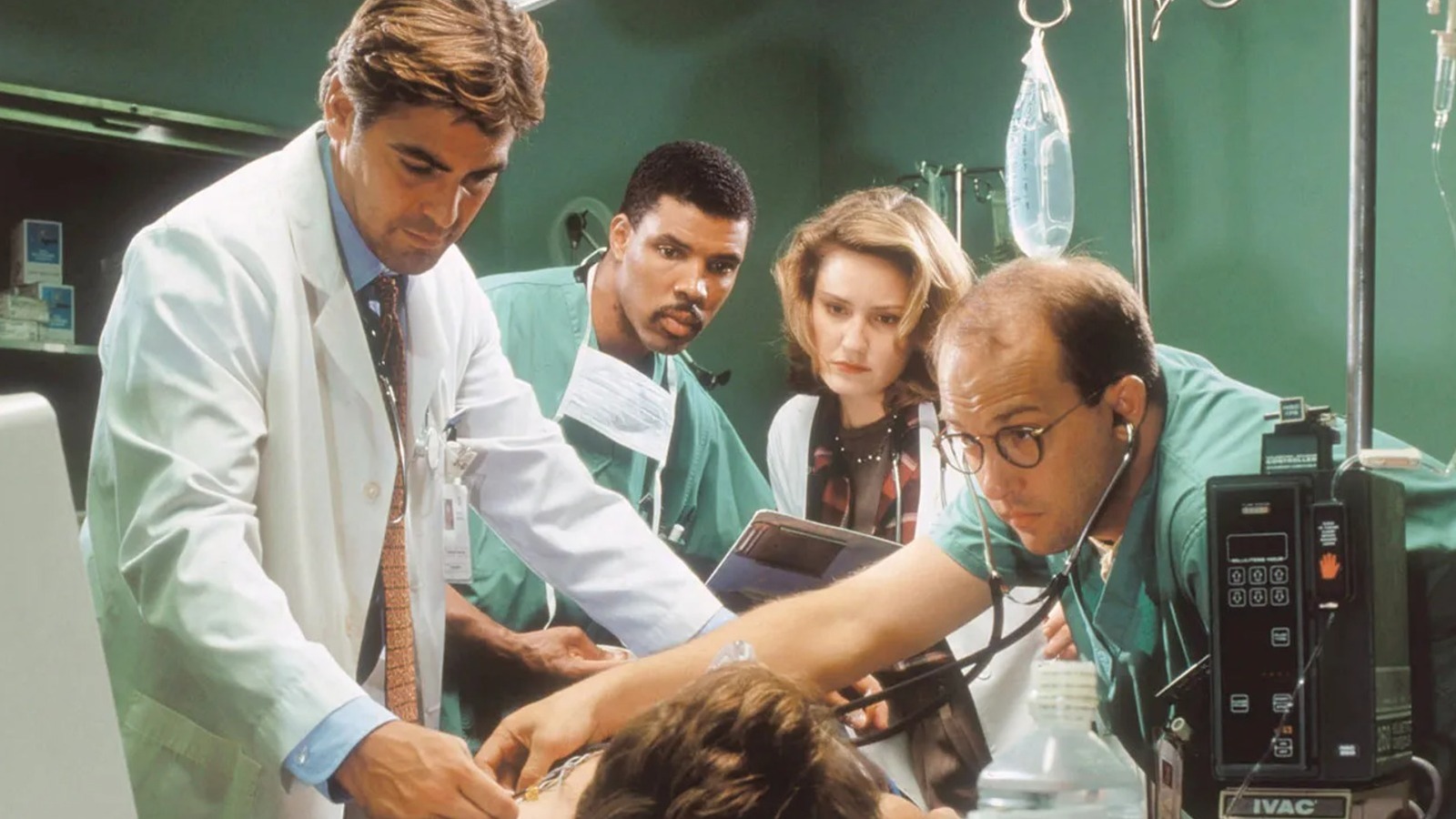
NBC’s “ER” ran for 15 seasons on the network, from its premiere on September 19, 1994, to its series finale on April 2, 2009. The show was eclipsed by “Grey’s Anatomy” as the longest-running medical drama of all time in 2019, but it will forever be one of the most groundbreaking shows in the genre for many important reasons. “ER” took its stories seriously, so while its characters were funny sometimes, it didn’t rely too strongly on a comedic premise like its predecessors, including “Doogie Howser, M.D.” and “M*A*S*H.”
The show covered many topics that had never been depicted so authentically on screen before, and it also helped Hollywood make progress behind the scenes. From unique filming styles that added intensity to scenes to focusing on diverse casting within the ensemble, “ER” quickly became the superior model for how to produce medical dramas. It even easily surpassed NBC’s previous medical drama “St. Elsewhere,” which featured an ensemble cast including Denzel Washington, William Daniel, and Howie Mandel.
Here’s a detailed look at what “ER” did better than the medical dramas that came before it. These details have kept the show relevant more than 30 years after “ER” audiences got their first glimpse inside County General Hospital.
Diverse ensemble casting
“ER” casting directors were focusing on diverse casting well before the phrase became buzzy. The 1994 pilot, “24 Hours,” featured Eriq La Salle as the only non-white main cast member. But actors like Yvette Freeman, Deezer D, Laura Cerón, and Lyn Alicia Henderson regularly guest starred for over 100 episodes each. Plus, Gloria Reuben and Ming-Na Wen played recurring characters on Season 1 and became series regulars later. Actors like Michael Michelle, Mekhi Phifer, and Parminder Nagra were regulars on later seasons. And on the 15th and final season of “ER” on NBC, “9-1-1” star Angela Bassett joined the cast as a series regular.
These are not the only minority actors who appeared on the show, and there is no way to explain how some of these characters’ storylines impacted minority communities (Reuben’s character, Dr. Jeanie Boulet, was HIV positive, which was important representation). “ER” arguably could’ve been even more inclusive and yet was miles ahead of so many medical dramas that came before it.
For example, “St. Elsewhere” ran for on NBC six seasons from 1982 to 1988 and only had one woman in its Season 4 opening credits. “Doogie Howser, M.D.” premiered on ABC in 1989 with an all-white main cast before Markus Redmond’s guest appearance as Raymond Alexander was expanded for Season 2. And one of the original network medical dramas, CBS’s critically acclaimed “Medical Center,” aired from 1969 to 1976 with James Daly and Chad Everett, two white men, as the main leads.
Mental health storylines
The representation of mental health journeys on screen is so rare throughout television history, although not unheard of, even before “ER.” The ABC series “Marcus Welby, M.D.” covered topics like depression and drug addiction during its run from 1969 to 1976. And “M*A*S*H” even had a psychiatrist character, Major Sidney Freedman, played by Allan Arbus. It makes sense on a show about war. But the representation on “ER” stands out among its predecessors because the show brought mental health issues home with the doctors, instead of always telling the stories through a patient of the week.
One major movie star who appeared on “ER” was Sally Field, whose portrayal of Maggie Wyczenski, Abby Lockhart’s mother who had bipolar disorder, earned the “Steel Magnolias” star two Emmy nominations and a win in 2001. Along with depicting the struggles of the illness, “ER” showed the impact Maggie’s behavior had on Abby’s life. In fact, Abby’s family struggles played a part in her alcoholism, another mental heath topic explored by the show. Maura Tierney earned an Emmy nomination for her work on Season 7 in 2001, the same year Field won her Emmy and viewers learned that Abby was a recovering alcoholic. On subsequent seasons, Abby relapsing was a huge part of her storyline.
On Season 3, Dr. Mark Greene (Anthony Edwards) was attacked at work, and his subsequent fear as a result of PTSD led him to buy a gun and threaten people with it on the train. Dr. John Carter (Noah Wyle) had an addiction storyline after he discovered Lucy Knight dead in Season 6. He also had depression in Season 11 because his partner left him after the stillborn birth of their child.
Disability representation
Similarly to mental health storylines, disability representation on medical dramas before “ER” was mostly via patients. There’s a strong argument that “Trapper John M.D.” was before its time for depicting doctors and nurses with disabilities at the hospital: Harold Russell, a double amputee, played diagnosing physician Leo Hopkins on a Season 2 episode of the show. Plus, in Season 7, a nurse returns to work using a wheelchair after an accident.
But “ER” was groundbreaking in presenting disability as a natural part of life that doesn’t always occur as a result of a tragic accident. It did this first through Dr. Kerry Weaver, who joined County General in Season 2. Dr. Weaver used crutches to walk, but her disability was rarely addressed in storylines, let alone used in a “very special episode” as sometimes happened in the past. Her portrayer, Laura Innes, wasn’t disabled, but this was still a huge step forward for disability representation on TV.
The show was also before its time with portraying Deafness respectfully on TV. Dr. Peter Benton’s son, Reese, was diagnosed as Deaf on Season 5 of “ER.” He struggled with the diagnosis at first but learned ASL in subsequent episodes. Reese was portrayed by Deaf actor Matthew Watkins on 26 episodes from Season 5 to Season 15.
Realistic medical scenes
In 2026, Perferred Healthcare Staffing (PHS) wrote that “ER” “still sets the standard” for the realistic representation of working at a hospital because of details like how it presented triaging, the pressure and budget limits, team-based care, and physician burnout. No predecessors of “ER” made the list for either good or bad depictions. Also in 2026, on our sister site /Film, “ER” was ranked third for medical show accuracy by Dr. Mary Siki, a surgical resident at Washington University, behind “Scrubs” and “The Pitt.” Again, no predecessor made the list.
The premise of some of the shows before “ER” automatically eliminates them from consideration. An education in medicine takes many years to complete, so physicians aren’t usually 16 like on “Doogie Howser, M.D.” Comedies can’t automatically be eliminated, because “Scrubs” makes both /Film’s and PHS’s lists. But “M*A*S*H” was a comedy set in a war, which can only be described as escapism, the opposite of realism.
Advancements in technology on modern sets also play a factor in “ER” being more realistic and chaotic than the shows that came before it. Digital filmmaking educator Todd Eastman told Stabilizer News that the “ER” set implemented “the first major widespread use of Steadicam technology in a television narrative production” that he’s aware of. So, even if shows like “St. Elsewhere” or “Medical Center” wanted to emulate the pace of an emergency room, footage would’ve been shaky and blurry because of filming methods that are now outdated.
Cultural impact
“ER” has the most Emmy nominations (124) and wins (23) of any medical drama in television history. So, as far as critical acclaim, it surpassed its most successful predecessor, “St. Elsewhere,” which received 62 nominations and 13 wins between 1983 and 1988.
But while critical acclaim is an acceptable measure of impact, the fact that “ER” basically grew up with the internet means its cultural significance reached levels that no shows before it could even imagine. “St. Elsewhere” put Denzel Washington in living rooms weekly. But “ER” did the same for fellow megastar George Clooney, and internet message boards gave fans a place to discuss the romance of his character, Doug Ross, with Julianna Margulies’ Carol Hathaway, pining for them to get and stay together. While “The X-Files” fans are widely credited with originating the term “shipping,” fans of early “ER” couples were part of that rise, too.
Other technological modernizations are also part of the reason why “ER” set so many standards for the many medical dramas that came after it. The show’s impact can’t be ignored, as it lives forever on the internet now. Its predecessors are important to TV history, but they’re no longer models of authenticity. The relevance of “ER” has endured so much more than the shows that came before it.
