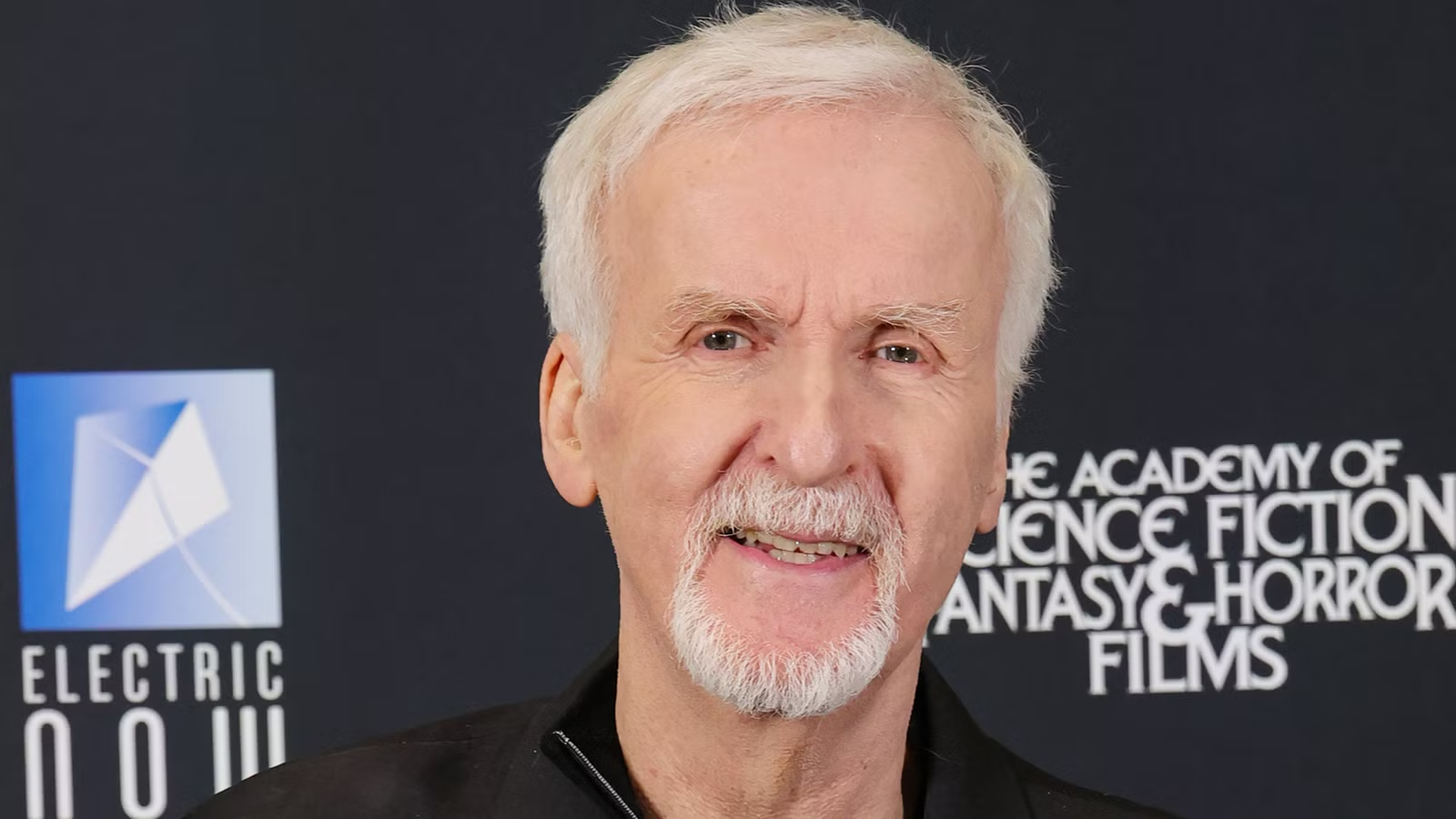
James Cameron’s work ethic has become almost as legendary as the movies he’s made. Whether he’s developing technology to realize something previously considered impossible or spending years expanding the world ofAvatar, the filmmaker isn’t exactly known for doing things by halves. That apparently isn’t something Cameron developed after becoming one of Hollywood’s most powerful directors, either. Michael Biehn discovered it firsthand while they were making the movie that changed both of their careers.
Biehn starred as Kyle Reese in 1984’s The Terminator, beginning a collaboration with Cameron that would later include Aliens and The Abyss. Speaking exclusively with Collider while promoting Onslaught, Biehn recalled the exhausting end of The Terminator’s shoot — and discovering that Cameron was already intensely working on what would become his next sci-fi classic just 48 hours later. Biehn explained that The Terminator had spent 11 weeks shooting nights, with the actor regularly working 12 or 13-hour days. Cameron and producer Gale Anne Hurd, he believes, were putting in considerably more.
“We were shooting The Terminator for 11 weeks, nights. Friday, as soon as the sun comes up, it’s over, right? So I go home. I’m exhausted. I’m totally exhausted. Jim and Gale probably put in twice as many hours per 24 hours than I did. They were probably working 16, 18-hour days. I was only working 12, 13-hour days.”
Two days later, Hurd called Biehn and invited him over. Cameron had assembled a rough cut of the famous Tech Noir sequence and wanted his leading man to see it. Despite still being exhausted from filming, Biehn drove over — only to discover Cameron had already moved on.
“I went into his office, and he’s just writing with intensity, really hardcore writing. I came within two or three feet of him, and he didn’t even notice me. Then all of a sudden he looked up and went, ‘Oh, hey, Michael. Good to see you.’ This is 48 hours after we wrapped.”
Collider Exclusive · Sci-Fi Survival Quiz Which Sci-Fi World Would You Survive? The Matrix · Mad Max · Blade Runner · Dune · Star Wars
Five universes. Five completely different ways the future went wrong — or sideways, or up in flames. Only one of them is the world your instincts were built for. Eight questions will figure out which dystopia, galaxy, or desert wasteland you’d actually make it out of alive.
💊The Matrix
🔥Mad Max
🌧️Blade Runner
🏜️Dune
🚀Star Wars
01
You sense something is deeply wrong with the world around you. What do you do? The first instinct is often the truest one.
02
In a world of scarcity, what resource do you guard most fiercely? What we protect reveals what we believe survival actually requires.
03
What kind of threat keeps you up at night? Fear is useful data — if you’re honest about what you’re actually afraid of.
04
How do you deal with authority you don’t trust? Every dystopia has a power structure. Your approach to it determines everything.
05
Which environment could you actually endure long-term? Survival isn’t just tactical — it’s physical, psychological, and very much about where you are.
06
Who do you want in your corner when things fall apart? The company you keep is the clearest signal of who you actually are.
07
Where do you draw the line — if you draw one at all? Every survivor eventually faces a moment that tests what they’re actually made of.
08
What would actually make survival worth it? Staying alive is one thing. Having a reason to is another.
Your Fate Has Been Calculated You’d Survive In…
Your answers point to the world your instincts were built for. This is the universe your temperament, your survival instincts, and your particular brand of stubbornness were made for.
The Resistance, Zion
The Matrix
You took the red pill a long time ago — probably before anyone offered it to you. You’re a systems thinker who can’t help but notice the seams in things.
You’re drawn to understanding how the system works before figuring out how to break it.
You’d find the Resistance, or it would find you — your instinct for spotting constructed realities is the machines’ worst nightmare.
You function best when you have access to information and the freedom to act on it.
The Matrix built an airtight prison. You’d be the one probing the walls for the door.
The Wasteland
Mad Max
The wasteland doesn’t reward the clever or the well-connected — it rewards those who are hard to kill and harder to break. That’s you.
You don’t need comfort, community, or a cause larger than the next horizon.
You need a vehicle, a clear threat, and enough fuel to outrun it — and you’re good at all three.
You are unsentimental enough to survive that world, and decent enough — just barely — to be something more than another raider.
In the wasteland, that distinction is everything.
Los Angeles, 2049
Blade Runner
You’d survive here because you know how to exist in moral grey areas without losing yourself completely.
You read people accurately, keep your circle small, and ask the questions others prefer not to answer.
In a city where humanity is a legal designation rather than a feeling, you hold onto something that keeps you functional.
You’re not a hero. But you’re not lost, either.
In Blade Runner’s world, that distinction is everything.
Arrakis
Dune
Arrakis is the most hostile environment in the known universe — and you are precisely the kind of person it rewards.
Patience, discipline, and political awareness are your core strengths — and on Arrakis, they’re survival tools.
You understand that the long game matters more than any single victory.
Others come to Dune and are consumed by it. You’d learn its logic and earn its respect.
In time, you wouldn’t just survive Arrakis — you’d begin to reshape it.
A Galaxy Far, Far Away
Star Wars
The galaxy far, far away is vast, loud, and in a constant state of violent political upheaval — and you wouldn’t have it any other way.
You find meaning in being part of something larger than yourself — a cause, a crew, a rebellion.
You’d gravitate toward the Rebellion, or the fringes, or whatever pocket of the galaxy still believes the Empire’s grip can be broken.
You fight — not because you have to, but because standing aside isn’t something you’re capable of.
In Star Wars, that willingness is what makes all the difference.
James Cameron Was Already Working on ‘Aliens’
Given how physically draining the shoot had been, Biehn couldn’t understand what could possibly have Cameron so focused only two days later. The answer was a shocker in one way, but no surprise in another.
“I said to him, ‘Jim, what could possibly be so important right now? I’m exhausted. What are you writing?’ ‘Well, I’m doing this Aliens treatment.’ He was writing Aliens two days after we wrapped The Terminator. He was writing Aliens. He’s just a remarkable, remarkable guy.”
Of course, the sequel to Ridley Scott’s Alien would allow Cameron the chance to work with Biehn once more, although not initially. James Remar was originally cast as Corporal Dwayne Hicks before Biehn replaced him during production, reuniting the actor with Cameron. The pair would work together again on The Abyss, and Biehn remains enormously complimentary about his longtime collaborator. Elsewhere in our conversation, he placed Cameron alongside Francis Ford Coppola, Steven Spielberg and Martin Scorsese among his four favorite filmmakers.
But the funniest part of the whole story is how simple Cameron made it seem to have made one of the best sci-fi movies ever, and just jumping right into the next one. No wonder he’s one of the greats.