
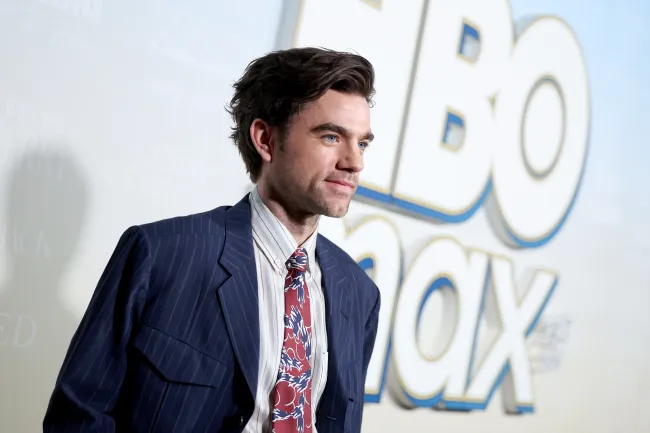
Patrick Ball can’t quite believe he’s an Emmy nominee for his first proper television role on The Pitt. The North Carolina native has become a fan-favorite for playing Dr. Frank Langdon, a senior resident recovering from addiction in the Noah Wyle-led series, and last month his performance earned him a Best Supporting Actor in a Drama bid. “The fact that the job that I got was telling the story that I actually believe in feels amazing,” Ball tells Gold Derby. “So I think, yeah, I’ve already won.”
The actor sat down to discuss what it means to authentically portray recovery on-screen, what fans of The Pitt might have missed, and where Season 3 of the Emmy-winning series might be going.

Gold Derby: Congratulations on your first Emmy nomination. How does it feel to be nominated alongside so many of your co-stars?
Patrick Ball: I wouldn’t have it any other way. It’s really amazing. I got to get the announcement while I was at work. We all got sort of gathered around the central hub and Scott [Gemmill, showrunner] took the mic and announced the 26 different people on our set that happened to get nominated for an Emmy, and we all got to sort of celebrate each other and pat each other on the back. And I think this show really prides itself on being a true ensemble show, a true team sport, and to get to go through this new crazy experience as a team feels completely right. I feel super lucky to be on the bus.
Our experts are predicting you will win your category. What would winning your first Emmy for this role in particular mean to you, especially because you’ve expressed how personal playing Langdon is for you?
This is a story that means a lot to me. I come from healthcare workers. My mom’s an ER nurse, my dad’s a paramedic, so I’ve grown up as a tangential sort of member of this community. And so I know these people and it’s a mission that I actually genuinely believe in, and as an actor, we spend a lot of time just hoping for a job and praying for a job and asking for just any old job. The fact that the job that I got was telling the story that I actually believe in feels amazing. I think I’ve kind of already won.
What conversations, if any, did you have with Scott or [executive producer] John Wells about showing the realities of someone going through recovery in Langdon’s situation?
Part of the fact that Langdon is, because of his addiction and because of this sort of spiritual metamorphosis that he’s going through and getting sober, there’s a lot of growth and change all throughout this period of time, which means that I get to find new things and I get to find new ways of moving through the world. New ways of understanding self, new ways of navigating the workspace and navigating my own sort of fears and resentments, and all of these relationships with everyone around me over the seasons are just becoming more and more rich and more and more dynamic. They’re not static relationships. They’re in flux. So it’s an incredible, incredible gift, and we’re in the middle of shooting Season 3 right now and I’m very excited. I think people are really going to be excited.
It’s great. So you only kind of get a sense of what happened over those last 10 months by what is able to exist in one day in a workspace, which is a really indirect way of sort of experiencing a pretty profound spiritual sort of experience, so that is very cool. And it’s very cool to have a showrunner that is really committed to maintaining that frame and to maintaining what would be realistic to have happen in one day at work. It creates a very subtle and unique sort of way of telling a story that is really super satisfying.
Some of your most impactful scenes in Season 2, as well as Season 1, were with Noah Wyle. What has working with an actor like Noah on your first major series taught you? What does he bring to the process?
There is honestly nobody in the history of television that knows more about how to do a hospital drama than Noah Wyle. If you think about it, there’s literally nobody in history. And he’s taught me so much. I mean, he’s literally, I showed up day one of Season 1 not knowing how to read a call sheet and not knowing anything about how television worked, and he has taught me a ton. I literally just came from work, and I think one thing that continues to be true is he teaches me patience. We shoot over eight months. There is a story that you’re going to tell and you’re going to tell it one little bit at a time. And that over eight months of filming is going to add up to the story that you’re going to tell, but you’ve got to be patient because it doesn’t happen all at once.
The other dynamic that was so crucial to Langdon’s storyline in Season 2 was his relationship with Santos. How do you and Isa Briones approach those tense moments when you’re in conflict? What about her as a scene partner pushes you to perform at your best?
I love Isa. She’s become a great friend and she’s one of my favorite people to work with. We’re both theater kids, so we very much come to set whenever we get to work together, and it very much feels like an early blocking rehearsal if we were doing a play. And so we can try things on and we can have open collaborative conversations about what story it is that we want to tell. I think both of us were really surprised and excited about the ride we were able to take the audience on throughout Season 1 as far as people picking sides and people saying, “OK, there is an assumed good guy, an assumed bad guy,” and then that expectation gets flip-flopped and subverted. And that is, as a storyteller, really good stuff, and so we wanted to make sure that we came back in, in Season 2, and we sort of kept that ambiguity and that sort of balanced conversation alive.
We also wanted to stay within the spectrum of what is realistically possible for one day. This is one day of coming back and trying to make amends and trying to re-approach this relationship, and I think the idea of going on some grand forgiveness journey might not be entirely realistic. And so I think being able to identify what story we want to tell and how to tell that story in a way that was true to the frame of one day was really cool.
So much has been said about the unique experience of filming The Pitt where you’re basically on-camera constantly even if you’re not in a scene, doing background work. What challenges does that pose and how has that actually become freeing for you as a performer now that you’ve made it to Season 3?
The challenges are that it’s long days. We spend a lot of time on deck, but that’s also sort of the benefit of it. So say I’m in Episode 5 or I’m in Scene 5. Well, for Scene 2, 3, and 4, I’m probably floating around the background, and so I will probably spend six, seven, eight hours on deck sort of doing things in the background before we even get to my scene, which can be really transporting. So by the time you get there, you’re not showing up and hitting an X and accomplishing your emotional plan that you set out for this scene. You are already thoroughly lost in a Groundhog’s Day and a Backrooms liminal space that is The Pitt. And so it really helps you land in the day.
What’s a moment in the second season you wish the fans had picked up on or gotten to fully see from your background work?
Some of the things that you do in those deep background moments, some of them make the edit, some of them don’t. But I think that there were probably a couple of moments that did make it where I was on the phone with my wife whenever the cyber attack happened, trying to tell her that I know it’s my first day back at work, and I know I’ve been at home doing my share of childcare and being present for everybody at home, and I know this is my first day back at work. And I know I told you things were going to be different and that I would be home on time, but I am going to be home late and I’m sorry. And there were little moments that I found in the background to have that sort of conversation with my wife that maybe you got, maybe you didn’t.
What are your hopes for Langdon in Season 3? Where’s Langdon’s head at vs. when we left him at the end of the second season?
I can say that it’s roughly four months later and I have been at work. And so in Season 2, you see somebody come in the door who has not been at work for 10 months and has not been on that sort of hamster wheel, that sort of propulsive sort of tempo that you have to move at in The Pitt. I have been off the train for 10 months. Now, in Season 3, I come back in the door and you’re going to meet somebody who has been back on the train that they were on whenever you met them in season one. But now I’m back on the train having gone through everything that you saw in Season 2, so I’m having a lot of fun.
Do you ever think about what Langdon gets up to in his rare free time?
Probably any free time that he has, he comes home and tries his best not to just collapse into a puddle and recharge, but coming home after a 12- or 14-hour shift and trying his best to show up for his responsibilities at home is probably all he has time to do.
Since we only get to know small details about characters each season, what’s a detail about another character you’d really like to know just as a viewer?
What is Dana [Katherine LaNasa]’s home life like? What’s going on there? I would love to know more about who Dana is outside of this world for sure. I would love to know more about what is going on with Whitaker [Gerran Howell] and Santos. What is that roommate dynamic like? One can only imagine. It’s pretty weird. So yeah, what’s going on with Mel [Taylor Dearden] and Becca [Tal Anderson]? What is going on with just Becca? I want to know a lot more.
Last year’s Emmys party bus is famous. What are the plans for this year?
The party bus Season 1 was incredible. It was really sort of the crowning moment of my life, and it was completely Noah Wyle’s doing. He came up at a certain point and was like, “Back in the day with ER, whenever we were having our first season and we were having this coming-out party together, we got a party bus and it was this really great moment.” I was like, “Yes, let’s make that happen.” And he did, and I have gently re-approached the subject coming into Season 2. And I’ve said, “OK, Noah, well, the party bus was a hit. It was a big hit. What can we do to up the ante here?” And so I’ve just put it out there. I’m fielding ideas, but I think like maybe a party bus, a double-decker.
I just got back from visiting my girlfriend in Nova Scotia because she’s filming a TV show up there and they had a party boat. It was like a river boat situation, and they came by and everybody looked like they were having a great time. “I Got Friends in Low Places” was playing and it just really looked like a fun time. So if we could pull something off like that … I know it’s not ideal for Los Angeles, but there are ideas being tossed around. We’re going to figure something out.
The interview has been edited for length and clarity.
