
Has any character ever redeemed themselves so fully — and so believably — in a single episode?
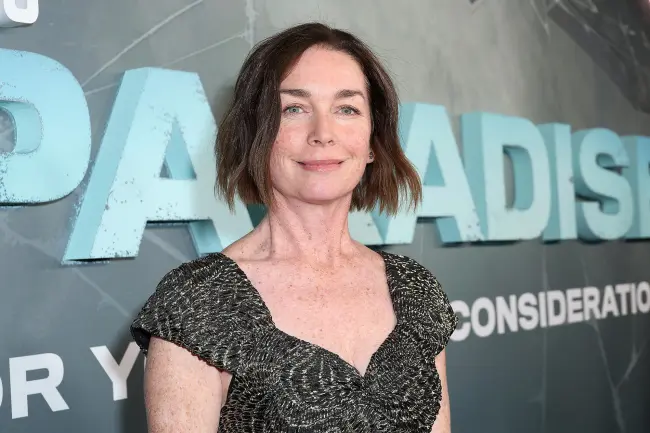
Leave it to Julianne Nicholson to pull off that evil-to-good transformation, turning from Paradise‘s most manipulative villain (well, maybe second to Nicole Brydon Bloom’s Jane) to its unlikely savior — sacrificing herself in the final moments to save the town and perhaps the world. Just watch those final moments as she wanders through the streets, imagining her reunion with her son, and it’s no wonder the actress landed an Emmy nomination for best supporting actress — one of the few non-Pitt performers to break into the category.

Here, Nicholson shares with Gold Derby her experiences filming that emotional, climactic finale, as well as what lies ahead for the third and final season of the hit Hulu thriller.
Gold Derby: So let’s start with an easy question: Is Sinatra really dead?
Julianne Nicholson: Ah, is Sinatra really dead? Is anyone dead in a Dan Fogelman show? I think that’s the question. I don’t think you can keep a good woman down, so we shall see.
So how is shooting Season 3 going?
You’ve done this before! [Laughs.] Very clever. I wouldn’t know. There’s a lot going on in Season 3. There are new characters, much like Season 2, and you’ll see some familiar faces. But I would really hate to give you any spoilers. It’s so much more fun to discover while you’re watching it.
Have we seen the last of Sinatra?
I don’t even know if I can answer these questions. I don’t want to be the one that gives it all away. But as we know, no one ever lives or dies. … And the way [Dan] plays with time, especially in this show, and quantum physics, and I believe even space this season.
Knowing that he knew where the three seasons were going, how much of that did he share with you in terms of your character?
I didn’t really know much beyond the first season when I started, and then at the beginning of the second season, he revealed what the overall arc for Sinatra would be. I’ve been getting information in dribs and drabs, I would say. I think Sterling was told the full picture, but I was not.
So much of that Season 2 finale really hinged on you and your performance. When did you know that was what was in store for Sinatra?
I think he told me right when we started filming the second season. I wasn’t in the first two or three episodes of the first season, so when I started filming — which would have been around Episode 3 or 4 — Dan shared with me what he thought the ending was going to be. They actually played with the idea of, “OK, are we going to find out at the end? Is she dead? Is she alive? Is there a way that we can get her out of the bunker?” So they didn’t really know until the season went on what the actual ending was going to be. I thought it was such a beautiful way to go out, and I feel like he just knows — he’s so tapped into a large audience, their emotional life, what moves them, what they respond to, what we respond to. I thought that was the perfect ending for her. I feel like it redeemed her and gave her grace. The person we see at the end of Season 2 was a very different woman than the one we met at the beginning of Season 1.
What changed her? What led her to end up in that place?
I think a lot of it was experiencing what she did and what they all did in the first season around the death of the president. And I think it was also realizing that this long-game idea she had with Alex worked — believing that her son still existed somewhere. Certain things just softened her edges a little bit, and there was growth there. I love that the writers allowed her that.
Do you think of her as good or evil, or somewhere in between?
Somewhere in between, I would say — like all of us, maybe, to a certain degree. She’s extreme, of course, but I wouldn’t say she was good or evil.
How did meeting Dylan/Link change her?
I think the death of Dylan when he was seven just tore her apart, and she never really came back from that. So to work toward this goal of maybe finding a way to keep him alive in some way — and then seeing that maybe that actually came true — it’s like the Grinch. Her heart grew three sizes. It was the greatest miracle, an impossible thing. People ask me about that, like, “Is it really Dylan? How does that work?” And I just said I had to trust the writers and feel like she really believed it. So that’s what I got to play with. The facts, on paper — how does that work? I have no idea.
It’s almost less important how it happens; it’s more important that she believes.
That’s what I thought too, and that’s something you can play. That’s something you can feel, believe, and work with.
Is that why you think she sacrifices herself in the end?
Having that understanding that he was still alive just shifted something in her. She worked so hard for this thing; she also couldn’t watch it be destroyed. I feel like she was almost at peace. It was OK now — she didn’t have to hold on, she didn’t have to have such tight control of everything. She could make the ultimate sacrifice.
Talk about filming that final scene, when you’re walking through the town and everything’s falling around you and she sees her son. What was that like?
We were filming on a lot, actually, so we didn’t have all those things falling down around us, of course. It was very emotional to feel like this giant thing that she had created was ending, and it felt so vast where we filmed, because of course it’s sky, it’s not a bunker. But imagining that it was actually an enclosed space with all these things falling down — they did such a great job. There was dust everywhere, and wind machines, and pieces of scaffolding on the ground around her. So it felt big, actually. It felt like what it feels like when you’re watching it.
It’s also so emotional. How do you balance this huge, practical, crazy scene but letting it all play out across your face?
Well, I think it’s grounded in that moment when she’s remembering her son, on the rocking horse. So you go small. You go with the details that you can connect to, and I think that’s probably what people can respond to — those smaller, more human moments. And then, hopefully, that’s still affecting when you see it on a wider screen, a wider experience. I found her story very moving — as the actor who played her, as an audience member, as someone who loves storytelling. I found her to be a very moving character. I had great writers around too, and I could always check in with Dan, and I knew what he wanted it to be. And I’m so supported by the music, by Sid [Siddhartha Khosla], who does our score and all the music in the show, and our editors. They’re incredible, and they helped create that performance every step of the way.
How did your understanding of her evolve as you got to play her, as you understood her more?
I understood her power more with each scene that I did. Originally, that felt more like an idea, or something that was on the page, and I didn’t really know what that was going to look like or feel like, or how it would play out. But it did. Because the other people have to listen to me, they have to obey me, and that begot a sense of confidence and strength. So when I’m playing a character, every scene informs who that person is, because you don’t know what’s going to happen until the scene actually plays out, which is the exciting thing. I never want to know what happens until we do it. And then you learn with each scene a little bit more — the nuance, the subtlety of who that person is and what it feels like to be them.
Especially this season, she’s that much more isolated. She doesn’t have anyone she can trust. She’s lost Dr. Torabi. She’s not really confiding in her husband anymore. How hard was that for you to play, when you can’t really reveal your true emotions?
I think her isolation ultimately served the story, and it just made everything feel more private and more expansive at the same time. I liked that she doesn’t give it all away — that she’s not talking a lot or sharing a lot, but still has so much going on. That felt exciting to me.
Do you still have questions about her backstory, or things you want to know about her?
No, I feel very happy with where she came to, and I felt like the closure that happens at the end of Season 2 was so bittersweet, but also the perfect little ending. I feel like she was quite literally put to rest there. I feel very peaceful about Samantha Redmond — the journey, the woman, the legend.

What was it like working opposite Sterling and having that reunion with him in the finale?
I found it so moving, because we had nothing to do with each other in the second season until that very last episode, and I love Sterling. He’s an incredibly talented actor. He’s a supremely generous person. I also find the relationship between Sinatra and Xavier very moving, because they’re so wildly different in who they are, but I feel like they have a respect for each other. I feel like she was genuinely pleased to see him when he comes back into the bunker in that final episode. He made it. She’s genuinely relieved and happy that he’s okay, that he went out there and made it back. And it’s so fun to work with him. I feel like there are some actors that you just click into a different place with pretty effortlessly, and he’s one of those people for me. It just feels rich already. When we’re in the elevator and I’m telling him, “I think it all worked, I think I saw my son today” — it just feels like being next to him grounds everything in reality.
What do you think Alex and the computer means to her? Is it the resurrection of her her son, or her life’s work?
I think it’s both of those things. Alex is very micro and macro for her. It’s very specific to the possibility of her son still being alive in whatever form, and it is also a decade of intense work and scrutiny and belief in something that not everybody believed in. And terrible decisions along the way, things that she felt had to be done to protect it. So her feelings about Alex were hugely complicated and layered, but ultimately it felt like a victory.
I always feel bad for her daughter. Maybe the finale, given that her daughter was at risk — do you think that brought up, “Oh wait, I’ve got another child here”?
Definitely, yeah. I love Kate, who plays Hadley — she’s a wonderful actress. Needing to save her daughter was definitely one of the big things about going down with the ship: somebody has to do it, I can’t, I have these two other people that I need to protect. But I agree, through the season she got a little bit of short shrift. It’s going to take a minute for her, but she’s got a father who loves her, and that was very present, so she’s going to be OK.
After the Season 2 finale, what questions should we be asking looking ahead to Season 3?
Expect the unexpected.. I have no idea what’s happening throughout most of Season 3. Honestly, your guess is as good as mine. I cannot wait to watch. It’s crazy — I saw a post of Elijah Wood in space, so I don’t know. How does that work? I have no idea.
So Hacks came to its conclusion. Were you sad not to see the return of Dance Mom?
I wasn’t. I felt like Dance Mom was a little capsule that should just live in those three episodes. I loved doing that show so much — and I loved it even more once I was on it and understood how they worked every day, and the relationship they all had between cast and crew. But I cannot walk by a buzzball in a supermarket and not want to text someone. I’ve never tried a buzzball, and I will never try a buzzball, God willing — but it definitely stayed with me. Dance Mom has stayed with me.
And I’ve got to ask about Task Season 2. It’s exciting to see that crossover. Anything you can share?
Well, not really about the storyline, but I started filming, and it was so much fun to go back and be back in that area, and work on that accent, and be with the incredible Brad Inglesby, the writer-creator. I don’t know why, but it feels like everybody’s grown up a little bit since then. We were all grown-ups and deep into our careers, but there’s an ease there. He doesn’t have to prove himself. Mare was incredible, the first season of Task was incredible — he’s such a talent. And it’s the same costume designer, my same makeup artist, my same dialect coach, so many of the same first and second ADs. It’s like old home week, and I’m loving being back. I’m a huge fan of Mark Ruffalo’s, and the story this year — the crime — is beautiful and intense, and I think it’s going to really hit hard. I’m excited.
