
Warning: This post contains spoilers for the series premiere of Lanterns.
Lanterns may be the latest entry in the rebooted DC Cinematic Universe, but it immediately differentiates itself from big screen entries like James Gunn’s franchise-relaunching 2025 hit Superman — not to mention this summer’s box office disappointment, Supergirl.
Gunn’s film was unafraid of embracing the more alien aspects of Superman, to the point where it opened in the Fortress of Solitude and threw multiple superheroes at audiences, including Mister Terrific and Hawkgirl. Lanterns, on the other hand, begins with a series premiere that’s rooted in recognizable human drama. True Detective has often been invoked as an inspiration for this series, which was created by thrio Damon Lindelof, Tom King, and Chris Mundy.

“A lot of TV shows and films treat the audience like they’re a bit stupid,” Lanterns star Kelly Macdonald tells Gold Derby. “It’s much more interesting to feel your way through something rather than see things in a cartoony superhero style. Our show is a real character study. You could feel it when we were doing the scenes. Everybody knew who they were and where they were coming from. Nothing felt like exposition, it felt like a real deep dive into human beings.”
Like True Detective and Lindelof’s own Watchmen series for HBO, Lanterns jumps around in time. The season premiere opens in 1996, where the current Green Lantern, Hal Jordan (Kyle Chandler), is being interviewed on TV, watched by a young John Stewart (played as a grown-up by Aaron Pierre). As readers of Green Lantern comics know, the green ring gains its power from the user’s ability to overcome fear. From an early age, the young Stewart’s resistance to fear is tested by his father (J. Alphonse Nicholson) who shoots an apple off his head.
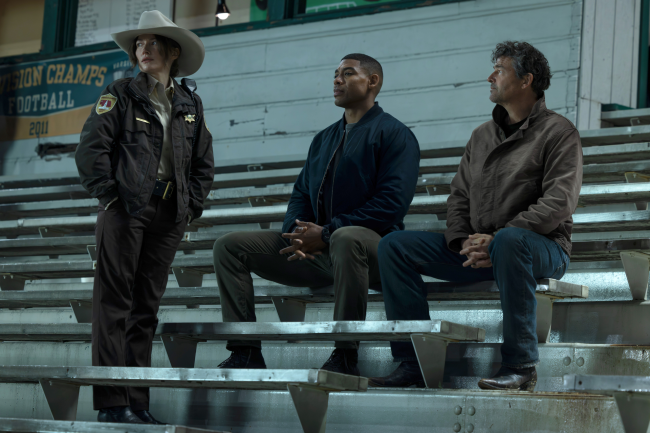
The show then jumps ahead to 2016, when John is being trained by Jordan to take over for him someday. Even when more sci-fi elements are referenced, such as the dead aliens that Jordan and Stewart are investigating in the premiere, they are explained through realistic dialogue between recognizably human characters like Macdonald’s Kerry, the sheriff of Rushville, Neb., who works with the two protagonists.

Later in the premiere, Jordan interrogates a captive alien who spends the whole scene in human form. The Green Lantern uncovers his identity by asking him things that a human Nebraska resident would know, including trivia about Nebraska football, as well as Harry Potter, and rural white criticisms of President Barack Obama.
Fans of Green Lantern comic books shouldn’t necessarily despair, though. As the season goes on, there will definitely be more superhero world-building. But it will still exist side-by-side with more human elements and detective archetypes. As a Green Lantern, Jordan is a space cop, but Kerry reacts to him much like local cops often do to federal agents moving in on their territory.
“With Hal and John, we’ve got the older and younger partners vying for control,” Macdonald says. “The show does all these things that we’re familiar with, but it does them with a fine touch.”
Investigating the mysterious alien deaths brings Jordan and Stewart into conflict with local Nebraska bigwigs, notably rancher William Macon (Garret Dillahunt) and his wife, Zoe (Poorna Jagannathan). Macon is interested in the dead aliens but won’t explain why, and the couple seems to be playing some sort of power game, as evidenced by Zoe cheating on her husband with Stewart in the premiere episode.
“The way it’s written is that every character, be it a superhero or a villain or everyone in between, has shades of so much humanity,” Jagannathan says. “That manifests in shades of good and shades of bad.”

Since Lanterns is both a superhero show and a detective show, viewers should remember not to take everything at face value. Just take the final scene of the premiere, which jumps ahead to 2026 where Stewart and Kerry find Jordan apparently dead and his power ring MIA.
“The death of Hal Jordan is probably the most controversial idea that we had,” Lindelof says in the post-show.” “When I first read the script, I was kind of shocked,” adds Chandler. “I just took me aback. I was like, ‘Oh, that’s going to be a good show.'”
How and why that happens — and how it recontextualizes the previous eras of the show’s story — will be revealed over the course of the season.
“The best scenes are kind of about the opposite of what they appear to be,” Dillahunt tells Gold Derby. “There’s a ton of that happening in this series, and it’s just great to be a part of great writing like that.”
