
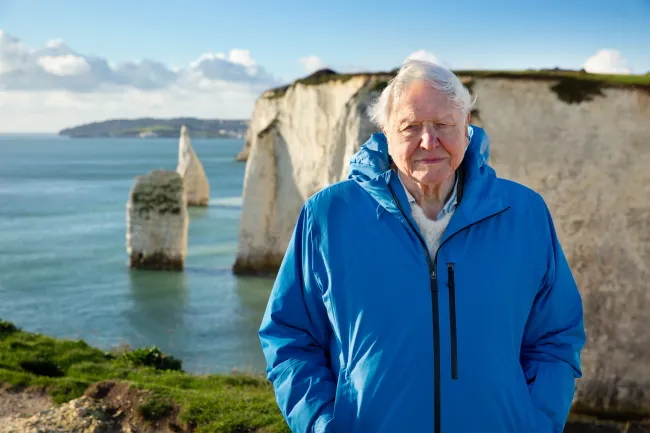
Ocean With David Attenborough has turned its narrator into a record holder. At 100, Attenborough is the oldest nominee in Emmy history, passing Norman Lear, who was 99 years and 11 months old on nomination day in 2022. (Lear turned 100 before that year’s ceremony.)
His Best Narrator nod is one of six for National Geographic’s documentary, along with Best Documentary or Nonfiction Special, Best Cinematography for Doug Anderson and Toby Strong, Best Music Composition for Steven Price, and both sound mixing and sound editing categories. Attenborough is up for Best Narrator twice this year, competing against himself for Netflix’s A Gorilla Story.

But the people who made Ocean are prouder of something else. They say the film helped change international law.
Directors Keith Scholey and Toby Nowlan, along with composer Steven Price, joined Gold Derby to talk about the making of Ocean: never-before-seen footage of the ocean floor being destroyed, a score built almost entirely out of one singer’s voice, and a treaty they believe the film helped make law.

“It has changed the world”
Scholey has been making films with Attenborough since 1983. This one sits at the top.
“Certainly in my career, it’s the film I’m most proud of,” he says. “To pull off a film of that power with him, which had such meaning, and actually ended up — I know it sounds maybe pushing the point, but it has changed the world. And there’s evidence about that.”
Asked what Attenborough did here that he hadn’t seen in four decades of working together, Scholey says it was closer to acting than presenting. “David really put his personal emotion into each take,” he says. “In some places he’s clearly really angry. He really doesn’t like what he’s seeing, what he’s being told. And at other times he’s just so filled with wonder about the solutions. When he contemplates his age and the time of his life, it’s desperately moving.”
Price, who won an Emmy for scoring David Attenborough: A Life on Our Planet, writes his music around that iconic voice. “David’s voice ultimately is an absolute gift if you’re a music person, because he is so musical and his performances of the words are so perfect,” he says. “Emotionally he totally leads everything that I wrote. He doesn’t waste any syllables, and the way he expresses himself is always so clear.”
Nowlan, who co-directed and co-produced the film and is a first-time Emmy nominee, knew early what he wanted the film to do. “This wasn’t just another film for us,” he says. “The great hope, of course, was that it would go on to make a difference for the ocean — an actual tangible difference.”

“We started looking for a library, and there isn’t any”
Bottom trawling — essentially dragging weighted nets along the ocean floor to scoop up whatever is living there — happens daily around the world, covering an area of seabed almost the size of the Amazon rainforest every year, according to the film. Almost none of it had ever been filmed. The team figured they would just buy footage somebody else had already shot.
“At the start, we thought, we’ll just get some library in,” Scholey says. “And then we started looking for library, and there isn’t any. And we said, wow, why is that? This is such a common practice. And then of course we quickly discovered why. They don’t want you to film it.”
So they went looking for scientists already out on the water studying the damage. That took them to two research teams: one in the Mediterranean off Turkey, and one off Britain working on scallop dredging, which rakes the seabed for shellfish.
“The group of scientists decided that the way they would measure the exact effect of bottom trawling could be using cameras,” Nowlan says. “So that was where we came in. We provided the cameras for those scientists. Which is extraordinary really — the first precise study of shallow bottom trawling is done by some wildlife filmmakers.”
Building the cameras took almost as long as getting permission. Anderson and fellow cinematographer Olly Scholey spent close to two years developing housings for the job. “It’s very dark down there, it’s happening 20, 30 meters plus. You can see the turbulence and the violence that these rigs have to withstand,” Nowlan says. Cameras were lost. What came back was worse than they expected: “The images that came up shocked absolutely everyone, including all of us. We weren’t quite prepared for how shocking they were.”
The archive that didn’t exist now does. “Part of the deal was that at the end, everything that we shot was going to become open source,” Scholey says. “So no one was ever going to have to go and look for archive of bottom trawling.” Clips, like the one below, have been seen tens of millions of times, and groups in other countries are repurposing the material.
“We took away a lot of the background sound”
Price won his Oscar for Gravity, a score built around the silence of space. Asked whether any of that thinking carried underwater, he says the connection isn’t the setting — it’s what the directors asked him for.
“What the two projects share is that the directors in both cases encouraged me to do something that sounded very different,” he says. “I’ve done a certain amount of natural history work that sounded florid and orchestral, and with this one, we wanted it to have its own identity.”
The score was built largely from sessions with singer Lisa Hannigan. “We kind of tracked her up hundreds of times. There’s so many of her moving around, and her voice would move along with the ocean and echo the movements of the water,” Price says. “We took away a lot of the background sound that might have cluttered that area, and we managed to create a soundscape using this musical voice.”
That left him space to set up ideas early and tear them apart later. “You could plant these ideas in the very first bits of the film where we’re talking about the wonder of everything, but then totally transform them into the horror of what’s happening down below the surface,” he says. “The images could take this incredible sort of sound that you would never think of doing in a natural history show.”

“It’s representative of the people of that ocean”
The hopeful half of the film is built around Papahānaumokuākea Marine National Monument in the Northwestern Hawaiian Islands, which Nowlan calls an engine of life for the whole Pacific.
“What happens when you truly protect an enormous slice of ocean is that life would explode back to life in the most spectacular way imaginable, far quicker and far more dramatically than any of us had ever dreamt possible,” he says. “And that includes all the fish in the sea.” The sequence includes the largest albatross colony on the planet.
Three Native Hawaiian women shaped what’s on screen: conservationist ʻAulani Wilhelm, who helped create the monument and narrates the sequence; Pelika Andrade, who appears on camera; and Mehana, who wrote an oli, a chant, for the film. What they asked for changed how the whole sequence was shot.
“They were very keen that whoever spoke or whoever was seen on screen, it wasn’t just one person — that it was reflective of a whole community, reflective of the Hawaiian people,” Nowlan says. “Which is why you never see names on screen, and you actually never see them talking. You just see these figures with the ocean, because it’s representative of the people of that ocean.”
It matched a rule that Toby Strong — the Emmy-nominated cinematographer who shot above-water sequences — applied to every person in the film, Attenborough included: dead center in frame, looking out at the sea.
The chant landed in Price’s inbox as a recording from the field, with no warning. “One day you get an email, just, how about this,” he says. “It gave me shivers. So my job was largely just to frame this thing and let it play and let you feel the emotion that was in the words. It was a gift.”

“It’s a win-win”
Scholey points to the High Seas Treaty as evidence that the film has had real-world impact. Two-thirds of the ocean lies outside any country’s waters, and until this year there was no law governing what happened out there. The U.N. agreed on the wording in 2023, but 60 countries had to ratify it before it meant anything. That gap is what the film was aimed at. The team screened Ocean for the British prime minister and in the U.K.’s House of Lords ahead of the U.N. Ocean Conference in June 2025. The 60th ratification came that September. The treaty took effect in January.
“Before the High Seas Treaty there was no governance of the high sea,” Scholey says. “The United Nations has agreed to put law onto the area of the open ocean that was previously lawless.” Colleagues of his had spent two decades trying to get it there.
He’s more careful about the rest of it. “What happens with conservation is you get pledges and then they get rolled back,” he says. “But it’s a long game. There will always be less and less bottom trawling as opposed to more and more. And I think the film has tipped that balance.”
The blowback they braced for never arrived. “We thought when we made this film that criticism from the fishing industry was going to come,” Scholey says. “But the respect for Sir David Attenborough is so great across everyone. If anything, the film has more unified opinion than created divergence about how we manage the ocean going forward.”
That was the pitch from the start, he adds. “We always said right from the get-go, we’re never going to make an anti-fishing film, because people fish and billions of people rely on the ocean,” he says. “The wonder of protection is you just get more fish. It’s a win-win.”
Ocean With David Attenborough is streaming on Disney+ and Hulu.
This article and video are presented by National Geographic.
