
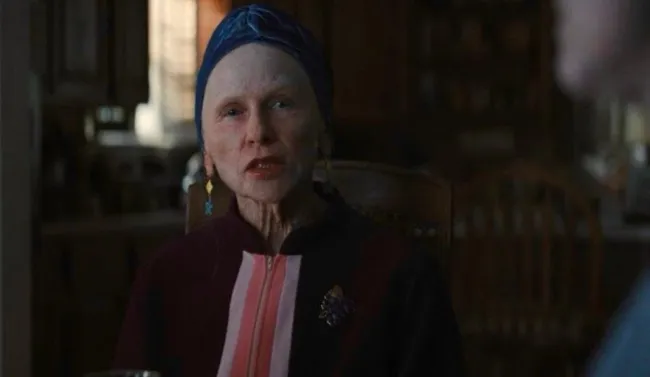
Zach Cregger was one of the featured attractions at the “Directors on Directing” panel at Comic-Con International on Thursday. The session, which also featured the Dungeons & Dragons and Game Night duo of Jonathan Goldstein and John Francis Daley, allowed Cregger to take a much-deserved but long-delayed victory lap for Weapons. It also afforded an opportunity to tease the upcoming Aunt Gladys prequel, which will fill in the backstory of the character that earned Amy Madigan her Oscar.
Here are the highlights:
On the status of the Aunt Gladys movie
Zach Cregger: I’m really excited about the Gladys movie. I loved working with Amy, I love that character, and for Weapons it made a lot of sense not to dive into her backstory, because the device of the film was to keep her very opaque and mysterious. However, there’s an amazing story to be told about where Gladys comes from and how she became what we know her as. It’s got a lot of twists and turns and mysteries, kind of like Weapons does, and I think it’s going to be great. The script is in process now. We’re taking it super seriously, and it’s moving in the right direction. It’s been written — that’s the short answer.

The timetable for the Gladys prequel
Cregger: My next project is going to be a science-fiction movie called Flood that I wrote. After Barbarian, I wrote Weapons, Flood, and Resident Evil in the same blast. I had a year-and-a-half hiatus between Barbarian and starting Weapons — I didn’t know which movie was going to go — and it ended up being Weapons, then Resident Evil, and then Flood will be next. After that, we’ll see.
The best advice he got while making Weapons
Cregger: When I was doing Weapons, I was very fortunate to be able to show the movie to David Fincher and have him sit with me and talk about a lot of different scenes. One lesson I learned from him was: first, stabilize everything. Don’t shoot in anamorphic handheld — stabilize. I learned that the hard way. Another was about audio. There’s a scene in Weapons where he blew my mind: Julia Garner is getting out of the car and walking from the car to her house, and we’re focused on her. She looks to her left, and we rack focus down the block, because she’s worried someone’s going to attack her, and then we rack back to her and follow her to the house.

Dave’s idea was: rack the audio, don’t just rack the visual. So we had all these cicadas in the street, and when we racked to the distance, we dropped down a certain frequency of cicadas and turned up a distant reverb — a slightly different tone of cicada — and suddenly it had this incredible effect of making me feel like I was really there. Such a simple tool. It taught me that you’re never done. When you’re in the edit, there’s always more to explore, and there are so many more tools at your disposal than I was even letting myself think about. The lesson was: take every scene you think you’re done with, and just keep going — keep pushing, keep exploring.
His favorite scene from Weapons
Cregger: For me, there was a moment when I was shooting Weapons. There was a scene with Amy Madigan sitting across the dining-room table from little Cary Christopher — the parents are stabbing themselves in the face — and Amy basically has a little monologue where she threatens him. It’s a really simple thing: a locked-off shot on a long lens, on her face.
Watching Amy take what I’d written and elevate it to such an amazing degree — I remember I was tearing up, sitting there watching her on the monitor, thinking, “This is so much better than I could have hoped.” That was a moment of immense pride for me. So, that’s the shot.
The moment he knew Weapons was a hit
Cregger: Oh my God, I don’t know. When Weapons came out, I was already in Prague in the middle of making Resident Evil, so I just wasn’t around for the party. I was getting some nice texts from people, but when you’re in the throes of making a movie, you have one gigantic emergency after another right in front of your face. So I sort of had to skip the whole thing. It felt like watching people have a good time on the other side of a giant gap. That realization crept in over time, after it happened. By the time I came back to America, the fanfare had subsided, and I was like, “Anybody?” So — terrible answer to your question. There was no moment.
Was there a favorite deleted scene?
Cregger: I cut some scenes out of Weapons, but they needed to go — they just didn’t move the story, so it was painless. It was like, “Oh, that didn’t serve what I thought it was going to do. Out.” I wish I’d cut them before I shot them.
Which director on which film would he have loved to shadow
Cregger: That’s such a good question — I’m going to come up with a better answer as soon as I leave. But what comes to mind is probably Stanley Kubrick — any movie, but maybe Barry Lyndon, just to see him tackle something that feels so daunting to make. And not just because he makes amazing things — the more I read about him, the more I realize how bizarre his process seems by the standards we’ve all entrenched ourselves in. Such a different way of working and thinking. I’d just love to be there. It’d be a pleasure.
