
Warning: This post contains spoilers for the season finale of The Vampire Lestat
Let’s start at the end… or should we say, the beginning?
The Vampire Lestat concludes its first season — and Season 3 of the Anne Rice-derived AMC series that started its (after)life as Interview with the Vampire — by bringing Sam Reid‘s titular vampire face-to-face with an apocalypse that he had a hand in manifesting. In the closing moments of “The Failures,” Lestat strolls through his Montreal apartment and then emerges onto his balcony to survey an utterly ruined cityscape. Or, at least, that’s what we, the viewers, see. When Reid was filming that closing moment, he didn’t get to observe the havoc his alter ego caused since the production didn’t actually destroy Montreal.

“They told me that the whole world has essentially been bombed,” the actor tells Gold Derby about the mental image the Vampire Lestat creative team gave him to play the scene. “We’re in a post-apocalyptic environment that Lestat is responsible for. I always knew that was going to be the last beat from the day we started filming, and it’s a good resolution because Lestat has spent the season working his way up to accepting his own failures. Now those failures have led to this cataclysmic event, and he fully understands that he’s responsible for it.”
What exactly that cataclysmic event is isn’t revealed in the season finale. But fans of Rice’s Vampire Chronicles know exactly what’s gone down: Akasha the Queen of the Damned has arisen, and woe be unto human and vampirekind alike. The book version of The Vampire Lestat concludes with a Lestat-headlined rock show that awakens the royal matriarch of the vampires, and that leads directly into the events of the third novel in the series, Queen of the Damned. According to showrunner Rolin Jones, the season was also intended to end with that Akasha-awakening concert, but during production the decision was made to postpone that sequence.
“We get a lot of money to make this show, but we’re not Game of Thrones,” he jokes. “So we decided to drive towards a more interior landscape with the finale, and that final image should give everyone a taste of what’s to come. It’s a tease of the reckoning, and it makes the audience go, ‘Tell me more.'”
Instead of closing out this season with Lestat’s concert and the havoc that follows, Jones says that the current hope is to use that event as the opening act for next season. As of press time, AMC has yet to officially announce a Season 4, but keep your eyes peeled on next week’s Vampire Lestat San Diego Comic Con panel where we’ll likely get an update on the show’s future.
“We’ve left Lestat surrounded by 50,000 screaming vampires who want a f**king show,” Jones says laughing. “We created as much tension for that concert as possible. Emotionally there are places that the characters get to by the end of this season that there’s satisfaction to this ending. But it’s also built to say, ‘We’re not done yet.'”
In separate interviews with Reid, Jones, Jacob Anderson, and Delainey Hayles, we drunk deep from the finale’s biggest moments — and got a few teasing glimpses of what could be in store when Lestat takes the stage.
Damned if you do

Coming off of two acclaimed seasons that were driven by the soulful storytelling of Lestat’s vampire lover, Louis (Jacob Anderson), Jones and the Interview creative team took a big risk by rebranding Season 3 as The Vampire Lestat with a new central character and a radical new visual and narrative style. While that change reflects how Rice approached the novels, it’s a harder shift to make for a television series.
“This season had to be Lestat’s show,” Jones emphasizes. “He’s a tragic clown, and we had to have him go on this journey to get him to place that he was to be in the finale. And this is only half of his story! There’s so much left that a Season 4 would need to complete.”
“It’s been a very internal season, even though it seem so chaotic,” Reid echoes. “It reflects the torrent inside his mind; he’s sifting through 250 years of life trying to make sense of and understand the things that have gotten him to this place we find him in the finale. He also finally accepts that he is loved, which is a really fundamental thing for the character.
“It’s a wild adaptation that Rolin and the writers have created, because they’ve pulled a throughline from multiple books to get to this place, and the audience won’t know until we go on why that’s so important,” the actor continues. “I had to ask them a lot of questions myself! I had to sit down and really be talked through a lot of things so that I could bringout the character that’s in the book and then re-mold him a little bit to fit into this adaptation while also trying to work out what the overall arc of the story is.”

As teased by her first appearance in the season’s fifth episode, Akasha, played by Sheila Atim, will be an important part of Lestat’s next chapter — especially as the series gets closer and closer to the events of Queen of the Damned. Unlike the first two books in the series, that installment is told from multiple perspectives and also plays out on a grand global scale, making it a bigger story than the series has attempted before. “Even HBO doesn’t have the money to do Queen of the Damned [as written],” Jones says with a sly smile.
But the creator is also relishing the challenge if and when the Season 4 announcement comes through. “We’ve had two seasons told by three people in a room in Dubai, and now a season told by this crazy person in his house in Montreal after the world has been destroyed,” he notes. “Season 4 seems to want to be told by multiple people.”
Asked if we could see the show’s title change again to reflect the shift, Jones declines to confirm whether that’s the plan, but he also doesn’t rule it out. “It seems like fans have embraced it,” he allows. “And when you think of the some of the biggest blockbusters of all time like The Empire Strikes Back and Return of the Jedi, no colons there. That’s the title — get on board.”
For his part, Reid indicates that he and Atim have had preliminary discussions about how they see the Akasha and Lestat relationship evolving should the Queen return in a still-theoretical Season 4. “This season, Lestat has examined his past through a very specific lens,” the actor says, choosing his words carefully. “And there were certain things that he didn’t really talk about this season, because The Vampire Lestat is a really big book, so they couldn’t adapt every single bit of it.
“Also, we were really adapting three different book and a little bit from further books down the line,” Reid adds. “So what I hope to see happen next is Lestat acknowledge that perhaps certain things that happened in his past — potentially in the 18th century — happened in a different light that he wasn’t really ready to examine in this season of the show.”
Head case

While the Lestat finale’s cliffhanger is pretty darn memorable, we have to give the (sharp) edge to the penultimate episode for the season’s best ending. That’s when Lestat and Louis had their heads separated from their bodies courtesy of the unlikely duo of Armand (Assad Zaman) and Daniel (Eric Bosgosian). “The Failures” opens in the immediate aftermath of that severing with Lestat’s head in Daniel’s possession, while Armand claims ownership of Louis’s noggin, which he keeps alive on a table like a scene out of the 1962 B-horror classic, The Brain That Wouldn’t Die.
Asked whether that film was an inspiration, Jones gives the credit to Rice, specifically referencing her 1998 novel, The Vampire Armand, where Armand finds a unique solution for bringing Claudia and Madeline — Lestat and Louis’s vampire daughter and her intended companion — back to life after his coven kills them. “Anne wrote an alternative version of what happened to Claudia with Armand saying he tried to attach her head to Madeline’s body,” he notes. “So we did our own spin on that with Louis here. We put Jacob through the biggest acting challenge he ever had!”
Anderson concurs with that sentiment. “It’s not the most fun I’ve had on a set,” the actor says with a grin. “I had to think a lot about the physicality of it — like, how does he make a sound without his lungs attached to him? I read some pretty gross things while trying to figure out how to do that. At one point, [director] Alan Taylor was like, ‘I need to think about that stuff slightly less.”

Claudia, of course, made her ghostly return in the preceding episode and expressed her profound displeasure with Louis and desire to never see him again. But Delainey Hayles still graced the finale as Regina, the waitress who Louis desperately wants to believe is some kind of reborn version of Claudia — to the point where he pays her to imitate his long-dead daughter. It turns out that she was under the control of Armand all along, and is brought in to witness what he’s done to her patron.
“When I first got to set, I saw the hole in the table and I was like, ‘I wonder what that’s going to be for?'” the actress remembers. “Then I saw Jacob climb in it, and I was like, ‘Whoa, okay!” It was a much more physical performance than I thought it would be, and I think he was in one of the most uncomfortable positions ever. He was in a constant squat and I kept asking, ‘Are you okay? You don’t have to be!'”
Armand uses Regina as leverage with Louis, eventually letting her go at the end of the sequence. And Hayles says that another death scene was never on the table, so to speak. “Regina always got to escape, and I think Louis being in the room helped with that outcome,” she says. “If he hadn’t been there, she’d probably be in the meat cellar or something. It’s one of those horrible traps where Regina wouldn’t have been in this position if it weren’t for Louis, but she also wouldn’t have made it out if it wasn’t for him.”
Hayles is understandably tight-lipped when asked if we’ll see her back as Regina — or as yet another character — should Lestat score its renewal. But Anderson makes it clear he wants her to remain a part of this Immortal Universe. “I don’t want to live in a world where I never get to do scenes with Delaney,” he says. “I’m just putting that out in the world.”
“I hope Claudia finds peace, and I hope Regina keeps living and keeps hustling,” Hayles says of the current status quo for her two alter egos. “You do these scenes that are really emotion-filled and then you go about your day, occasionally thinking, ‘I wonder what the characters are to right now; I hope they’re okay.'”
Give it some zazz

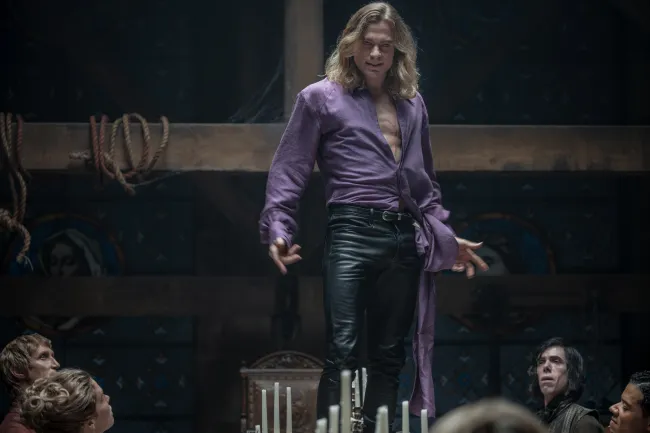
Speaking of cinematic influences, before the cliffhanger ending “The Failures” reaches a crescendo with an extended set-piece where a near-death Lestat delivers a command performance for the various souls he’s taken over the years.
It’s a sequence that immediately brings to mind the ending of Bob Fosse’s immortal musical classic, All That Jazz, where Roy Scheider heads off to the afterlife with a final hallucinatory musical number performed in front of his friends and family. Both Jones and Reid confirm they are big fans of Fosse’s film — and that sequence in particular — but stop short of calling it a deliberate homage.
“Mostly what happened is that when we were deep into shooting, our production designer said, ‘You know what I’m missing right now? Lestat on stage,'” Jones recalls. “So we turned that long table where he spends much of the episode into a stage. I’ve always loved All That Jazz, but if I had to pick two movies that were the biggest influences on this season, I’d have go with The Great Beauty and Barton Fink, which does this incredible thing of seeming like John Turturro has this dream that he never wakes up from. That’s a really special movie”
Among the dead people that Lestat sees in that final performance is Louis’s brother, Paul (Steven G. Norfleet), who took his own life in the show’s first season. “That’s a beautiful scene, because Paul was the last person that Louis said “I love you” to before he was turned,” Reid explains. “In that moment, Lestat realizes that Louis loves him, and also that Louis has his own traumas that prevent him from giving Lestat the one that he needs to hear. Now he no longer has to hear that from Louis, so that’s an element of their relationship that’s complete.
“It’s also notable because all of the people in that scene are there because Lestat made them, murdered them, or traumatized them,” Reid adds. “So he’s acknowledging that he probably traumatized Paul, but he did not kill Paul.”
Since we’re in Lestat’s headspace throughout that sequence, Louis doesn’t get to be part of the reunion with his brother — but Anderson says that was appropriate. “That scene is about Paul offering something to Lestat that Louis can’t offer him,” the actor notes. “So Louis can’t be there. But I am in the background of that scene — Caricature Cartoon Louis, as I call him, is back there somewhere having fun.”
